


AI Summary
Do you want to make an online pledge form in WordPress? Pledge forms are super helpful if you want to raise funds for an urgent cause.
Unlike donation forms (which collect payment immediately for ongoing support), pledge forms collect commitments first and payments later.
This makes them ideal for campaigns where you need to demonstrate community support before launching, reach a funding threshold before accepting money, or coordinate payments around a specific event date.
In this article, I’ll show you how to create an online pledge form for your WordPress site. I’ll also show you how easy it is to review entries so you can collect your donations.
Create Your WordPress Pledge Form Now! 🙂
What’s the Difference Between a Pledge and a Donation?
Pledge forms are great for fundraisers that have a target or deadline. Normally, the supporter promises to make a donation if the target is reached.
Donation forms are a little different. On a donation form, the nonprofit would usually take payment right away. Pledge forms have the advantage of being quick and easy to fill out, which is great for an urgent event. Y
ou can collect contact details for supporters and store them until you’re ready to collect their payment. Pledge forms are also perfect for different types of fundraising campaigns, such as:
- Sponsored sports events or challenges
- Match funding campaigns
- Crowdfunders
- And more.
How to Make an Online Pledge Form in WordPress
The WPForms plugin makes it easy to make many types of WordPress forms. Let’s take a look at the steps we’re going to work through to make a pledge form.
In the steps below, I’ll make a sponsor form for a school event. You can easily use the same process for any fundraiser you’re planning.
Step 1: Install and Activate the WPForms Plugin
To start, install and activate the WPForms plugin on your website. If you need help, jump over to this beginner’s guide to installing a plugin in WordPress.
Next, we’re going to install the Form Locker addon. We’ll use this to make sure that our pledge form closes on the fundraiser deadline.
Go ahead and click WPForms » Addons in the WordPress admin menu to start. Find the Form Locker addon in the list and click Install Addon.
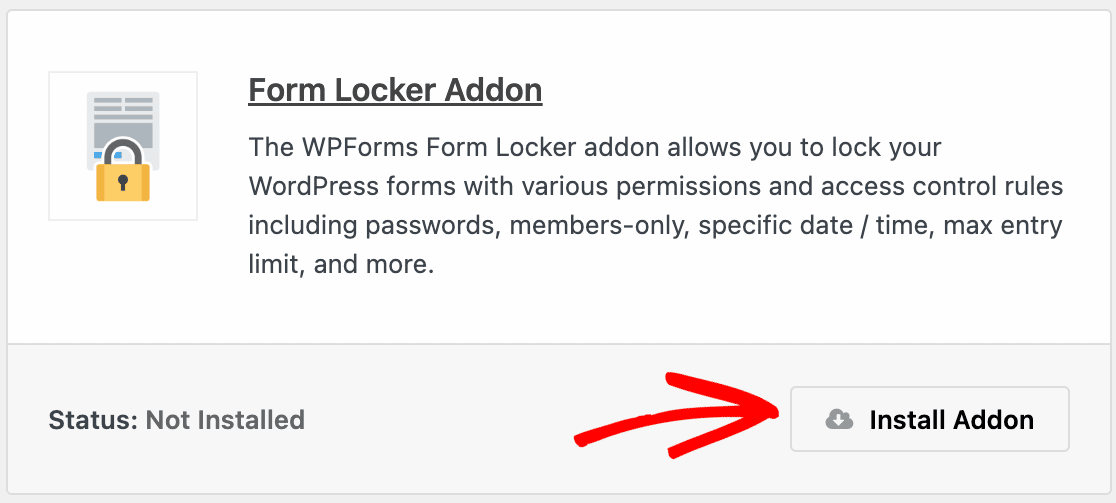
The addon will install and activate automatically. Once you see the green Active status, you’re ready to create your pledge form with deadline capabilities.
Step 2: Design Your Online Pledge Form
WPForms makes it easy to create any kind of form. And because WPForms comes with 2,100+ WordPress form templates that you can customize however you like, we can get a head start with the design.
So let’s use the Pledge Drive Form template to speed things up. Start in your WordPress dashboard. In the admin menu, click WPForms » Add New.
The form builder will open up in a fullscreen window. Go ahead and type in a name for your form at the top, such as “School Walkathon Pledge Form” or “Capital Campaign Pledges.”

Next, scroll down to the Select a Template section. This section contains all of WPForms’ templates. Go ahead and search for “pledge.” Then click on Use Template to open the Pledge Drive Form.
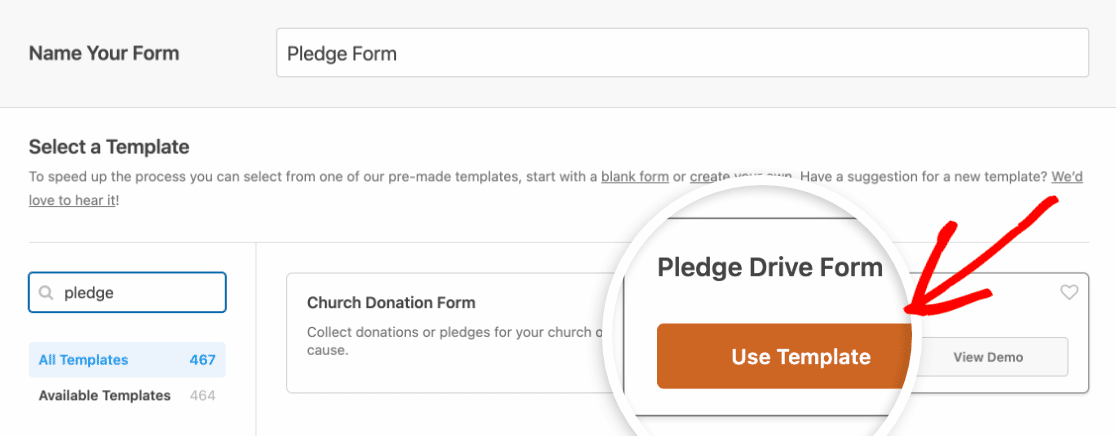
Great! The template will open up in the form builder so you can get to work. You’ll notice that your pledge form has the following fields already set up on the right hand side:
- In Honor Of
- Name
- Phone
- Address
- Pledge amount (I am pledging support to this campaign as…)
- In Memory Of
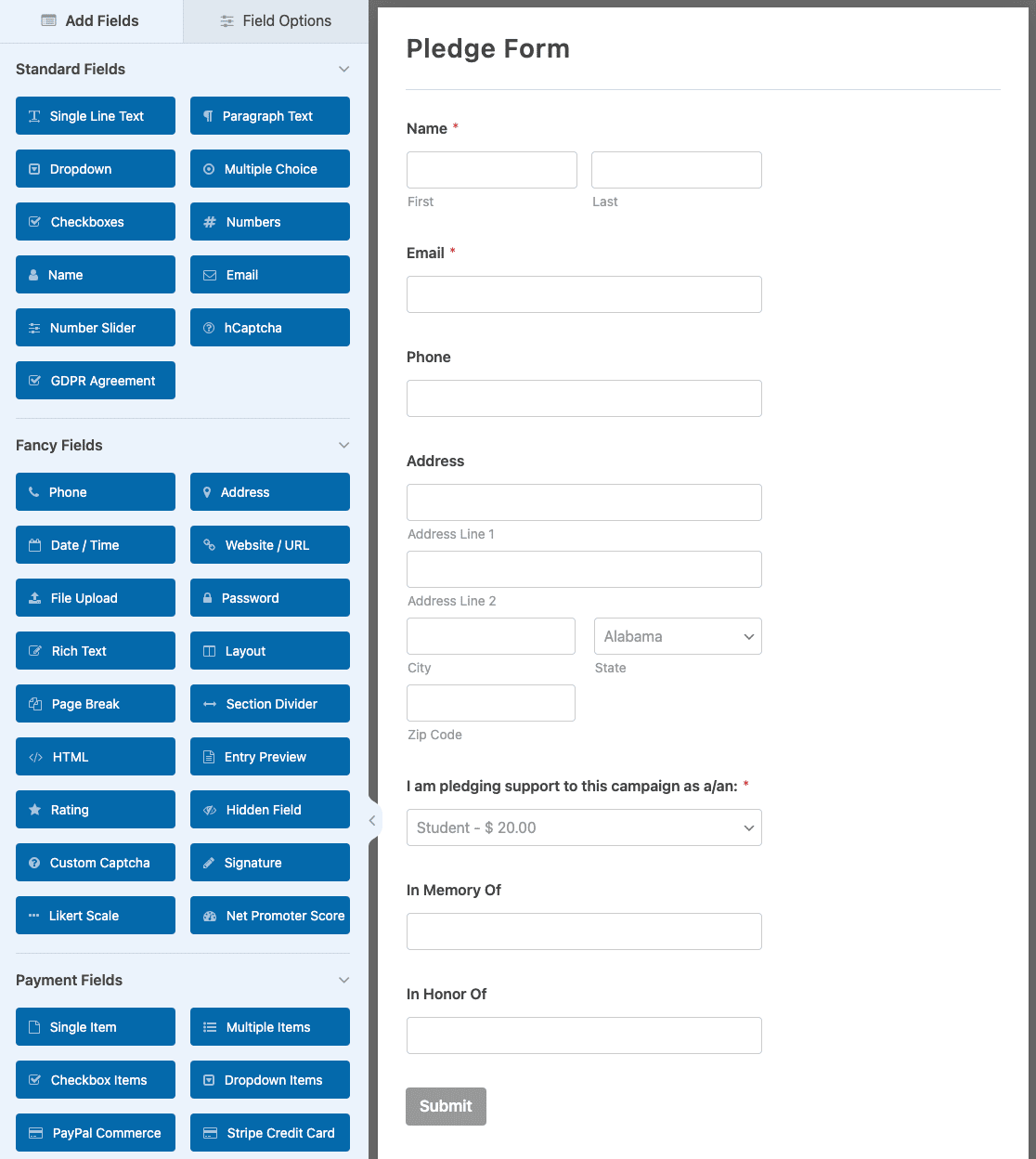
You can use this template as-is for basic pledge collection. For this tutorial, I’ll customize it to show you how to add suggested pledge amounts and custom pledge options for maximum flexibility.
Add a List of Pledge Amounts
We want the pledge form to be super easy to fill in. To help people out, let’s add a dropdown to make it easy to select a pledge amount from a list. First, we’ll drag and drop a Dropdown field into the preview area.
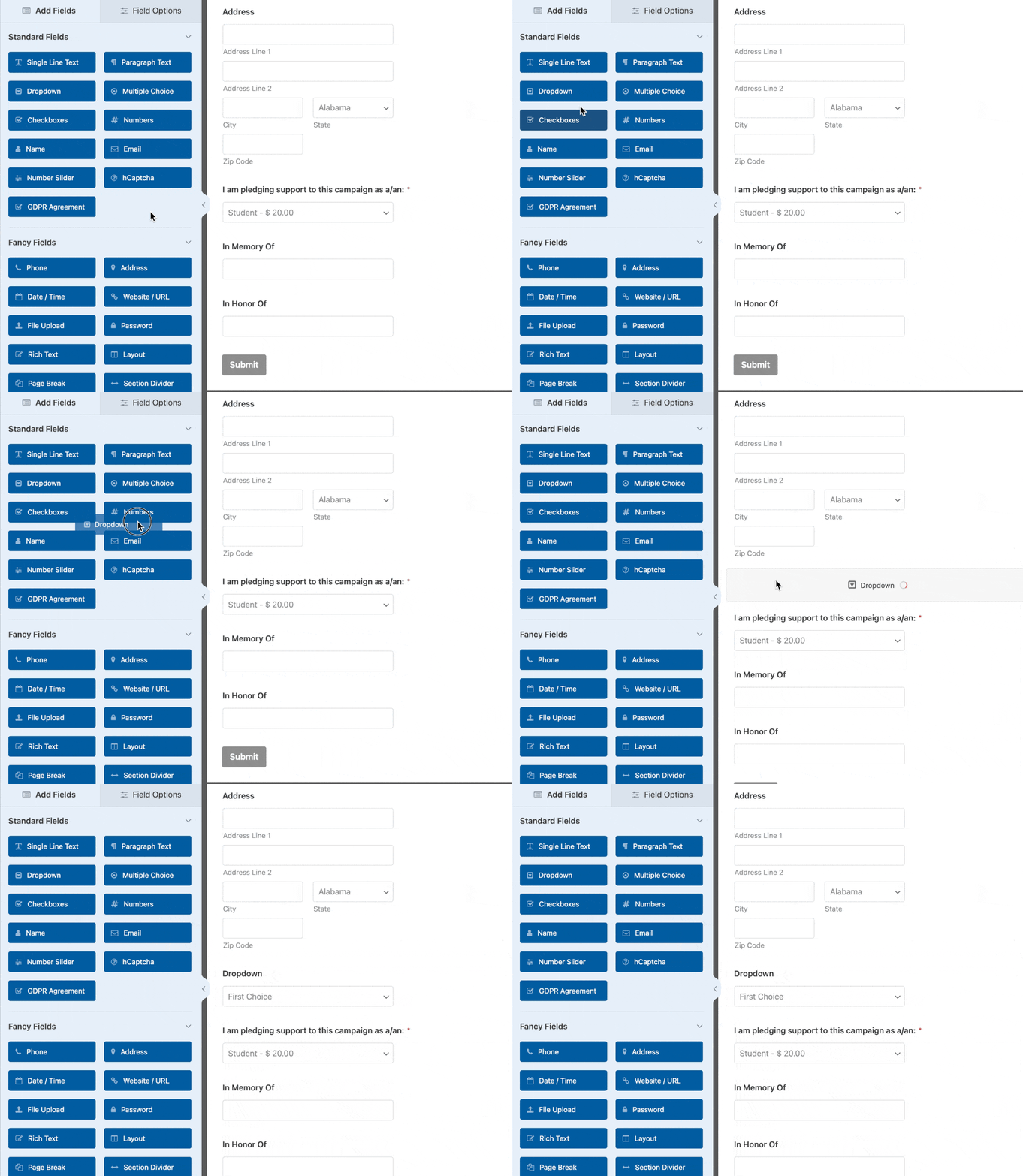
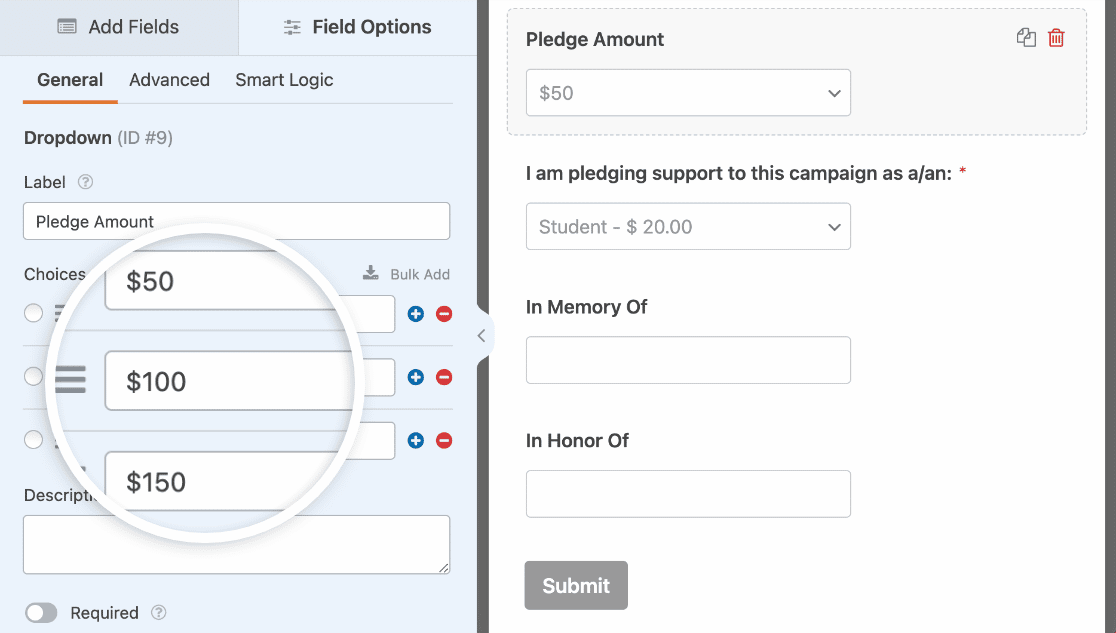
Click the field in the preview to open its options. Change the label to “Pledge Amount” and add your suggested amounts as choices. For a school fundraiser, you might use $25, $50, $100, and $250 as your options.
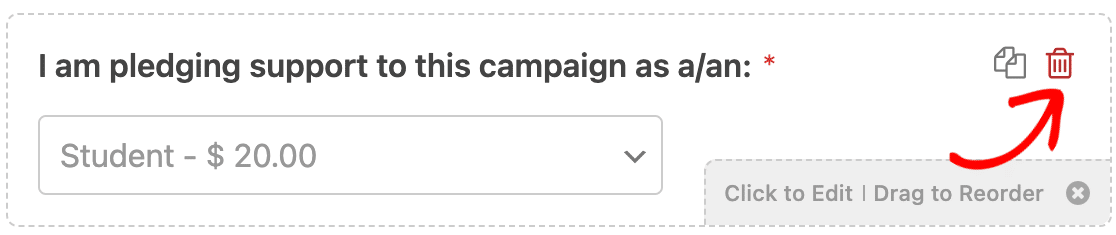
I’ll also delete the Dropdown field labeled “I am pledging support to this campaign as a/an”, since we’ve created our own custom amount selection field. Click on the trash icon to delete a field.
If you have many pledge level options and want a more compact layout, click the field, go to Advanced Options, and set the Choice Layout to 2 or 3 columns. This prevents long vertical lists that make forms feel overwhelming.
That’s it! Now supporters can quickly choose a pledge. But what about custom amounts? Let’s add a field that people can use to type in their own pledge amounts.
Add a Custom Pledge Field
Some supporters want to pledge amounts that don’t match your preset options. To accommodate them without cluttering your form, we can use some easy conditional logic.
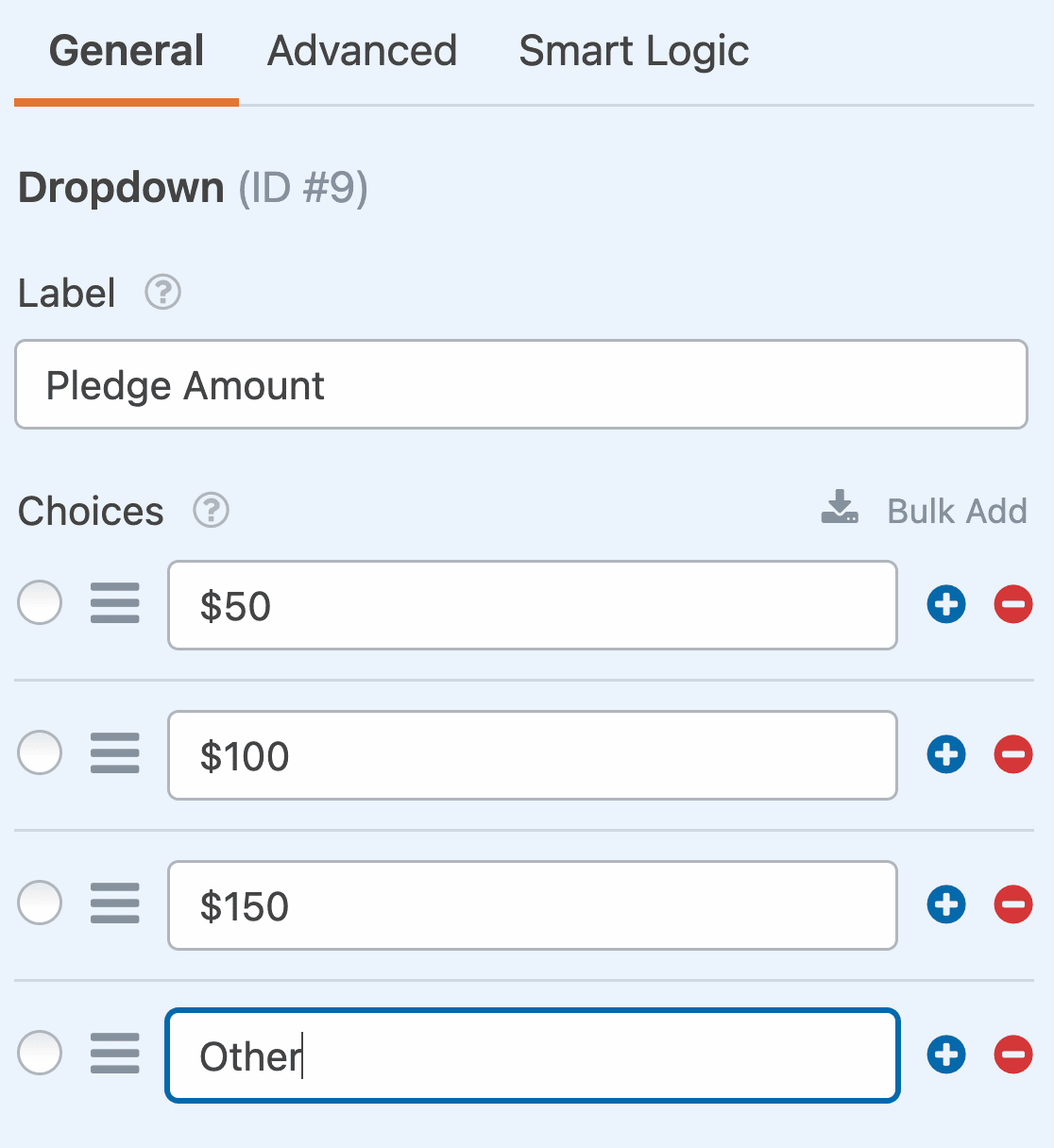
Let’s start by adding another answer choice to the Pledge Amount dropdown. Click the plus icon to add a new choice below your donation amounts. Instead of adding an amount, simply type Other.
Next, drag a Numbers field onto your form and position it directly below the Pledge Amount dropdown. Click the Numbers field to open its options and change the label to “Your Pledge Amount.”
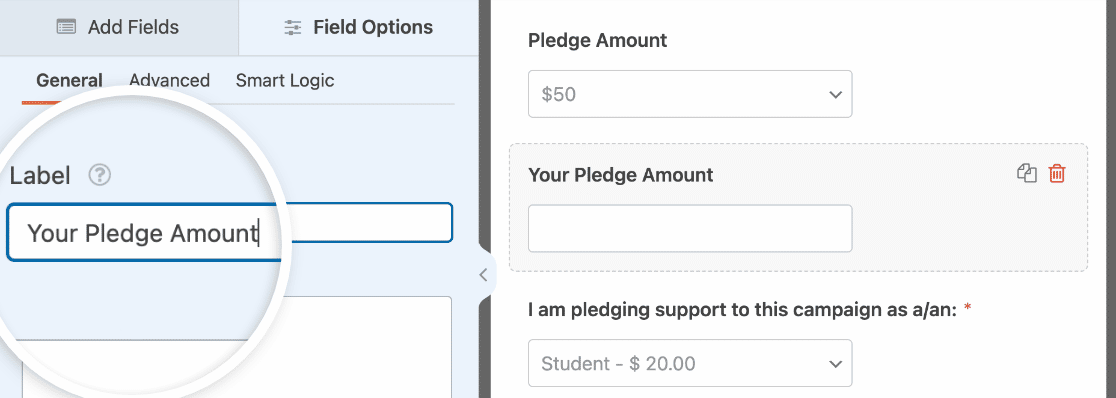
Now configure conditional logic to show this field only when supporters select “Other” from the dropdown.
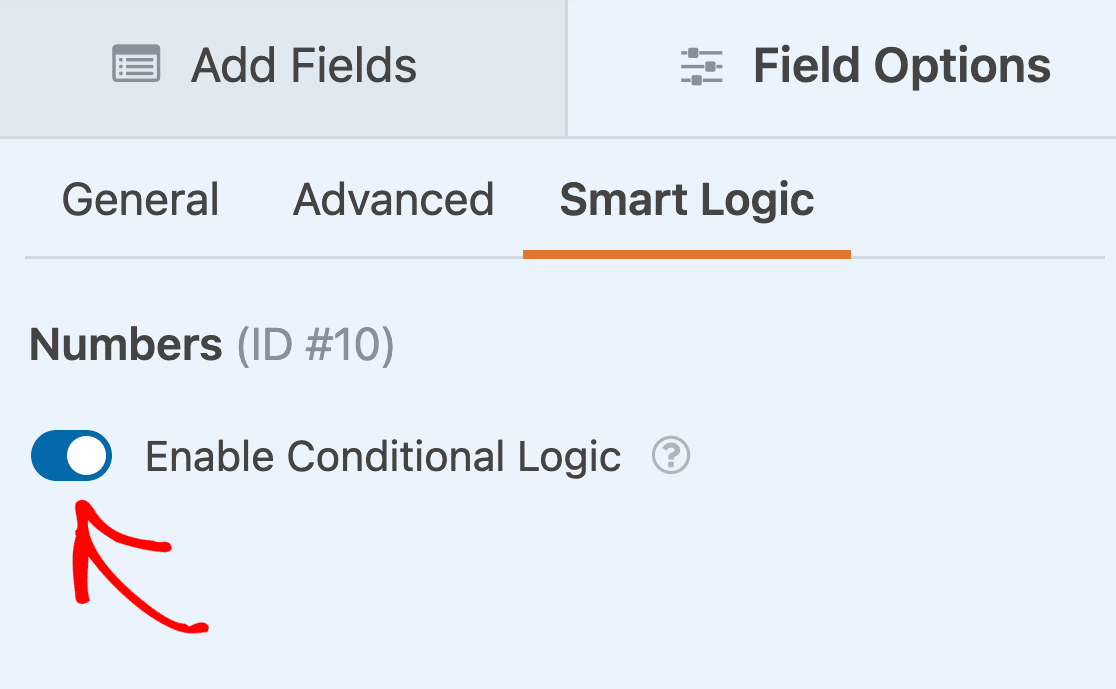
Click the Numbers field again, select the Smart Logic tab at the top of the Field Options panel, and toggle ON Enable Conditional Logic.
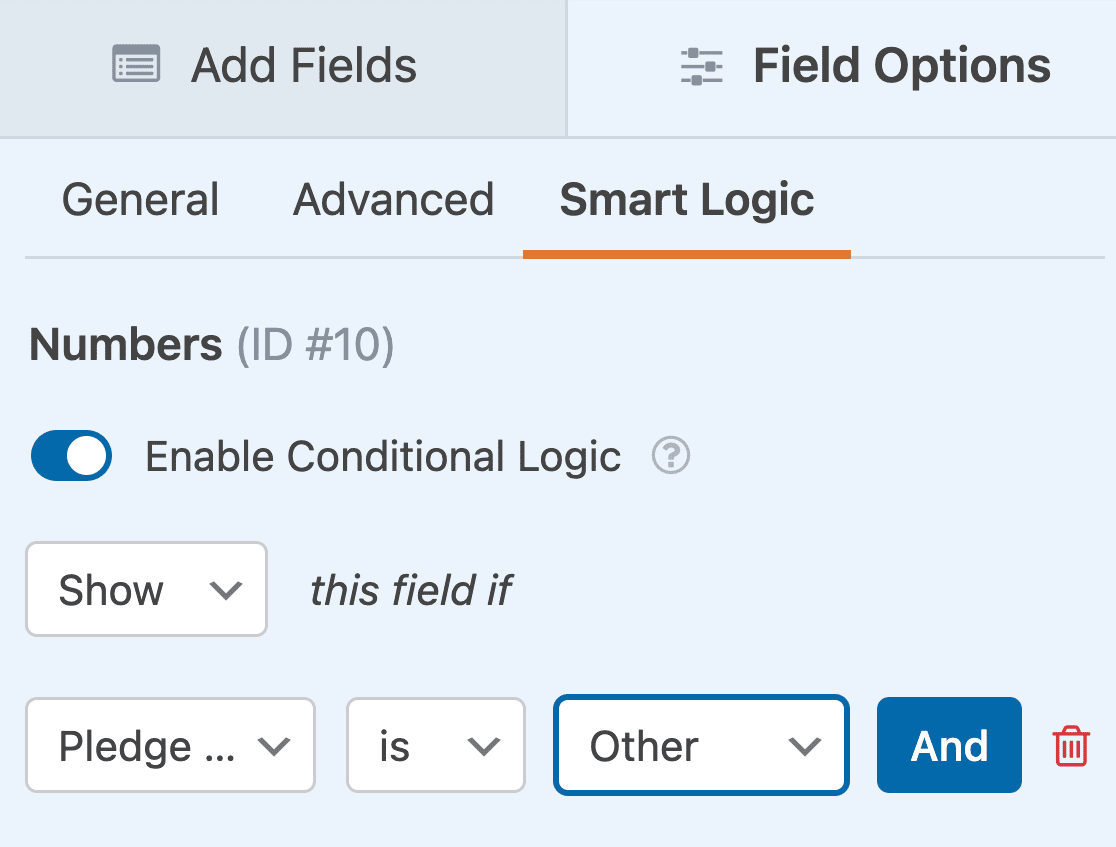
We’re almost done. Next, let’s use the dropdowns to tell WPForms only to show the Numbers field if the supporter selects Other as their pledge amount. To do that, you’ll want to select Show this field if Pledge Amount is Other.
Great! Now we have an optional custom donation field on our pledge form. We’ll test this out later on when we publish the form.
Add Fields For Agreements and Terms
Depending on the status of your nonprofit, you might also need to add some legal terms or disclaimers to your form. WPForms makes it easy to create:
- A GDPR Agreement checkbox
- A Terms and Conditions checkbox
For now, we’re done editing our online pledge form. Don’t forget to click Save at the top of the form builder to save your progress so far.
Step 3: Set Up Pledge Form Notifications
Email notifications are critical for pledge forms because they create a paper trail of commitments for both you and your supporters.
You need to know when pledges arrive, and supporters need confirmation that their pledge was recorded successfully. Click Settings in the left sidebar of the form builder, then select Notifications to configure your email alerts.
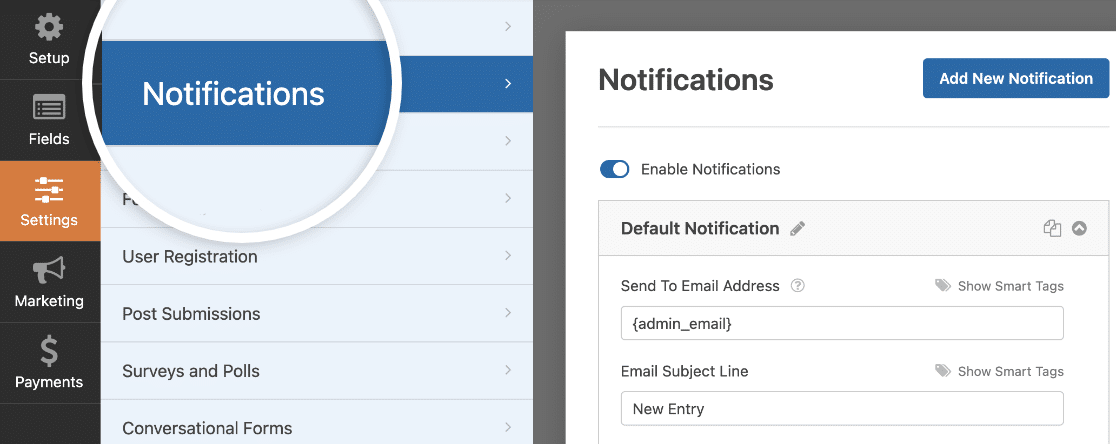
By default, WPForms creates one notification sent to your WordPress admin email. This is your internal alert that a new pledge was submitted.
Customizing the Admin Notification
If you’d like to type in a different email address for your notification, it’s easy to change it. Go ahead and delete the {admin_email} Smart Tag and type in the address you want to use.
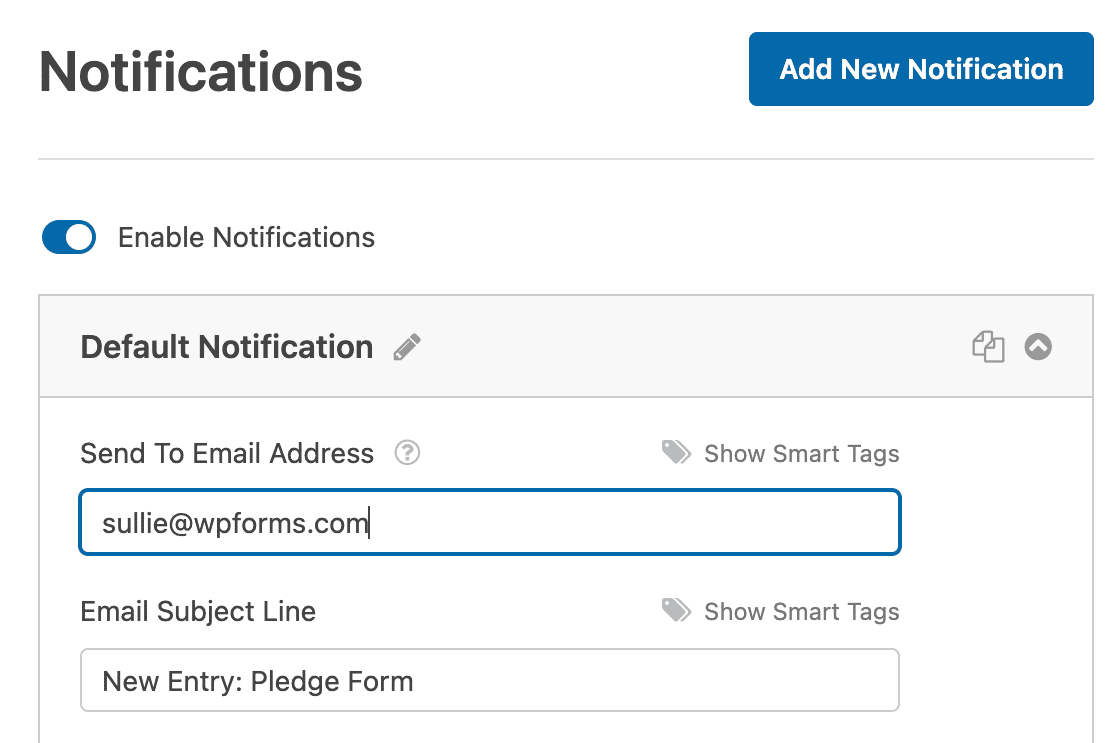
You can also send notifications to multiple people by separating email addresses with commas. This ensures your entire fundraising team knows about new pledges in real-time.
Adding a Supporter Confirmation Email
Supporters need confirmation that their pledge was received. This serves as both a receipt and a reminder of their commitment. Click the blue Add New Notification button to create a second email.

Give this notification a distinctive name like “Supporter Pledge Confirmation” so you can easily identify it later when managing multiple notifications.
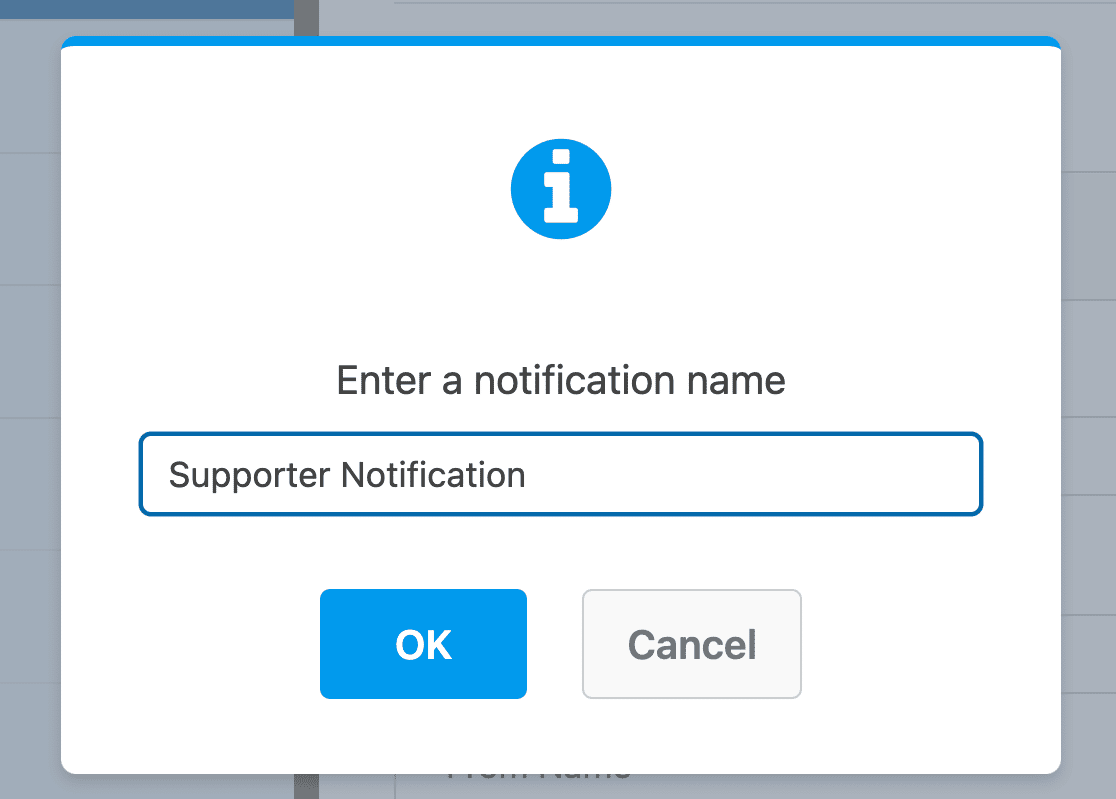
You’ll now see two notifications listed. Click on the new one to edit its settings. In the Send To Email Address field, we’re going to use the Email Smart Tag.
This automatically sends the confirmation to whatever email address the supporter entered in your form.
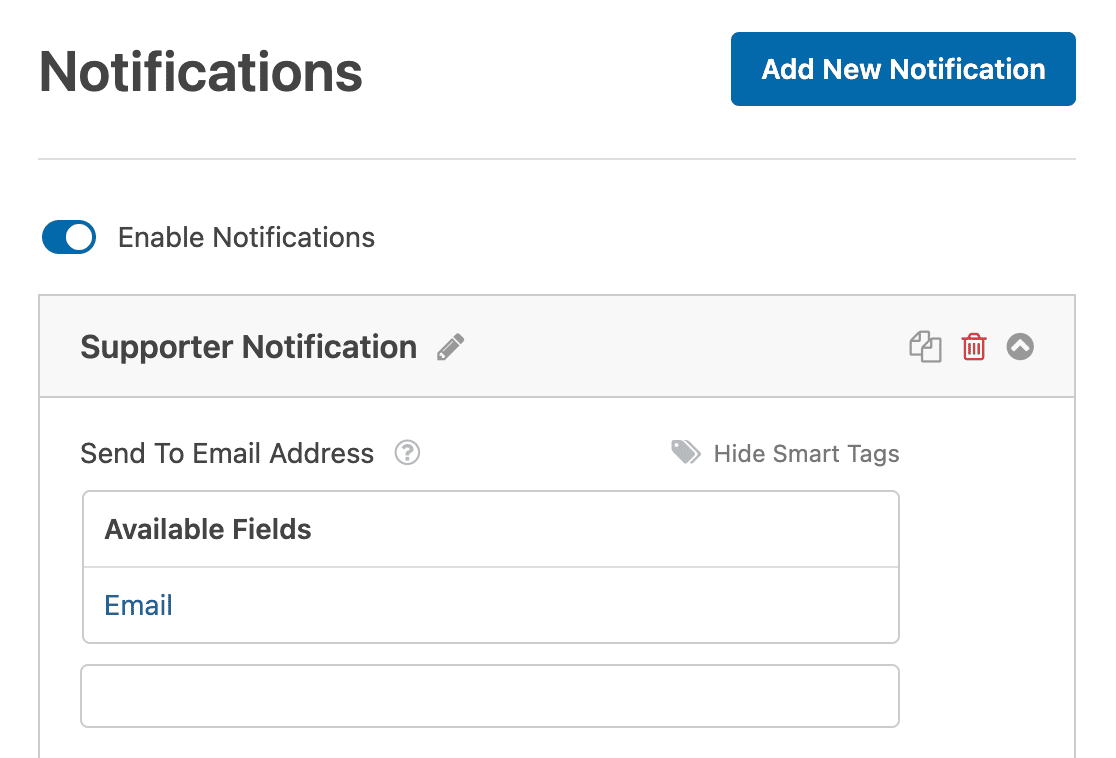
Customize the subject line and email body to include important details: the pledge amount they committed, your campaign goal, when payment will be collected, and how to contact you with questions.
Click Save to preserve your notification settings. Now we can set the closing date on the form to ensure all entries are received within the specified time frame.
Step 4: Set Up Your Pledge Form Closing Date
Pledge campaigns are most effective when they have clear deadlines. Automatic form closing creates urgency, prevents late pledges after your event has passed, and ensures you can plan based on confirmed numbers.
The Form Locker addon makes this simple because it lets us easily add an expiry date to your form and displays a custom message when your deadline arrives.
From the Settings panel in the form builder, click Form Locker, then toggle ON Form scheduling.
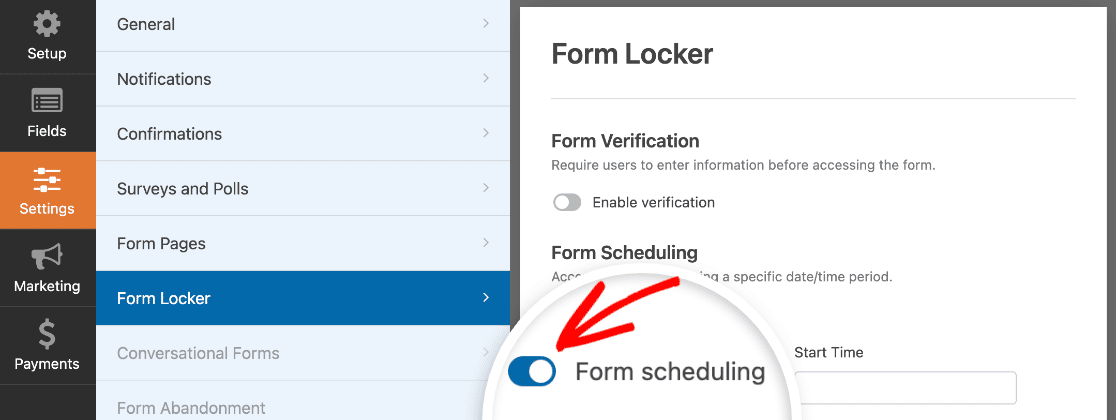
Set your campaign closing date using the End Date and End Time fields. Choose the date your event occurs or when you need to finalize pledge counts.
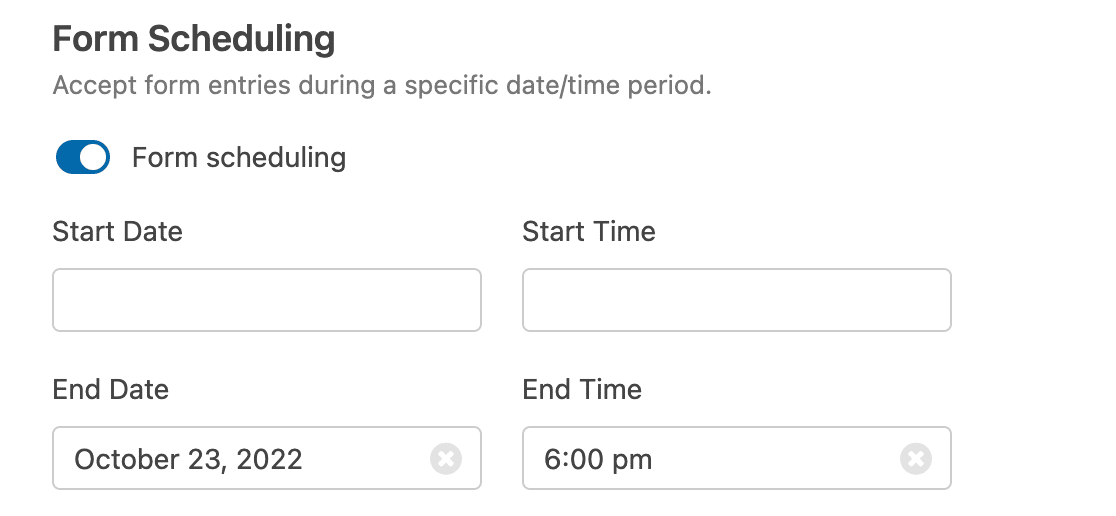
Remember: this field uses the timezone that’s set up in WordPress. If you need to check your site’s time settings, here’s a guide to changing the time and date in WordPress.
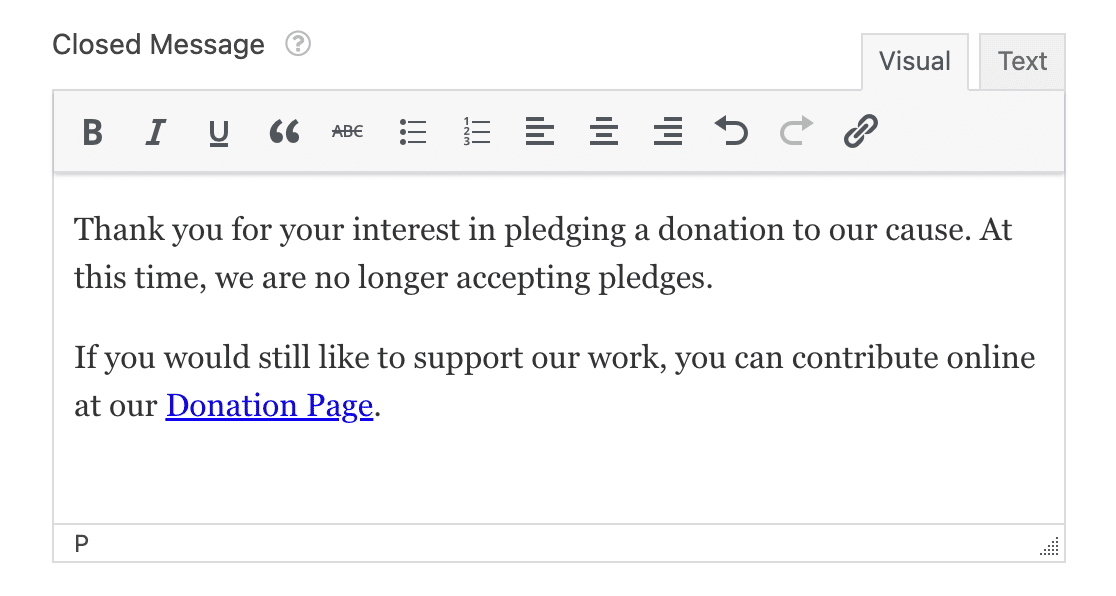
On this date, the form will automatically close and the form will disappear. When that happens, the Closed Message will appear in its place.
Underneath the date and time, you can customize the Closed Message. We’re going to add a link to our regular donation form so that our supporters still have an opportunity to give money to the fund.
Don’t have a donation page yet? Here are some great donation page examples you can use as inspiration. OK, we’re all set. Now we just need to publish the pledge form on your website.
Step 5: Publish Your Online Pledge Form
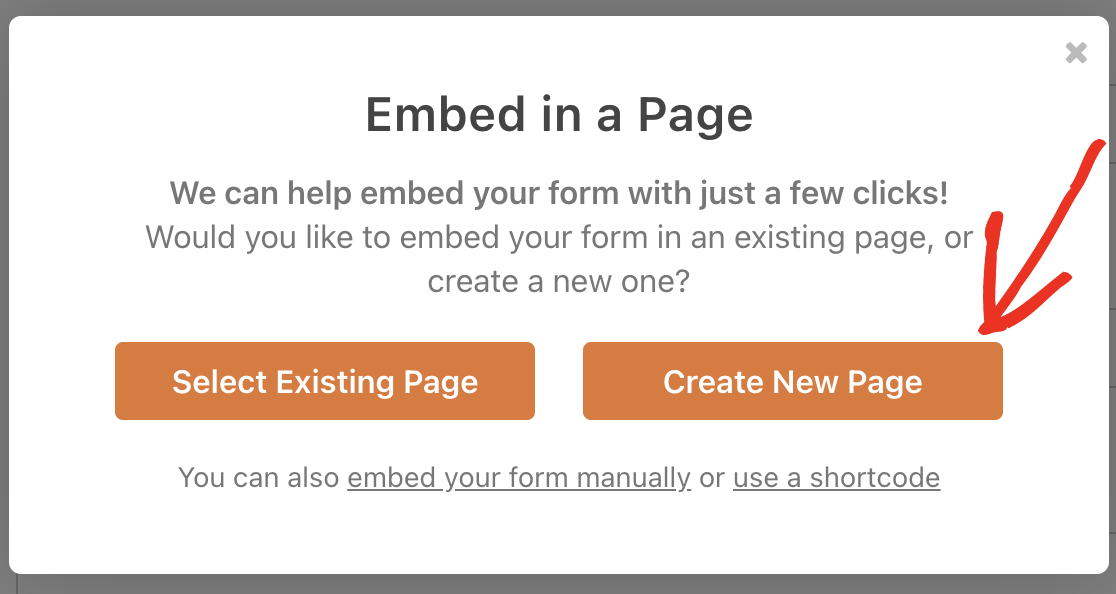
With your pledge form fully configured, it’s time to publish it on your WordPress site and start collecting commitments from supporters. Start by clicking the Embed button at the top of the form builder.

When the embed dialog appears, click Create New Page to create a dedicated page for your pledge campaign.
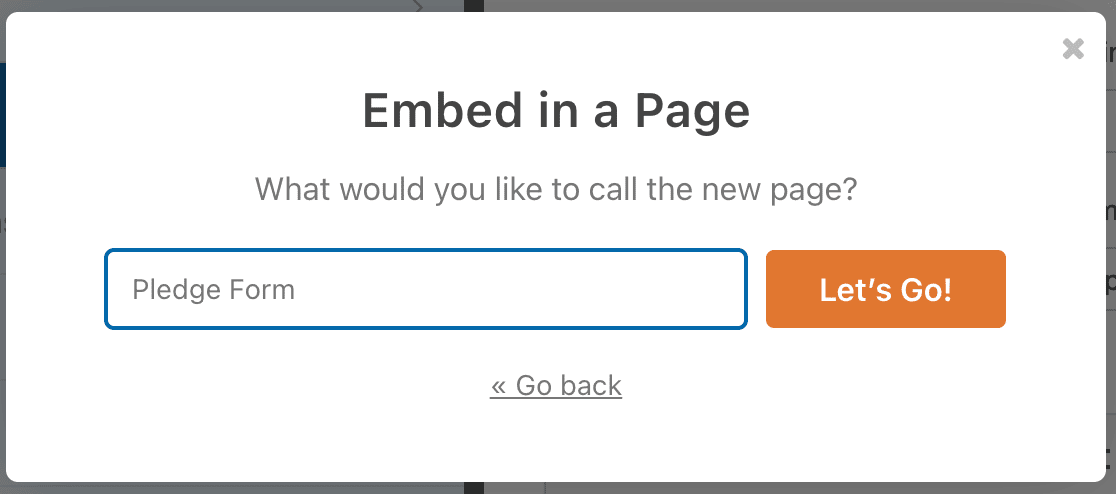
WPForms will ask you to name your new page. Use a clear, descriptive title like “Make Your Pledge” or “School Walkathon Pledges,” then click Let’s Go.
WPForms opens a new page with your pledge form already embedded. Before publishing, add supporting content above or below the form to explain your campaign and create urgency:
When your page content is complete, click Publish or Update at the top to make your pledge form live.
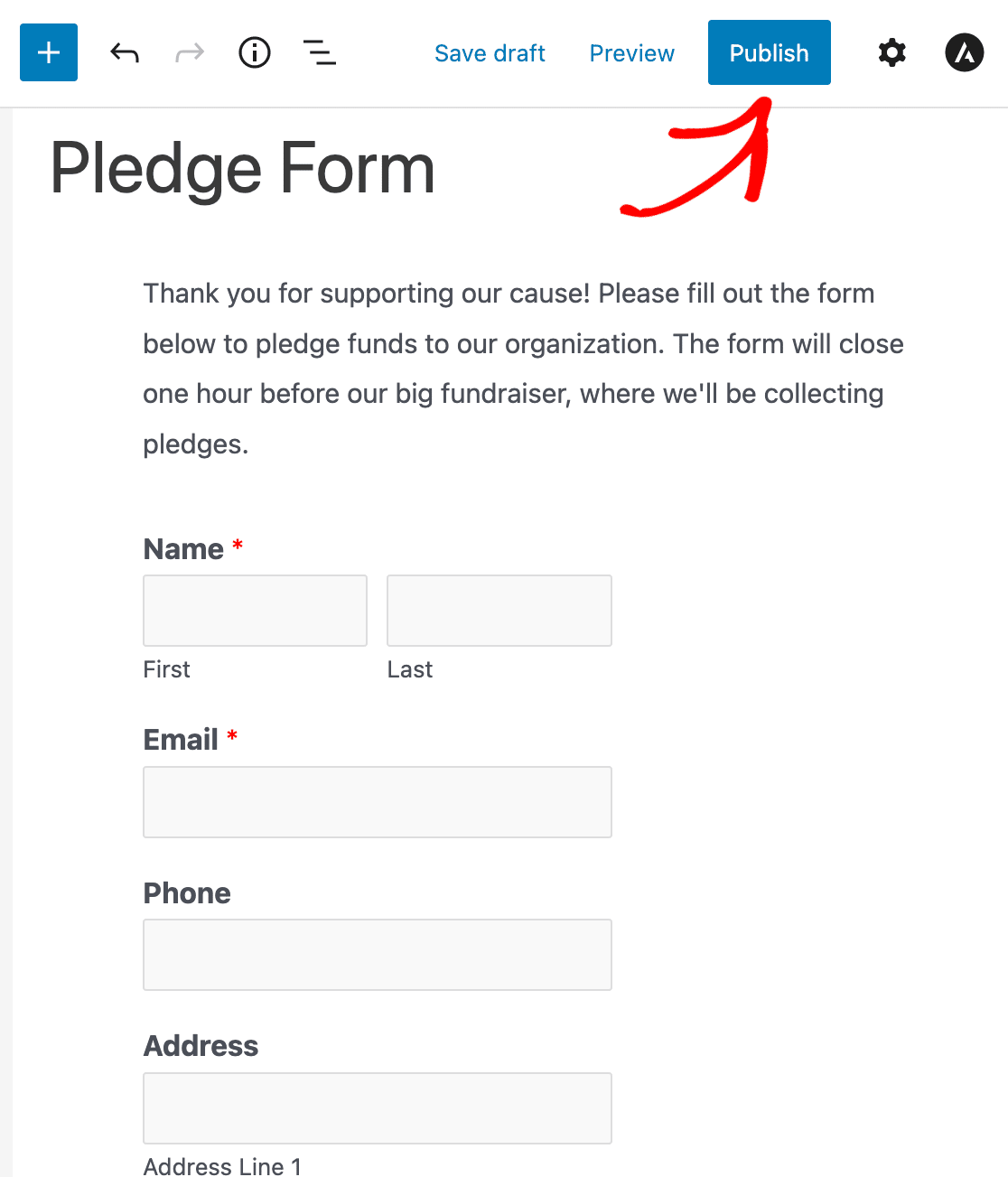
Your pledge form is now live and ready to collect commitments. Here’s what the finished form looks like:
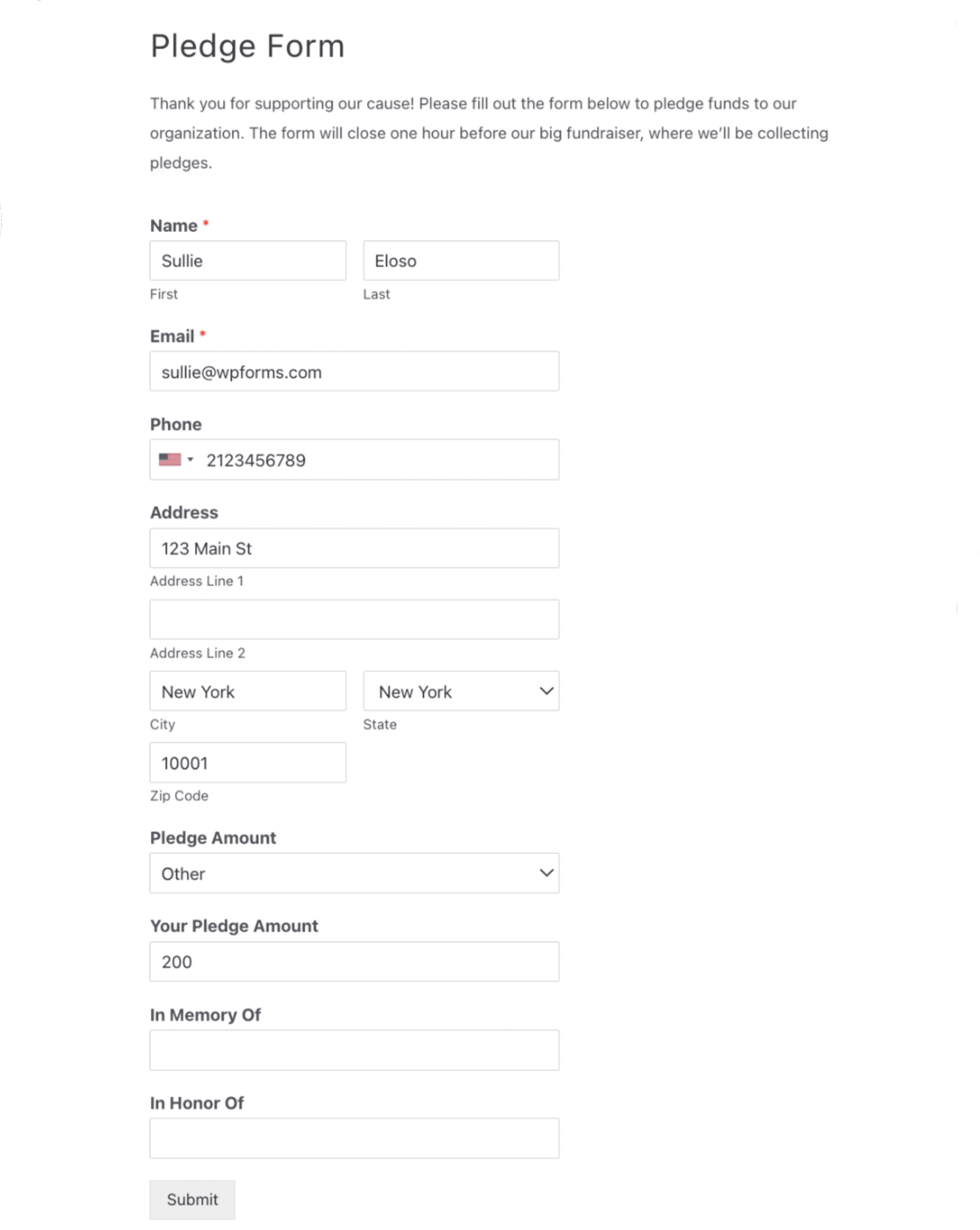
Notice how selecting Other reveals the custom amount field we configured with conditional logic earlier. This gives supporters complete flexibility while keeping the form clean and simple.
So the form is done. But the most important step is still to come. We need to collect your donations! Let’s look at the ways WPForms can help with that.
Step 6: Collect Donations From Your Supporters
When you have all of your pledges, you’ll want to go back and email your supporters to collect their donations.
With any paid license, WPForms saves your contact form data in the WordPress database. So you can easily export these to a CSV file to open them in Excel.
To view your entries, go back to the WordPress dashboard and click WPForms » Entries. You can click the name of your form here to open up a list of all of the entries.
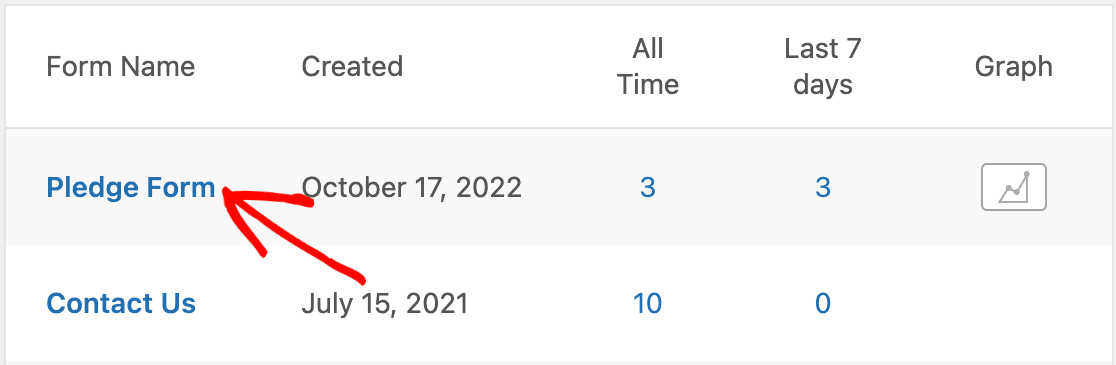
Now you can see all of your pledges in 1 place. From here, you can export form entries to CSV so you can view all of your supporters’ contact details in Excel or Google Sheets.
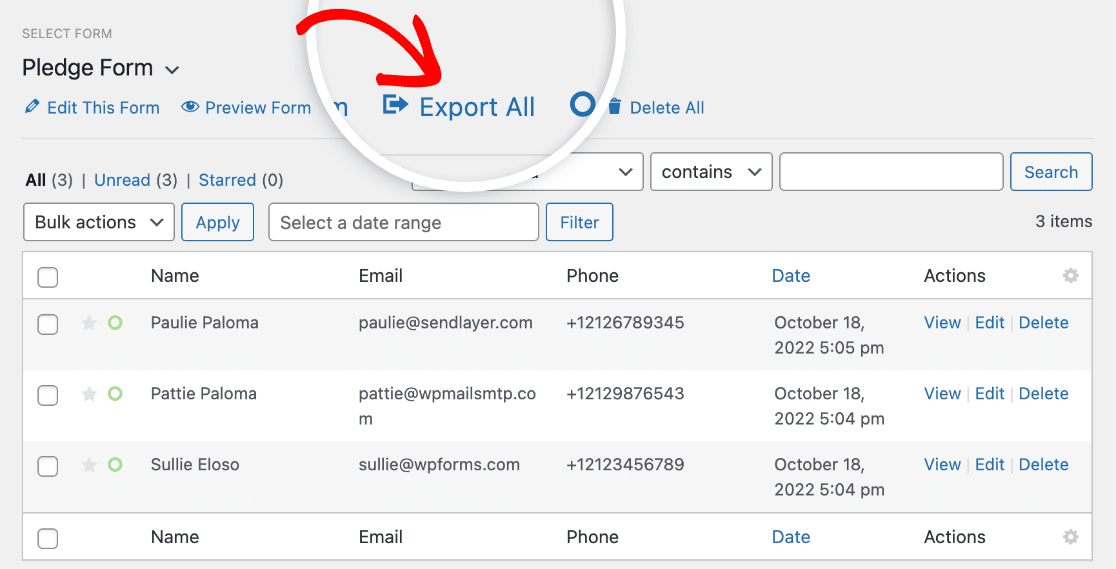
You can also use the WPForms Google Sheets addon to send pledges to Google Sheets automatically. The Entries screen also allows you to work with entries in WordPress. For example, you can:
- Click the star icon next to the form entries you need to follow up
- Edit an entry if a sponsor wants to change their donation or contact details
- Search and filter the list of form entries to find specific pledges.
And that’s it! Now you have all of the information you need to run a successful fundraiser with a pledge form.
If you’re using Salesforce for Nonprofits, check out our guide to helpful Salesforce integrations that will help you save time.
FAQs on How to Make an Online Pledge Form in WordPress
Here are answers to the most common questions about creating and managing pledge forms for fundraising campaigns.
What is a pledge form?
A pledge form is a fundraising tool that collects commitments to donate a specific amount once certain conditions are met, such as reaching a campaign goal, completing an event, or hitting a deadline.
Unlike donation forms that collect immediate payment, pledge forms record supporter commitments and contact information for later payment collection.
How do I create an online pledge form?
Install WPForms Pro and the Form Locker addon. Go to WPForms » Add New, select the Pledge Drive Form template, customize the pledge amount options, set up email notifications for both you and supporters, configure an automatic closing date using Form Locker, and publish the form on your website. The entire process takes about 20 minutes.
How do I collect pledges for fundraising?
Create a pledge form using WPForms to collect supporter names, contact information, and pledge amounts.
When your campaign goal is met or your event concludes, export the pledge data from WPForms » Entries to CSV.
Use this list to send personalized payment collection emails with direct links to your donation form, making it easy for supporters to fulfill their commitments.
What should I include on a pledge form?
Essential fields include Name, Email, Phone, Pledge Amount (with preset options and custom amount capability), Address (for thank you letters and receipts), and optional honorary/memorial designation fields.
Also add clear text explaining your campaign goal, deadline, and when payment will be collected. Many pledge forms include checkbox fields for supporters to opt into email updates or volunteer opportunities.
How do I set a deadline for my pledge form?
Use the WPForms Form Locker addon to enable Form scheduling. Set your End Date and End Time to match your campaign deadline or event date.
The form automatically closes at that time and displays a custom “closed” message. This prevents late pledges and creates urgency that encourages supporters to commit before time runs out.
Can I show a running total of pledges collected?
While WPForms doesn’t have built-in live progress tracking, you can manually update a progress bar or thermometer graphic on your pledge page.
For automatic updates, use the Google Sheets Addon to send pledges to a spreadsheet, then use Google Sheets formulas to calculate totals that display on your page via embedded charts.
How do I follow up with supporters to collect pledges?
After your campaign goal is met or event concludes, go to WPForms » Entries and export your pledge data to CSV.
Create segmented email lists (high-value pledges get personal outreach, smaller pledges get group emails) and send payment requests with direct donation form links.
Include the pledge amount they committed in the email and make payment as easy as possible with one-click links pre-filled with their pledge amount.
What’s the pledge form fulfillment rate?
The average pledge fulfillment rate (pledges that convert to actual donations) ranges from 60-75% for most campaigns. Personalized follow-up for major pledges increases fulfillment to 90-95%.
Factors that improve fulfillment include immediate confirmation emails after pledging, clear communication about when payment will be collected, easy payment methods when follow-up time arrives, and personal outreach for pledges over $500.
Next, Get More Nonprofit Form Conversions
Now you have your pledge form set up, you’ll want to get more people pledging and donating. Check out our insider tactics to boost nonprofit form conversions.
And don’t forget to make an online model release form. That way, you can legally use photos from your fundraising events on your website. Finally, you can also utilize WPForms to create forms for taking paid leaves requests from your employees.
Ready to build your form? Get started today with the easiest WordPress form builder plugin. WPForms Pro includes lots of free templates and offers a 14-day money-back guarantee.
If this article helped you out, please follow us on Facebook and X (Twitter) for more free WordPress tutorials and guides.



How to display the Total sum of donations in the frontend?. Is there a shortcode for this?
Hey Sharon, you can add the total field to your form and be sure to mark it as required as outlined in our great guide here.
I hope this helps.