



AI Summary
Do you want to connect your WordPress website to Salesforce? You can send incoming leads from your site directly into your CRM with an integration tool, but which one is best?
There are a few different ways to make the connection, and the right one depends on what you need to send over. If you mainly want form leads in Salesforce, a native form addon is the simplest path.
If you want to sync your whole site, a dedicated sync plugin makes more sense. Below are the five WordPress Salesforce integration tools I’d recommend, what each is best at, and what it costs.
Connect Your Form With Salesforce Now 🔗
Best WordPress Salesforce Integrations
Salesforce CRM is a powerful automation tool with many features, so you’ll want to link it to your website. Let’s look at which tools let you integrate WordPress with Salesforce.
| Tool | Best for | Integration type | Starting price |
|---|---|---|---|
| WPForms | Sending form leads to Salesforce with no connector | Native form addon (Elite) | $299.50/year |
| Formidable Forms | Developers who need structured form data | Form add-on | $79/year |
| WP Fusion | Syncing users, orders, and memberships, not just forms | Native sync plugin | Free, paid from $297/year |
| Zapier | Connecting Salesforce to apps without a dedicated addon | Third-party connector | Free, paid from $19.99/month |
| Account Engagement | Teams already committed to Pardot | Official Salesforce plugin | Free plugin |
1. WPForms
If your goal is to turn WordPress form submissions into Salesforce leads and contacts, WPForms is the most direct way to do it.
It’s the beginner-friendly WordPress form builder used on over 5+ million websites, rated 4.8 stars, and its Salesforce addon connects your forms to your CRM without any middleman service.
The addon is part of the Elite license, and once you install it from WPForms » Addons, you open any form and go to Marketing » Salesforce to add a connection.
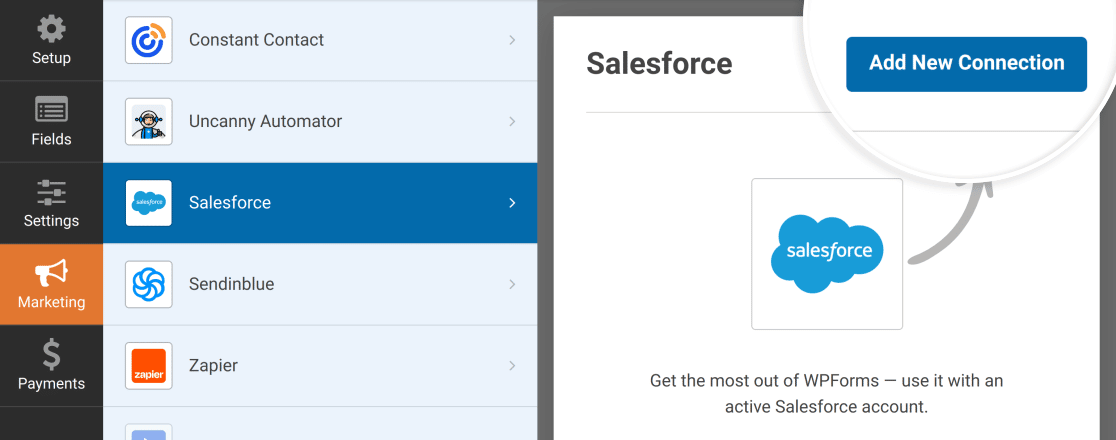
From there you map form fields to Salesforce objects like Leads, Contacts, and Accounts, and you can point fields at custom objects as well.
What I like most is that the whole setup lives inside the form builder, so there’s no separate connector to maintain and no per-task fee counting against you.
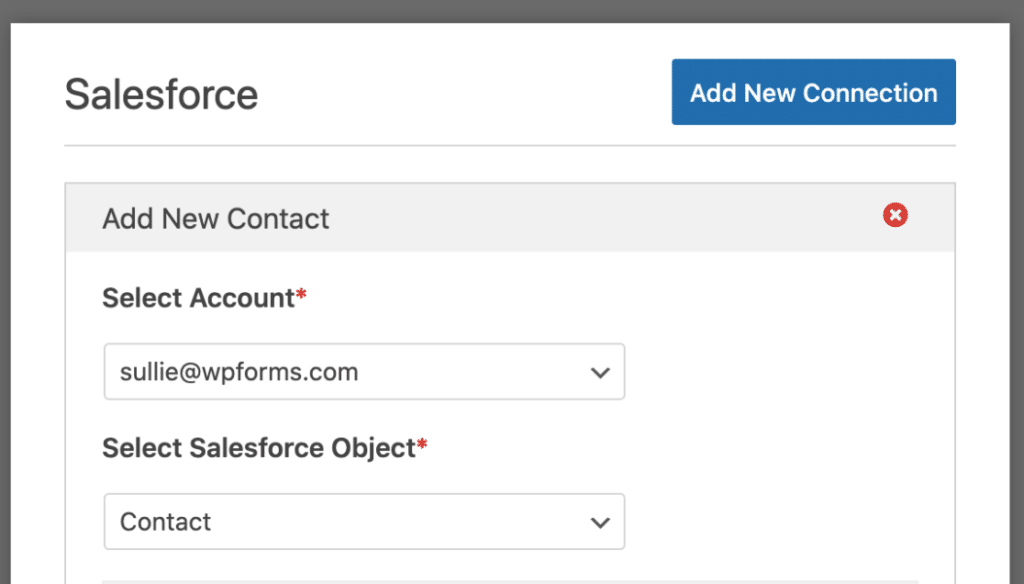
Conditional logic decides which entries get sent, which means a “Request a demo” form can create a lead while a general contact form stays out of your pipeline.
If you want the step by step, WPForms has a guide on how to set up the Salesforce addon and one on capturing leads from WordPress to Salesforce.
What I Liked
- Native connection: Forms sync straight to Salesforce, with no Zapier or third-party bridge.
- Field mapping: Map to Leads, Contacts, Accounts, and custom objects.
- Conditional routing: Only the submissions you choose get sent to the CRM.
- More than Salesforce: The Elite license also covers lead generation forms, webhooks, and other CRMs like HubSpot and Pipedrive.
How Much Does WPForms Cost?
The Salesforce addon is included with WPForms Elite, which is $299.50 per year and covers unlimited sites. You’ll also need a Salesforce plan with API access.
2. Formidable Forms
Formidable Forms is the option I’d point developers and data-heavy sites toward. It’s built around structured data, with views, calculations, and relationships that go beyond a standard contact form, and it has a Salesforce add-on that maps your form fields to the CRM.
Formidable earns its spot when your forms are doing real work, like application forms, calculators, or directories that feed records into Salesforce.
You map fields to Salesforce leads, contacts, and custom objects such as accounts, campaigns, and tasks, so it handles more than a simple name-and-email handoff. It carries the same 4.8-star rating as WPForms on WordPress.org, so the polish is there alongside the flexibility.
What I Liked
- Custom objects: Send data to accounts, campaigns, tasks, and other Salesforce objects.
- Developer-friendly: Detailed views and calculations for complex, data-driven forms.
- Flexible mapping: Match Salesforce contact and lead fields to your own form fields.
How Much Does Formidable Forms Cost?
Formidable’s plans run from $79 per year (Basic) to $599 per year (Elite), and the Salesforce add-on sits on its higher tiers. A free version is available for basic forms.
3. WP Fusion

WP Fusion is the tool to reach for when you want to sync your entire site to Salesforce, not just your forms. It connects WordPress activity to your CRM and keeps the two in sync in both directions, applying tags in Salesforce based on what people do on your site.
This is where WP Fusion pulls ahead of the form-only options, because it syncs registered users, membership and course activity, and WooCommerce orders and customers, so your Salesforce records reflect what a person actually did rather than just the form they filled out.
Since WooCommerce is a WordPress plugin like any other, WP Fusion treats your store data as one more source to map, which means you can push customers and purchases into Salesforce without a separate WooCommerce integration.
What I Liked
- Full-site sync: Users, memberships, LMS activity, and form entries all flow to Salesforce.
- WooCommerce data: Push orders and customers into your CRM.
- Bidirectional: Update WordPress based on Salesforce fields, not just the reverse.
- Tag-based automation: Apply Salesforce tags automatically from on-site behavior.
How Much Does WP Fusion Cost?
WP Fusion has a free Lite version, with paid plans from $297 per year (Personal) up to $647 per year (Professional) for unlimited sites.
If your goal is connecting your forms to your store rather than to Salesforce, WPForms also has a no-code WooCommerce integration you can use instead.
4. Zapier
Zapier is the connector to use when there’s no native addon for the exact tool you’re linking.
It sits between apps and passes data along, and it supports a wide range of Salesforce triggers and actions, so it can create leads, update records, and more from a WordPress form.
Zapier’s biggest strength is its reach, connecting to more than 8,000 apps, so if your workflow involves Salesforce plus Mailchimp, Slack, or Google Sheets, you can route a single form submission to all of them.
WPForms connects to it through the WPForms Zapier addon, and you can automate your marketing across tools from there. The trade-off is that Zapier is a middleman with its own pricing, and it bills by task, so a busy form can burn through your monthly allowance faster than you’d expect.
What I Liked
- Huge app library: Connect Salesforce to more than 8,000 other apps.
- Many triggers and actions: Create and update Salesforce records from form data.
- No-addon bridge: Useful when a tool has no direct WordPress integration.
How Much Does Zapier Cost?
Zapier has a limited free plan (100 tasks per month, two-step Zaps). Paid plans start at $19.99 per month billed annually on the Professional tier.
5. Salesforce Account Engagement (Pardot)

Salesforce Account Engagement, formerly Pardot, is the official plugin built by Salesforce. That sounds like it should top the list, but in practice it’s narrow, and it only makes sense if you’re already using Pardot for marketing.
The plugin lets you drop a Pardot form onto your site, but you can’t freely customize the fields or the design the way you can with a form builder. I
t connects only to the marketing side of Salesforce, and its reception reflects that. On WordPress.org it sits at 2.6 out of 5 stars across a handful of reviews, with around 2,000 active installs, and its last update was back in 2024.
If you need custom forms in WordPress, building a custom Pardot form through a form builder gives you far more control.
What I Liked
- Official plugin: Maintained by Salesforce for Account Engagement customers.
- Simple embed: Drops a basic Pardot form onto a page.
How Much Does Pardot Cost?
The plugin is free, but you need a paid Salesforce Account Engagement (Pardot) subscription to use it.
FAQs About WordPress Salesforce Integration
Connecting WordPress and Salesforce raises a few common questions. Here are quick answers to the ones I hear most from readers deciding how to link the two.
How do I integrate WordPress with Salesforce?
Install a tool that connects the two, then map your WordPress data to Salesforce fields.
With a form addon like WPForms, you install the Salesforce addon, add a connection inside the form builder, and map each form field to a Salesforce lead or contact field.
A sync plugin like WP Fusion works the same way for users and orders.
Do I need API access in Salesforce?
Yes. Most of these tools connect through the Salesforce API, which is available on the Enterprise, Unlimited, Developer, and Performance editions, along with Professional editions that have API access enabled.
If your plan doesn’t include API access, contact Salesforce to turn it on before you start.
Is there a free way to connect WordPress to Salesforce?
There are free options, but they’re limited. The Account Engagement plugin is free (though it needs a paid Pardot subscription), and WP Fusion has a free Lite version.
For reliable form-to-CRM syncing, the paid addons give you the field mapping and conditional routing that the free tools don’t.
Can I connect WordPress to Salesforce without code?
Yes, every tool on this list is no-code. You map fields through a visual interface instead of writing API calls, whether you’re using a form addon, a sync plugin, or a connector like Zapier.
Next, Connect WordPress to Any CRM
WPForms is my pick for sending WordPress leads into Salesforce, since the native addon does the job without a connector or usage fees.
And, the alternatives each win for a specific case. Whichever you choose, the goal is the same, getting the leads you already collect in front of the team that works them.
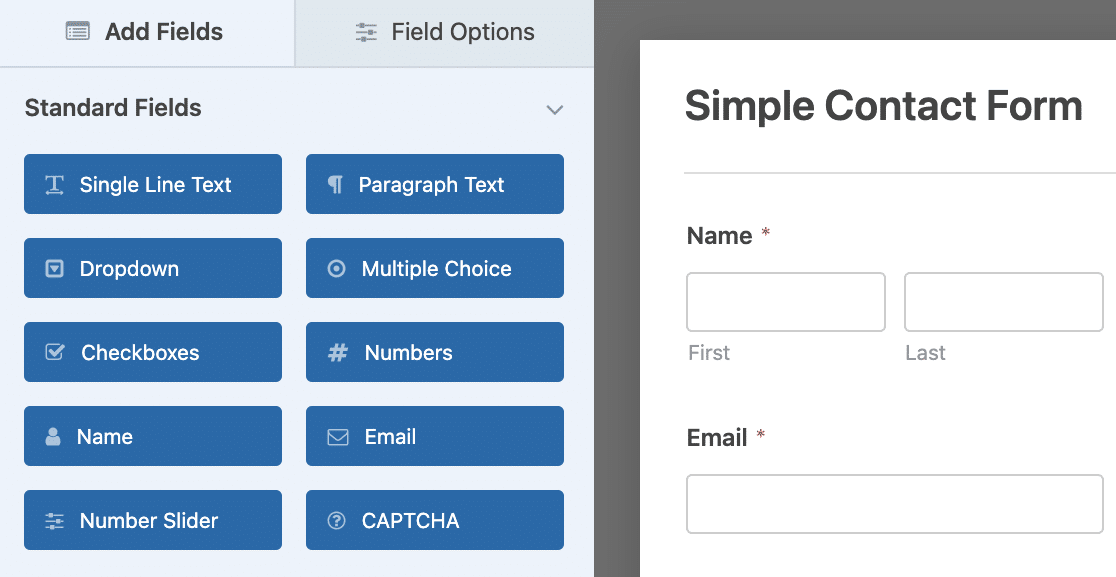
If Salesforce isn’t the only tool in your stack, it’s worth seeing how WPForms connects to any CRM and browsing the best CRM plugins for WordPress to round out your setup.
Connect Your Form With Salesforce Now 🔗
Ready to build your form? Get started today with the easiest WordPress form builder plugin. WPForms Pro includes lots of free templates and offers a 14-day money-back guarantee.
If this article helped you out, please follow us on Facebook and X (Twitter) for more free WordPress tutorials and guides.