


AI Summary
Looking for the best WordPress popup plugins to grow your email list and boost conversions?
Popups get a bad rap, but when used correctly, they’re one of the most effective tools for turning casual visitors into subscribers and customers.
OptinMonster is the best WordPress popup plugin for most sites that want to grow an email list, and Popup Maker is the best free option.
Below, I’ll walk you through 9+ proven WordPress popup plugins with honest assessments to get more subscribers and sales on your website.
Best WordPress Popup Plugins Compared
Here’s a quick side-by-side of the popup plugins I’ll cover, with hosting type and performance footprint included so you can spot the lightweight options at a glance.
| Plugin | Best For | Free Version | Hosting | Performance Impact | Pricing |
|---|---|---|---|---|---|
| OptinMonster | Advanced targeting and exit-intent | Yes (500 impression credits) | Cloud-based | Light | $9 to $67/month |
| TrustPulse | Social proof and FOMO notifications | Yes (up to 500 sessions) | Cloud-based | Light | $5 to $39/month |
| Popup Maker | Free, WordPress-native popup builder | Yes | Self-hosted | Light | Free or from $59.40/year |
| Thrive Leads | A/B testing and on-site analytics | No | Self-hosted | Moderate | $99/year |
| HubSpot | All-in-one with free CRM | Yes | Cloud-based | Light | Free or $20/seat/month |
| Icegram Engage | Budget-friendly with no traffic limits | Yes | Self-hosted | Light | Free or $99/year |
| Elementor Pro | Elementor users wanting a popup builder | No | Self-hosted | Moderate | $84/year |
| BDOW | Popups, smart bars, and countdown timers | Yes | Cloud-based | Moderate | Free or $19/month |
| Bloom | Divi users with an Elegant Themes plan | No | Self-hosted | Moderate | $89/year (with Divi) |
Note: Prices were checked in October 2026 and show what you’d pay in the first year. Several of these tools renew at a higher regular price, so check the renewal rate before you buy.
Best WordPress Popup Plugins
Now that you have a general idea of the available popup plugins for WordPress, let’s take a closer look at the pros and cons of each, as well as how much they cost.
- 1. OptinMonster (The Conversion Powerhouse)
- 2. TrustPulse (The Social Proof Specialist)
- 3. Popup Maker (The Best Free Option)
- 4. Thrive Leads (Best for A/B Testing)
- 5. HubSpot (Best All-in-One with Free CRM)
- 6. Icegram Engage (Best Budget-Friendly Option)
- 7. Elementor Pro (Best for Existing Elementor Users)
- 8. BDOW (formerly Sumo) (Best for Countdown Timer Popups)
- 9. Bloom (Best Bundled with Divi)
1. OptinMonster (The Conversion Powerhouse)
Best For: Sites serious about email list growth and conversion optimization
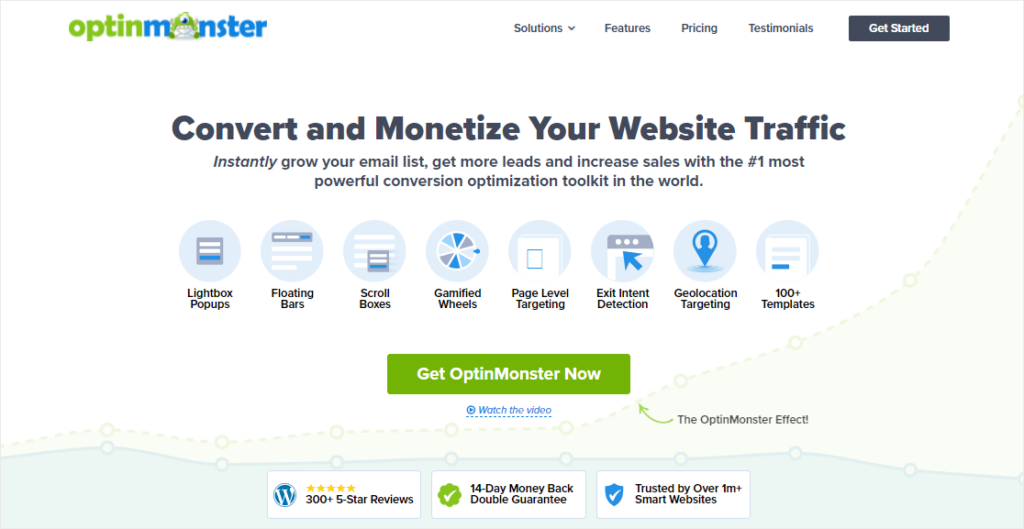
OptinMonster is the most powerful popup builder I’ve tested, and it’s still the one I reach for first when a client’s lead gen needs to actually move the needle. It goes well past basic popups, supporting inline forms, slide-ins, fullscreen overlays, floating bars, and gamified spin-to-win campaigns.
Disclosure aside, OptinMonster is built by the same team behind WPForms, so I’ve watched the product up close for years. The thing that consistently impresses me is the targeting engine.
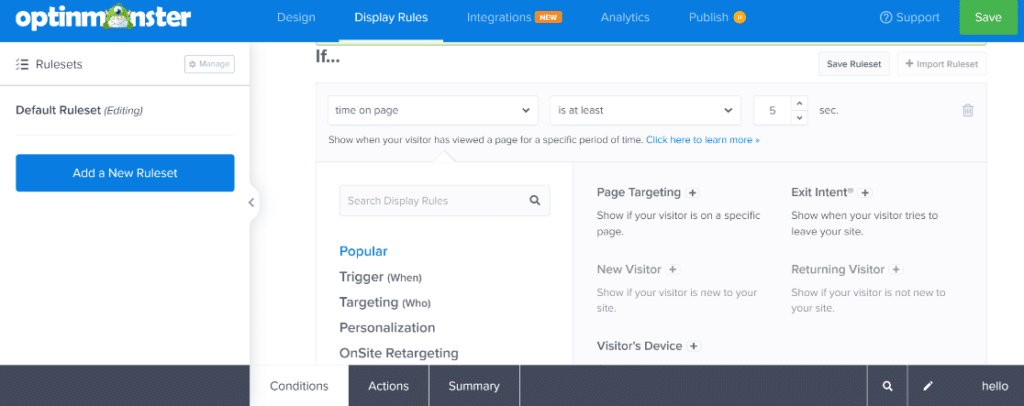
You can show different popups to first-time visitors, returning customers, mobile users, geographic regions, referral sources, and even people who scrolled past a specific section of an article. That kind of granularity is rare outside of enterprise-priced tools.
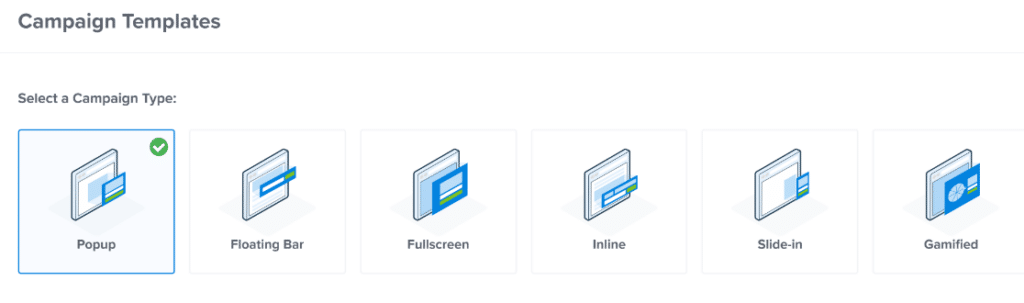
In testing, I built an exit-intent popup using one of the templates and had it live in about eight minutes. The drag-and-drop builder is what you’d expect, and the templates are genuinely modern (not the stock-photo-heavy designs you see in some older tools).
Because OptinMonster runs on its own cloud infrastructure, it doesn’t bloat your WordPress install. The script loads asynchronously, so it doesn’t block page rendering. That’s why it scored Light on my performance footprint test, even running multiple campaigns at once.
If you’re already using WPForms to collect leads, OptinMonster has a direct WPForms integration that hands form submissions to your popup workflow. That combination is what I run on most of my own projects.
What I Liked
- Exit-Intent technology that actually catches abandoning visitors with no false positives in testing
- 700+ professionally designed templates that don’t need a designer to look good
- Granular targeting (geo, referrer, device, scroll depth, time on site)
- Built-in A/B testing without a separate add-on
- Works with WPForms, Mailchimp, ActiveCampaign, ConvertKit, and 60+ other services
Pricing
You can start free with every Basic feature and 500 impression credits, and the account auto-upgrades to the Plus plan once you go past them. Paid plans start at $9/month (billed annually) for Basic and go up to $67/month for Growth.
A/B testing starts on Plus at $27/month, and Exit-Intent starts on Pro at $37/month. These are first-year prices, so expect renewals to cost more (Basic renews at $210/year).
2. TrustPulse (The Social Proof Specialist)
Best For: Ecommerce stores and high-ticket service sites that need to build trust fast

TrustPulse takes a different angle from every other plugin on this list. Instead of email opt-in popups, it shows small notification bubbles in the corner of your site that display real-time visitor activity.
Recent purchases, new signups, downloads, page views, the kind of activity that signals “real people are using this site right now.”
It’s also an AwesomeMotive product, so the same disclosure applies. I’ve used TrustPulse on a SaaS launch and a Shopify-WordPress hybrid store, and the conversion lift was measurable in both cases.
The notifications don’t interrupt the user the way a lightbox does, so you get the credibility boost without the bounce-rate hit.

Setup took me about five minutes. You install the plugin, connect to your TrustPulse account, and pick the activity feed you want to surface. There are pre-built campaign types for ecommerce purchases, form signups, and on-page activity counters.
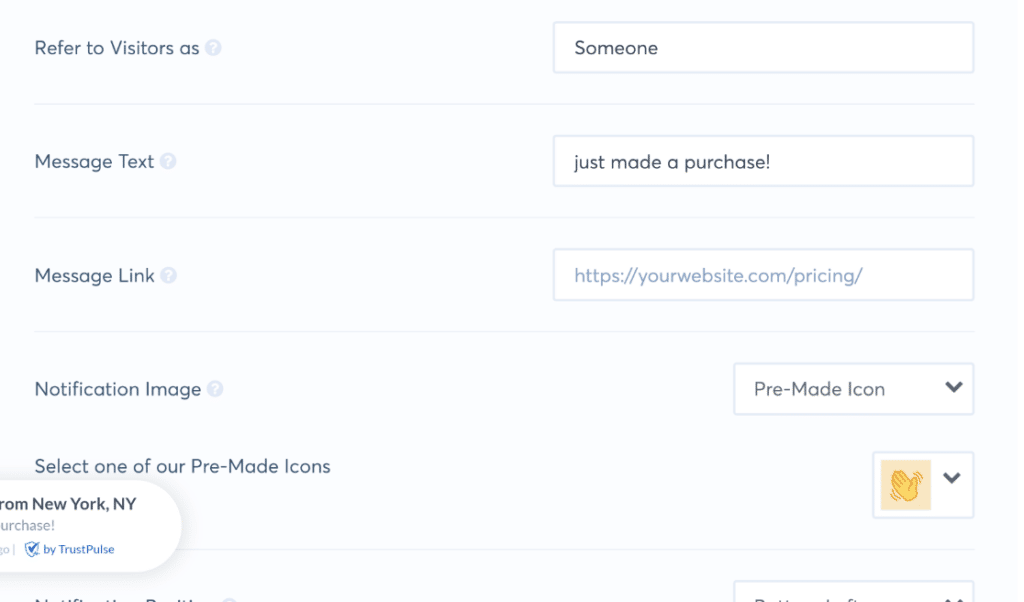
What I appreciate is that the notifications are honest. They’re pulled from real activity on your site, not made up. The plugin can also display “Active visitors right now” counters, which work well on landing pages where you want to nudge someone over the conversion line.
For most stores, the OptinMonster + TrustPulse combination is what I’d recommend. OptinMonster captures email and offers, TrustPulse builds trust through social proof. They’re built to work together. I went into the details in our TrustPulse review if you want a deeper look.
What I Liked
- Real-time activity notifications based on actual site behavior
- Smart targeting that suppresses notifications when they’d feel forced
- Lightweight script with no measurable performance impact
- Works alongside other popup plugins without conflicts
Pricing
Plans start at $5/month for Basic and go up to $39/month for Growth (billed annually). Those are introductory rates, and Basic normally costs $9/month. Brand-new sites can also start on a free plan with up to 500 sessions.
3. Popup Maker (The Best Free Option)
Best For: Beginners and budget-conscious site owners who need a fully functional popup builder without paying

Popup Maker is the most installed free WordPress popup plugin on the official repository, and it earned that spot honestly. The free version isn’t a stripped-down demo, it’s a complete popup builder with unlimited popups, no traffic caps, and a respectable set of trigger options.
I’ve used Popup Maker on multiple small-business sites where the budget didn’t justify a paid SaaS plugin. Setting up a basic email opt-in took me about ten minutes, including connecting it to the existing newsletter form built in WPForms.

You write the popup content in the WordPress editor, then configure when and where it should appear from a settings panel. The trigger options in the free version cover the basics most sites need (page load with delay, scroll percentage, click triggers).
Exit-intent is part of the paid extension, which is the main reason it didn’t take a higher spot on this list. If you don’t need exit-intent specifically, you may genuinely never have to pay.
What sets Popup Maker apart from other free plugins is the click-to-open trigger. You can attach a popup to any button or link on your site, which is great for “Subscribe” or “Get the discount” CTAs scattered through blog posts.
For a free WordPress popup plugin, this is the strongest option I’ve used. Promote it from “bonus” to a primary recommendation any day.
What I Liked
- Fully functional free version with no traffic limits
- Click-to-open triggers (rare in free tools)
- Works with the standard WordPress editor, no separate UI to learn
- Strong condition logic, even on the free tier
- 700,000+ active installs means plenty of community resources and documentation
Pricing
The core plugin is free, and Popup Maker Pro costs $59.40 for the first year on a single site ($99/year after that). Pro+ adds revenue attribution and ecommerce features for $149.40 in the first year, then $249/year.
You’ll need one of the paid plans for exit-intent and scroll triggers, plus the advanced targeting rules.
4. Thrive Leads (Best for A/B Testing)
Best For: Marketers who want detailed analytics and testing without leaving WordPress

Thrive Leads is a self-hosted popup plugin that runs entirely inside your WordPress dashboard. Unlike OptinMonster, none of your data gets routed through a third-party cloud, which appeals to teams that prefer to keep visitor data on their own server.
I tested Thrive Leads on a client project where the priority was deep A/B testing. The reporting dashboard inside Thrive shows you which popup variants are converting, by lead group, by content type, and across time.
That depth of on-site analytics is something OptinMonster also offers, but Thrive bundles it without a separate cloud subscription.
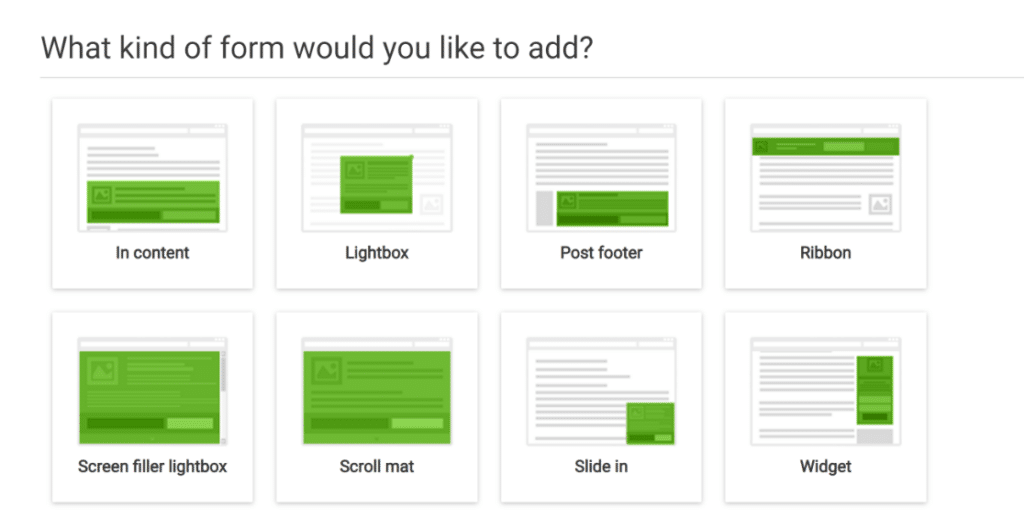
The popup builder is flexible. You can customize backgrounds, typography, form field layouts, and CTA button styles directly in the visual editor. Live preview means you see exactly what visitors will see before publishing.
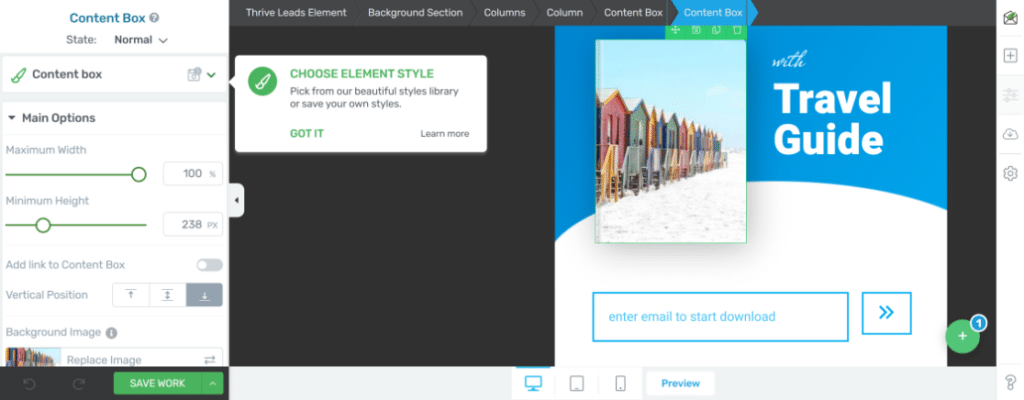
The catch is that Thrive Leads is best for people already using Thrive Suite. As a standalone purchase, it’s still solid, but you’re not getting the full value of the ecosystem.
If you’re already a Thrive customer, this is a no-brainer add-on. If you’re shopping fresh in 2026, OptinMonster usually wins on pure feature depth.
What I Liked
- Full A/B testing built in, no separate add-on required
- Self-hosted, so all data stays on your server
- SmartLinks feature avoids showing opt-ins to existing subscribers
- Conversion reports with content grouping for easy analysis
Pricing
$99/year for Thrive Leads as a standalone, or $299/year for the full Thrive Suite (which includes Thrive Leads plus several other Thrive plugins). Both are first-year prices, with renewals at $199/year for Thrive Leads and $599/year for Thrive Suite.
5. HubSpot (Best All-in-One with Free CRM)
Best For: Teams that want popups, CRM, and email marketing in one place
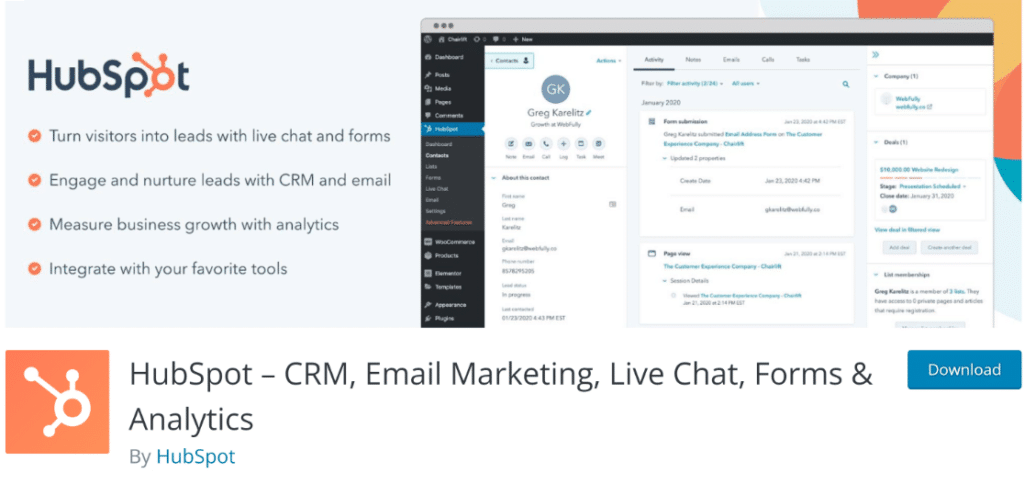
The HubSpot WordPress plugin bundles popups with a free CRM, live chat, email marketing, and forms. If you’d otherwise be buying three separate tools, HubSpot’s free tier is a meaningful saving.
I tested HubSpot on a client site that needed lead capture wired into a sales pipeline. You build a popup, customize the form fields, set display rules, and the moment someone submits, their data lands in HubSpot’s CRM as a contact record.
From there, the sales team can pick up the conversation in HubSpot’s interface or sync to Gmail and Outlook. The popup builder itself is fine, templates are clean, the editor is straightforward, and the trigger options cover the basics (time delay, scroll, exit-intent on paid tiers).
But you’re not really here for the most polished popup design, you’re here for the integration story. The trade-off is that HubSpot’s full power lives in the paid tiers.
If you only need popups and basic CRM, the free plan is genuinely useful. If you want advanced segmentation, marketing automation, or A/B testing, you’ll be looking at $50/month and up.
What I Liked
- Free forever plan that includes both popups and CRM
- Tight integration between popup form submissions and contact records
- Marketing automation tools (in paid tiers) ready to take over after capture
- Reliable form delivery, no hosting issues during my testing
Pricing
Marketing Hub Starter lists at $20 per seat per month, and HubSpot was running a new-customer discount on it when I checked. The free plan covers up to 2 users, while Professional starts at $800/month and scales up to enterprise tiers.
6. Icegram Engage (Best Budget-Friendly Option)
Best For: High-traffic sites that don’t want to be penalized for growth
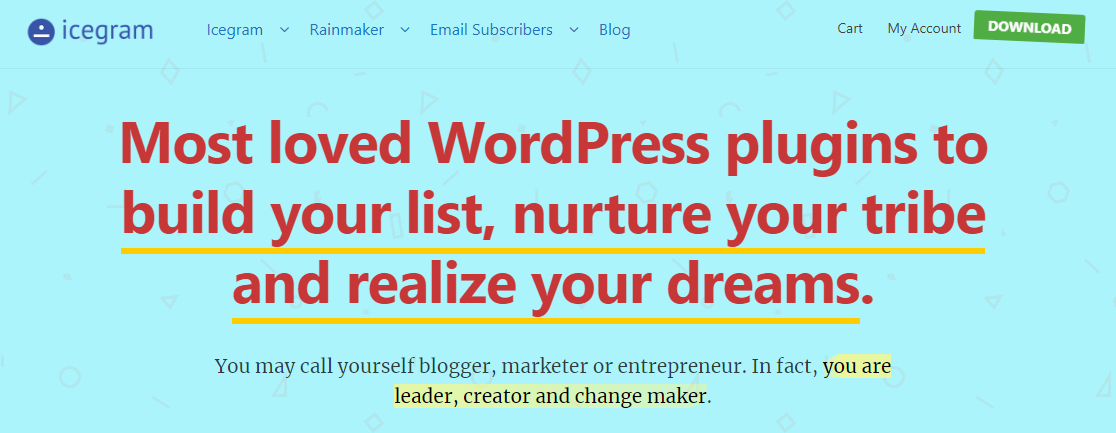
Icegram Engage (formerly just Icegram) is a freemium popup plugin focused on affordability. The thing that sets it apart is its policy on traffic. Most popup plugins charge more as your impressions go up. Icegram doesn’t.
I tested Icegram on a high-traffic content site doing roughly 50,000 monthly visitors. With most popup plugins, that volume would push me into a $39 or $67/month tier.
Icegram’s free version handled the load without nagging upgrade prompts. That alone makes it worth a look if you’re scaling and don’t want to keep moving up tiers.
Setup is workable, and the interface is functional rather than polished. Time-delay and click triggers are free, while scroll-depth and exit-intent triggers need the paid Max plan. Templates are decent (not on OptinMonster’s level, but clean enough to ship).
For a growing publisher who doesn’t need the most advanced design or targeting, Icegram is the best price-to-features deal on this list. If you outgrow it, the upgrade path is reasonable too.
What I Liked
- No traffic limits on the free plan
- Self-hosted, so no recurring fees just because your site got popular
- Multiple campaign types (toaster, lightbox, ribbon, sticker) included
- Easy upgrade path if you eventually need exit-intent or analytics
Pricing
Free for the core plugin. Icegram Engage Max costs $99/year and covers up to 3 sites.
7. Elementor Pro (Best for Existing Elementor Users)
Best For: Sites already built on Elementor that want to keep popups in the same builder

Elementor Pro is best known as a page builder, but the popup module is one of the strongest reasons to upgrade from Elementor Free.
If your site is already built with Elementor, the popup builder uses the same drag-and-drop interface you know. There’s almost no learning curve.
I tested the popup builder on multiple Elementor-based sites this year.
The trigger options cover everything you’d want (page load, scroll percentage, exit-intent, click triggers, and time on page).
The catch is that Elementor itself ships a fair amount of CSS and JavaScript. On a site that’s already running Elementor, adding popups doesn’t add much overhead.
On a site that isn’t, switching to Elementor just for popups would be overkill, performance-wise. That’s why it sits in the Moderate column on this list.
For Elementor-native sites, this is the obvious choice. The popups inherit your site’s styling automatically, which means they look like part of your site rather than a third-party widget bolted on top.
What I Liked
- Same UI as the rest of Elementor, no new tool to learn
- Custom popup designs that match your site identity exactly
- Solid trigger and condition logic
- Tight integration with Elementor’s form widget
Pricing
$84/year for the Elementor Pro Advanced Solo plan, which includes the popup builder. The cheaper Essential plan ($60/year) doesn’t include the Popup Builder, so skip it if popups are the reason you’re buying.
8. BDOW (formerly Sumo) (Best for Countdown Timer Popups)
Best For: Small businesses that want popups, smart bars, and countdown timers from a free starting plan
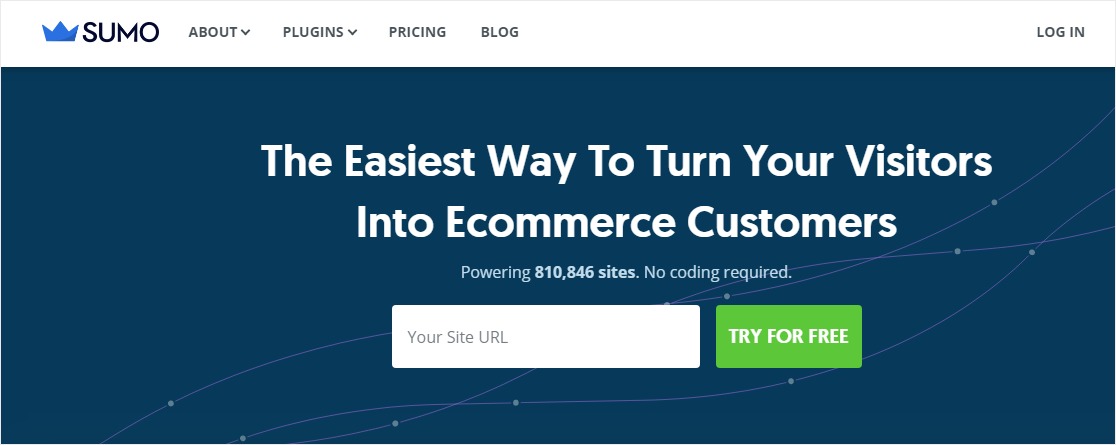
BDOW (formerly known as Sumo) is now a pop-up and form tool built by Showit, and BDOW says more than 30,000 businesses use it. Alongside standard popups, it builds smart bars and scroll boxes, plus newer tools like social proof pop-ups and evergreen countdown timers.
The free-forever plan gives you the core popup and form builder, with BDOW branding on your campaigns. Its email integrations include Mailchimp and Kit, along with Flodesk and MailerLite.
The WordPress plugin is actively maintained, with its latest update in October 2026 and a script BDOW says is now at least 35% faster.
What I Liked
- Free-forever plan with the core popup and form builder
- Smart bars, scroll boxes, welcome mats, and inline forms in one tool
- Social proof pop-ups and evergreen countdown timers on the same account
- Email integrations with Mailchimp, Kit, Flodesk, and MailerLite
Pricing
BDOW Pro costs $19/month billed annually ($228/year) or $25/month billed monthly for one site. It removes BDOW branding and includes 1,000 stored contacts. Storing more contacts raises the price, starting at $29/month (billed annually) for 2,500 contacts.
9. Bloom (Best Bundled with Divi)
Best For: Existing Elegant Themes members who already have a Divi license
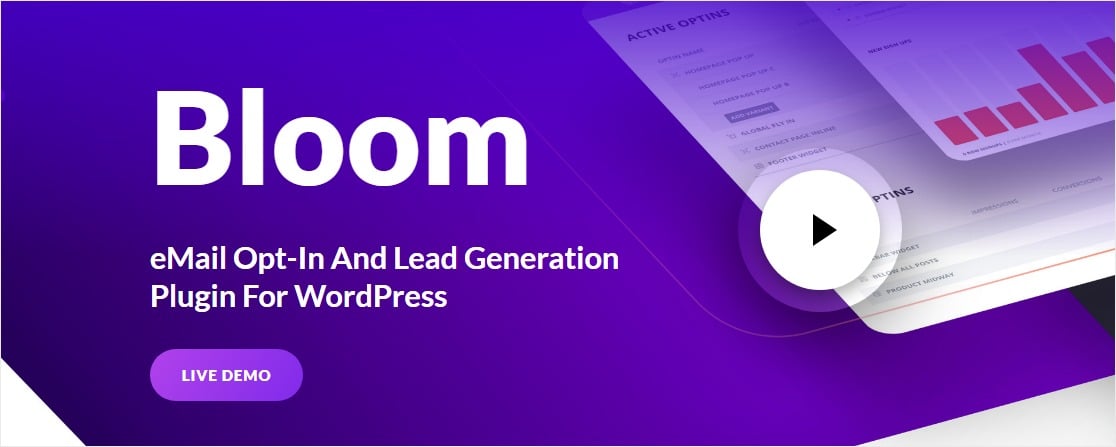
Bloom is a popup plugin from Elegant Themes, the company behind Divi. If you already pay for Elegant Themes, Bloom is included at no extra cost, which is the main reason to use it.
I tested Bloom on a Divi-based client site. The template library has roughly 100 prebuilt designs across the common use cases (email signups, discount offers, content upgrades).
Customization happens through Bloom’s settings panel rather than a true visual builder, so it’s faster than Thrive Leads but less flexible than Elementor Pro.
Bloom hasn’t had an update since version 1.3.12 in 2021, while Elegant Themes keeps adding new tools to Divi itself.
If you’re already paying for Elegant Themes, it’s worth testing on a staging site before you rely on it. If you’re not, the actively maintained plugins above are a safer bet.
What I Liked
- Six trigger types (page load, scroll, after comment, after purchase, after time, exit-intent)
- Bundled with the Elegant Themes membership at no extra cost
- A/B testing included in the dashboard
- 19 email service integrations (Mailchimp, Kit, ActiveCampaign, and more)
Pricing
$89/year as part of the Elegant Themes membership, or $249 for a lifetime license.
What Is the Best WordPress Popup Plugin?
After three weeks of head-to-head testing, the answer depends on what you need most. Here’s the simplest way to think about it.
- If you want the most powerful, all-around tool, OptinMonster is the clear winner. The Exit-Intent technology, advanced targeting, and 700+ templates consistently outperform simpler plugins.
- If you want the best free plugin, Popup Maker is the strongest free option I’ve tested. Unlimited popups, no traffic caps, and a free plan with no time limit.
- If you want social proof notifications specifically, TrustPulse is the best at displaying real-time activity to build trust and urgency. It pairs especially well with OptinMonster on ecommerce sites.
- If you’re already using Elementor, the Elementor Pro popup builder gives you design flexibility that matches your existing workflow.
- If you use Divi, Bloom is already part of your Elegant Themes membership at no extra cost, though it hasn’t been updated since 2021.
- If you want everything in one tool, the HubSpot WordPress plugin bundles popups, CRM, and email marketing on a free tier.
For most WordPress site owners focused on email list growth and conversion optimization, OptinMonster is the strongest combination of features, templates, and targeting depth. If your budget is tight, Popup Maker is genuinely capable enough to launch and grow with for free.
FAQs About WordPress Popup Plugins
WordPress popup plugins come up in almost every conversation about list growth and conversion optimization. Here are the questions I get asked most often, with honest answers based on my own testing.
Will popups hurt my SEO?
Done badly, yes. Done well, not at all. Google has been clear since 2017 that intrusive interstitials on mobile can lower rankings, especially when they cover the main content immediately on page load.
The key word there is “intrusive.” Here’s what to avoid if you want popups that don’t trigger Google’s penalty.
- Don’t show a fullscreen popup on first page load on mobile: This is the textbook intrusive interstitial. Google can and does demote pages that do this.
- Avoid stacked popups: One popup can be useful. Two popups firing back-to-back feels spammy and degrades the user experience signal Google measures.
- Make the close button obvious and easy to tap: Tiny X buttons or hidden close affordances frustrate visitors and risk a “deceptive interstitial” classification.
- Use timing or scroll triggers, not immediate display: Showing a popup after 30 seconds or 50 percent scroll depth is far less likely to trigger Google’s interstitial rules than firing on page load.
- Pick a plugin that loads asynchronously: Render-blocking scripts hurt your Core Web Vitals, which Google now uses as a ranking factor. Cloud-based tools like OptinMonster and TrustPulse handle this by default.
If you stick to exit-intent on desktop and time-delayed popups on mobile (with an easy close button), you’ll capture leads without paying for it in rankings.
What is the best free popup plugin for WordPress?
Popup Maker is the best free popup plugin for WordPress in 2026. Its free version is a complete popup builder you can keep using without ever upgrading.
You get unlimited popups, conditional display rules, click-to-open triggers, and integration with the standard WordPress editor. With 600,000+ active installs, it’s also the most installed self-hosted popup plugin on WordPress.org.
OptinMonster and TrustPulse also have free plans, but they’re capped at 500 impression credits and 500 sessions. If you eventually need exit-intent or scroll triggers, Popup Maker Pro starts at $59.40 for the first year and $99/year after that. But for most basic email list growth, you may genuinely never have to pay.
Do I need a WordPress popup plugin?
If you want professional, conversion-optimized popups on your WordPress site, yes. Most email marketing services let you create simple opt-in forms, but generic forms tend to look unstyled and miss most of the high-converting trigger options (exit-intent, scroll depth, smart targeting).
A dedicated popup plugin gives you better designs, more trigger flexibility, and proper analytics. If notification bars are more your style, you can also look at our roundup of the best WordPress notification bar plugins for an alternative format.
Will popup plugins slow down my WordPress site?
Well-coded popup plugins don’t significantly slow down your site. Here’s what I observed during my 2026 testing.
Light performance impact:
- OptinMonster loads asynchronously, no measurable slowdown
- TrustPulse ships a lightweight script, minimal performance footprint
- Popup Maker is WordPress-native and only loads scripts where popups exist
- Icegram Engage has efficient code, no measurable slowdown
- HubSpot runs through their tracking script, light footprint
Moderate performance impact:
- Bloom ships its own CSS and JS bundle, watch your page load times
- Thrive Leads generally efficient but adds CSS and JS files
- Elementor Pro depends on your overall Elementor usage
- BDOW loads an external script, though BDOW says a recent update made it at least 35% faster
To keep performance impact low, only display popups where they’re needed (don’t run them sitewide if a single page would do), use scroll or time triggers instead of immediate display, and limit how many active popup campaigns run at once.
How many popups should I show per page?
One popup per page is the right starting point for most sites. Two can work if they’re targeted (for example, a slide-in newsletter signup plus an exit-intent discount), but stacking three or more popups feels spammy and tanks the user experience.
If you’re testing multiple campaigns, run them on different pages or to different audience segments rather than firing them all on the same visitor at the same time. Most modern popup plugins (OptinMonster, Popup Maker, Thrive Leads) include suppression logic that prevents the same visitor from seeing the same popup repeatedly.
Can I use popup plugins with WPForms?
Yes, most WordPress popup plugins integrate well with WPForms. The typical setup is to build your signup or contact form in WPForms, then use a popup plugin to display that form inside a popup. WPForms builds any form with a drag-and-drop builder and no code. It doesn’t show popups on its own, so our guide on how to create a popup form using WPForms pairs it with OptinMonster.
Confirmed integrations:
- OptinMonster has a direct WPForms integration
- Popup Maker works smoothly with WPForms
- Elementor Pro lets you embed WPForms forms inside Elementor popups
- HubSpot can sync WPForms submissions to HubSpot CRM with the WPForms HubSpot addon (Elite plan)
- Thrive Leads is compatible with WPForms forms
- TrustPulse can turn new WPForms entries into notifications once you connect WPForms to TrustPulse through Zapier (WPForms Pro)
This combination gives you WPForms’s form builder with the popup plugin’s display and targeting features.
Are popup plugins GDPR compliant?
Most reputable popup plugins are GDPR-ready, but you need to configure them correctly. Compliance is part technical, part legal.
GDPR-ready popup plugins:
- OptinMonster includes GDPR features and consent handling
- TrustPulse is GDPR-compliant when configured properly
- Popup Maker is GDPR-ready out of the box
- HubSpot has GDPR compliance built into the platform
To stay compliant:
- Add clear consent checkboxes to your signup forms
- Link to your privacy policy
- Don’t pre-check consent boxes
- Store consent records with form submissions
- Provide easy unsubscribe options
The plugin handles the technical side, but you’re responsible for the legal side. For a deeper look, our guide to GDPR WordPress plugins covers compliance in detail.
Next, Grow Your Email List With More WordPress Tools
Looking for more tools to grow your WordPress site? Check out these helpful resources.
- Best Free WordPress Plugins, must-have plugins for every site
- Best WordPress Lead Generation Plugins, grow your email list faster
- Lead Generation Form Examples, see what high-converting forms actually look like
- Best WordPress Social Media Plugins, increase social engagement
- Best WooCommerce Affiliate Plugins, create affiliate programs
- Top Online Form Builders, compare form building options
Ready to build your form? Get started today with the easiest WordPress form builder plugin. WPForms Pro includes lots of free templates and offers a 14-day money-back guarantee.
If this article helped you out, please follow us on Facebook and X (Twitter) for more free WordPress tutorials and guides.





I don’t know about the others on this list, but OptinMonster places cookies which currently cannot be disabled by popular cookie bars such as CookieYES, so EU websites using it will not be PECR compliant.
Hi Joe,
To disable either cookie option, set the number of days to zero (0). Please see this guide for more insights
And for more assistance on this, please feel free to reach out to their support
Hope this helps! 🙂