


AI Summary
Are you looking to incorporate rating scale questions into your surveys?
Rating scale questions can offer insight into how much a respondent agrees with a statement, how satisfied they are, or how likely they are to do something.
I’ve built plenty of survey forms in WPForms, and the field you pick shapes your data more than the wording of the question does.
A star rating gives you one quick score, while a Likert grid collects six ratings in the space a single question would normally take.
This guide walks through all five field types, when to reach for each one, and how to read the results once responses start landing.
What Is an Example of a Rating Scale Question?
Survey questions with rating scales typically give a range of answer options. They differ from multiple choice questions in that each response option holds a different value.
A common example of a rating scale question can be found on customer experience or satisfaction surveys that ask shoppers the degree to which they agree with the following statement:
“I am likely to recommend this business to others.”
Response options might include Strongly Agree, Agree, Neutral, Disagree, Strongly Disagree. Our guide on what a Likert scale is covers the format itself in depth.
How to Create a Rating Scale in WordPress
Creating a rating scale in WordPress is super easy using WPForms. Follow the steps below to get started, and drop a comment at the end, if you face any troubles.
Step 1: Install the WPForms Pro Plugin
WPForms is the most beginner-friendly WordPress form builder plugin that allows you to build a form through its drag-and-drop builder, AI features, and a huge list of 2,100+ form templates.
What I like most about WPForms for rating scales is that they’re real fields rather than workarounds, so you’re not restyling radio buttons to look like stars or pulling in a second plugin just to render icons.
For the full set of scales you’ll want a Pro license, because the rating scale fields come from the Surveys and Polls addon, which also gives you access to advanced survey reporting features.
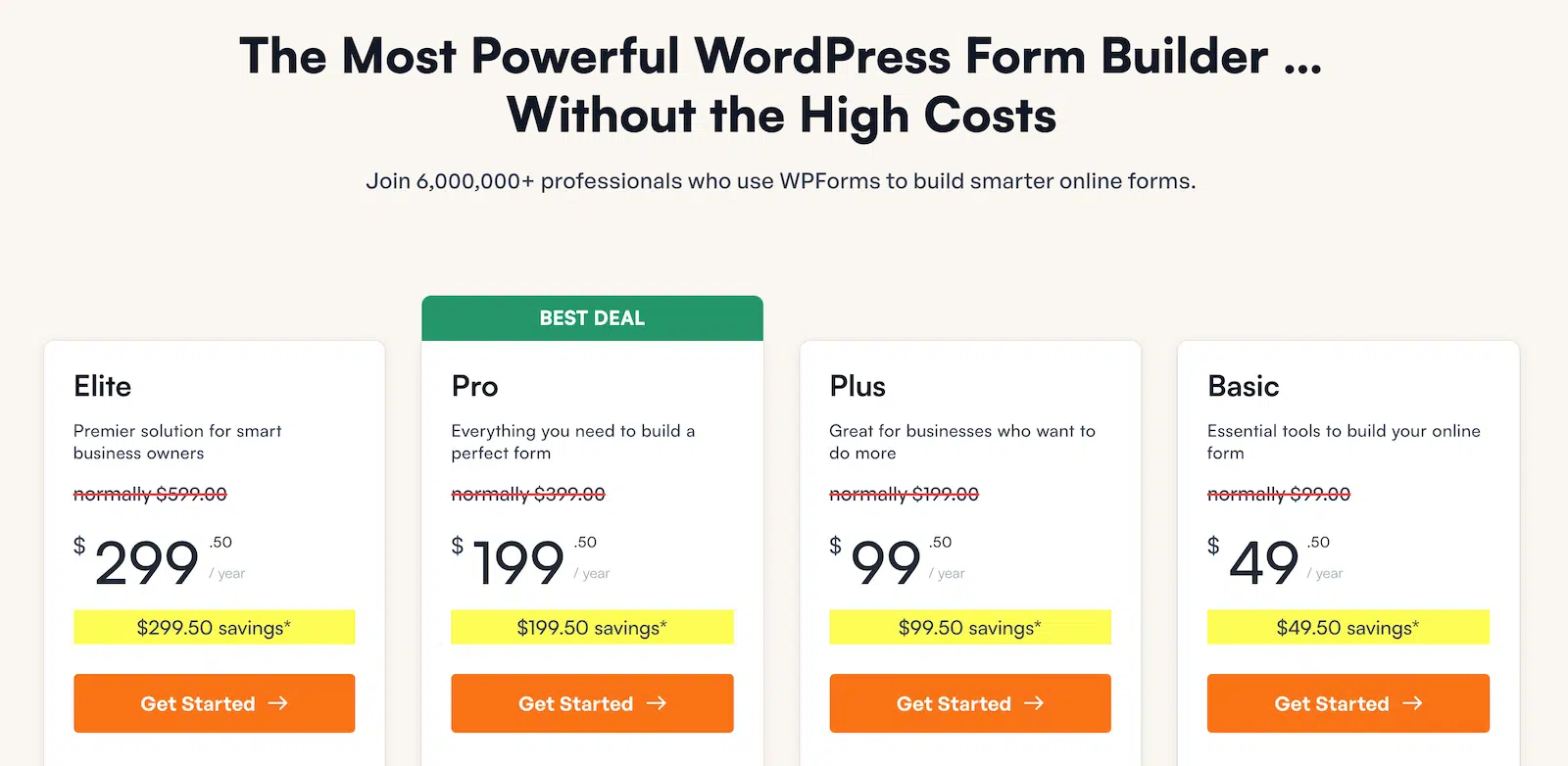
To get started, buy the Pro license. Then, install WPForms on your website. If you need help, follow these instructions on how to add a plugin to WordPress.
Step 2: Activate the Surveys & Polls Addon
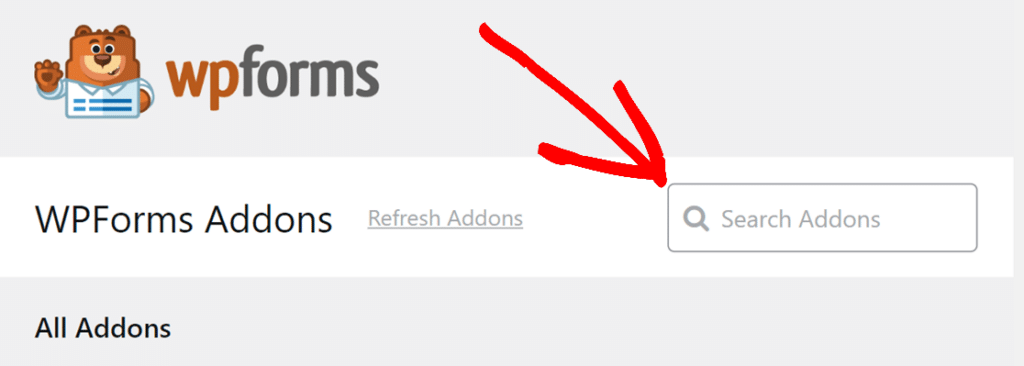
Once the plugin is active, go to WPForms » Addons and search for the Surveys & Polls Addon, which is what we need to activate the rating scale fields.
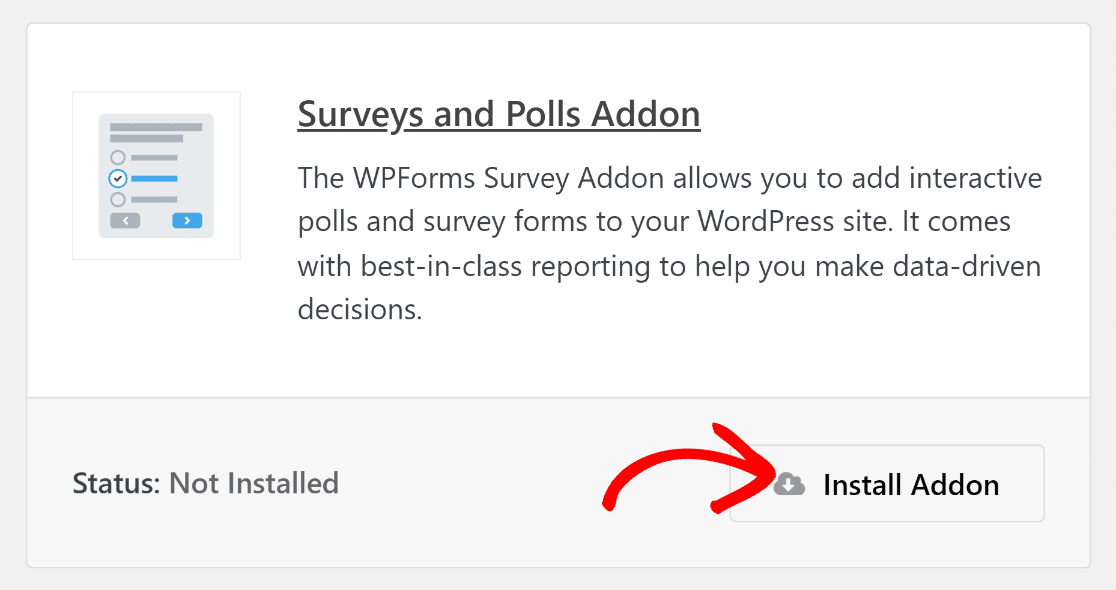
Hit the Install button for the addon, it will activate on its own, and the Likert Scale and Net Promoter Score fields appear in the builder from that point on.
Excellent job! In the next section, I will demonstrate how to create a new form and then add the relevant rating scale fields you require.
Step 3: Create Your Survey Form
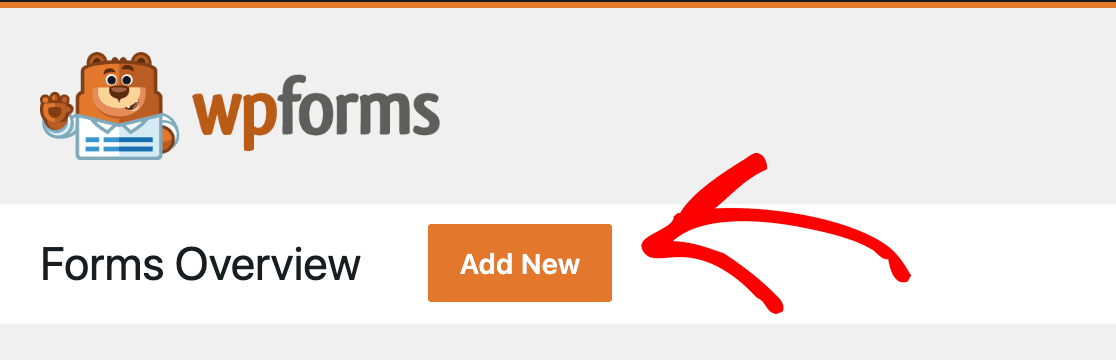
Go to WPForms » Add New to open the builder, give your form a name, and pick a template or start from scratch.
You can even use the WPForms AI to generate a complete form by simply telling it what kind of form you want to build, and it will create the whole thing for you.

From here you can shape the survey however you like, including a version that advances one question at a time if a long scrolling form feels like too much to ask.
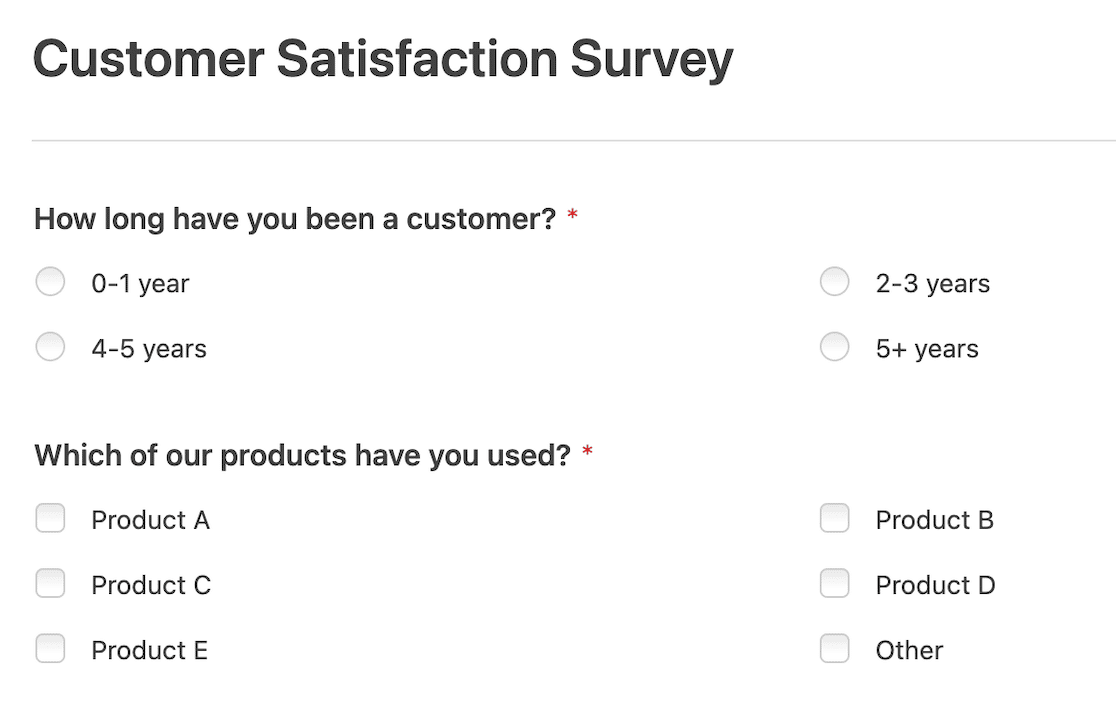
For this walkthrough I’m using a customer satisfaction survey. A couple of easy multiple choice and checkbox questions at the top get people moving before you ask them to think, and the rating scale comes next.
Step 4: Add Your Rating Scale Field
Pick whichever of the five options below matches what you’re measuring, then carry on to Step 4. You can absolutely use more than one in the same form, and a good satisfaction survey often does.
Option 1: Rating Field (Star, Heart, Thumb, or Smiley Icons)
Go ahead and open Fancy Fields in the form builder, then drag the Rating field into your form. That alone gets you a working 1 to 5 star rating with nothing else to configure.
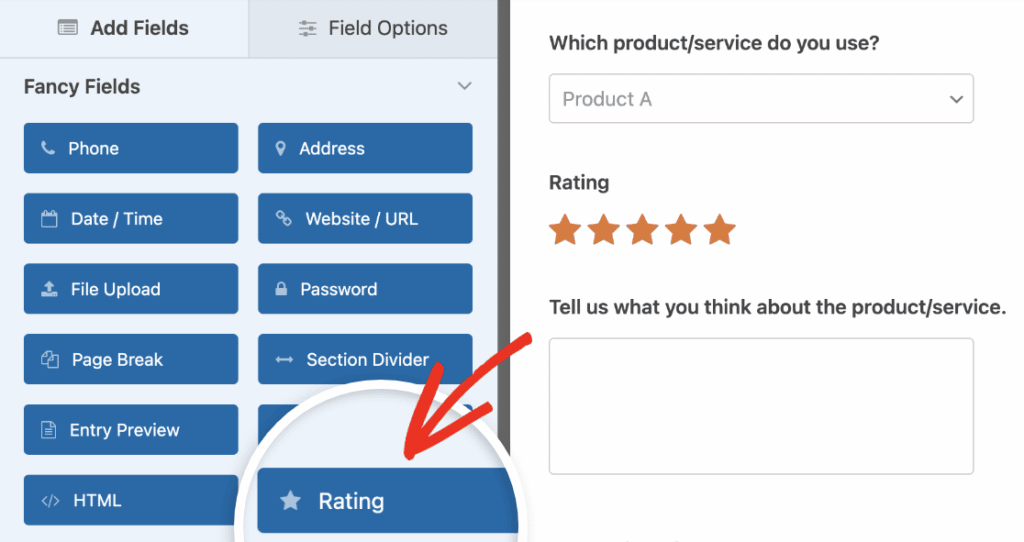
To change how many icons show, click the field to open Field Options and use the Scale dropdown. Anything from 2 to 10 works, so moving from a 5-point scale to a 10-point one is a dropdown change rather than a different field.
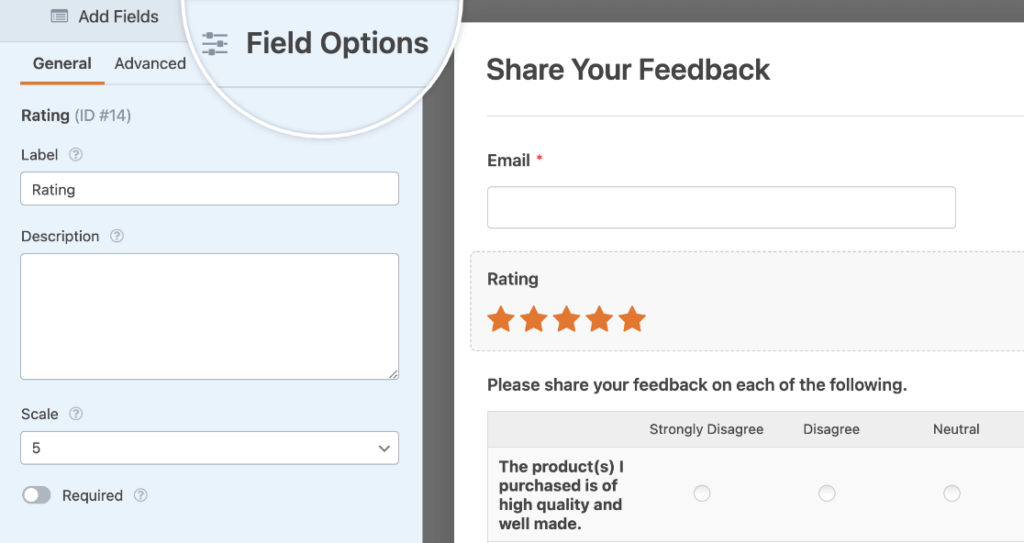
The Advanced tab is where this field earns its keep:
- Icon: Star, heart, thumb, or smiley face. Choosing the smiley gets you most of the way to an emoji rating scale.
- Icon Size: Small, medium, or large, with medium as the default.
- Lowest Score Label and Highest Score Label: The words that sit under the first and last icon, like Poor and Excellent.
- Label Position: Puts those labels Above or Below the icons.
- Icon Color: Orange out of the gate, and the color picker takes any value you want.
The documentation covers all of the Rating field’s options if you want the complete reference while you’re building.
Option 2: Likert Scale (Rate Several Statements at Once)
The Likert Scale field also lives under Fancy Fields, and it’s the format most people recognize on sight, which means you rarely have to explain how to fill it in.
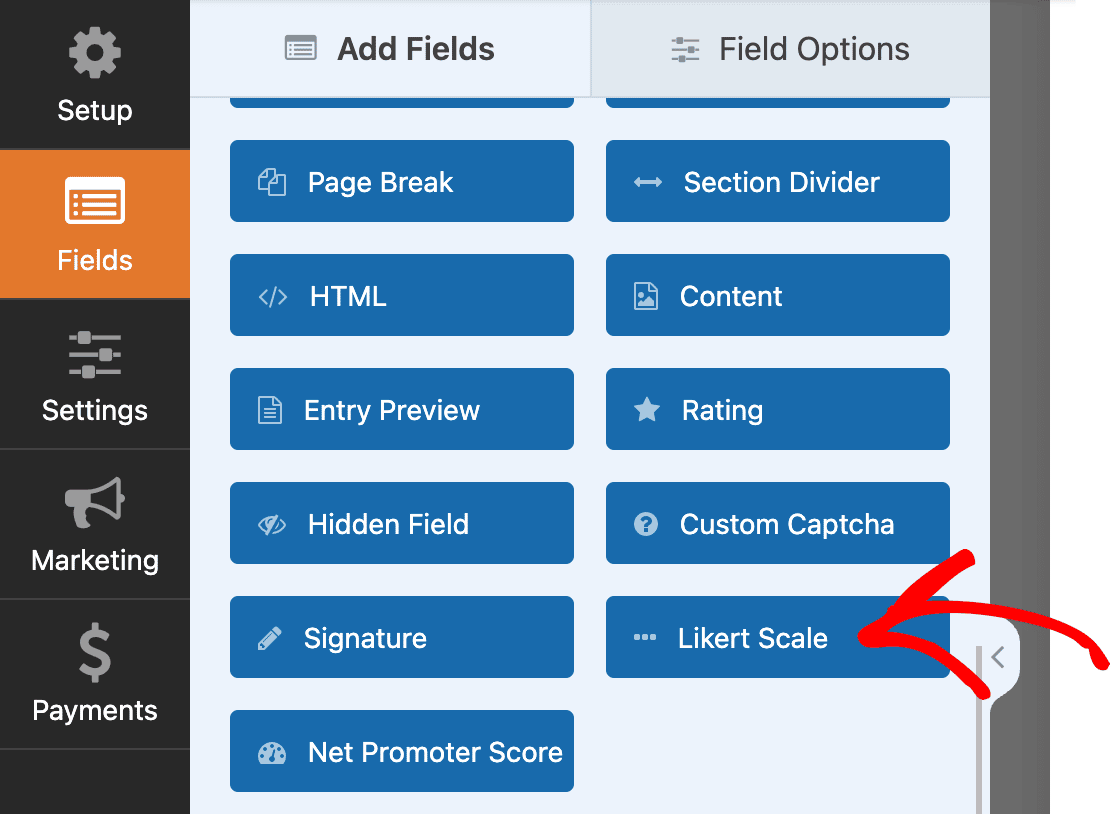
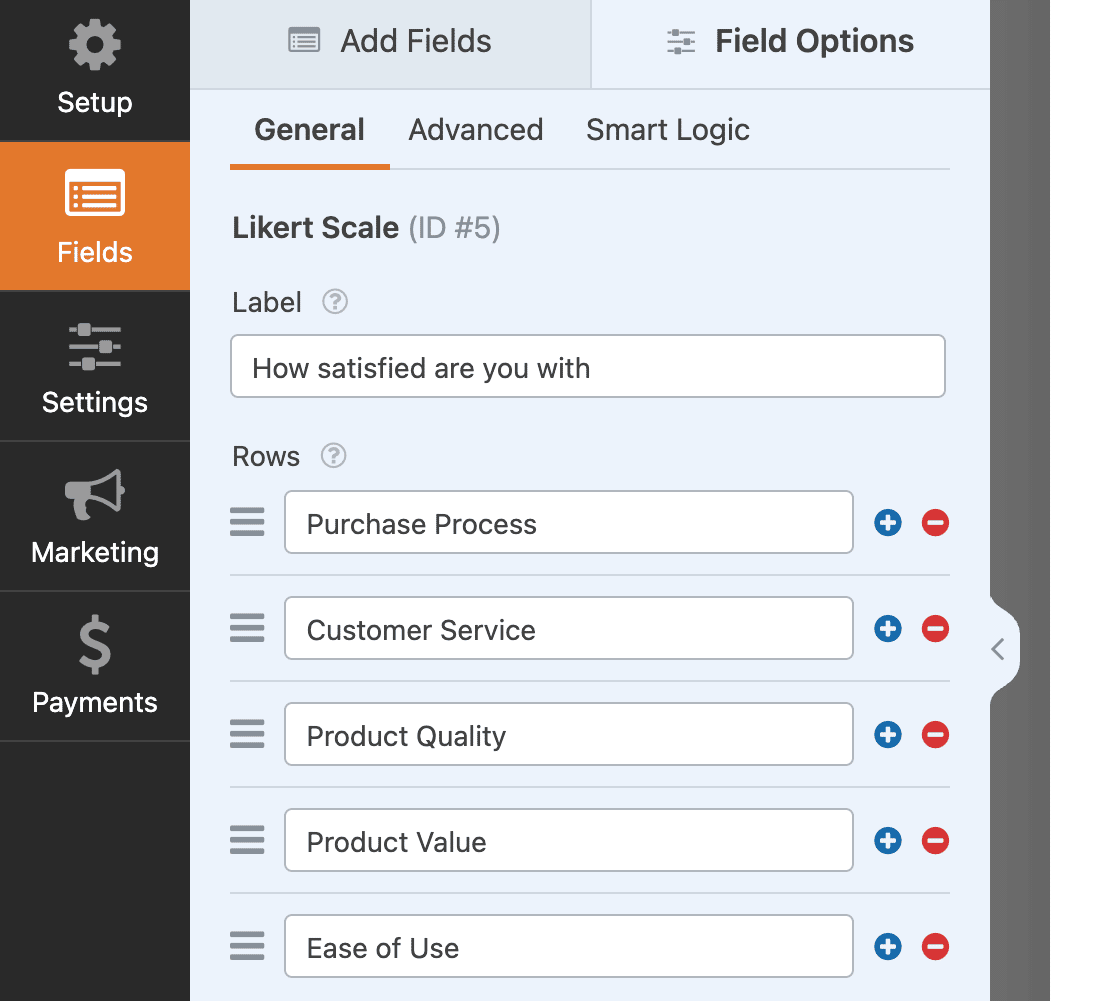
Once it’s in your form, use the Label field to start the statement, then add a row for each thing you want rated.
For a satisfaction survey, the label might read “How satisfied are you with the following?” and the rows name each thing being rated, like the purchase process, the delivery time, and the support team.
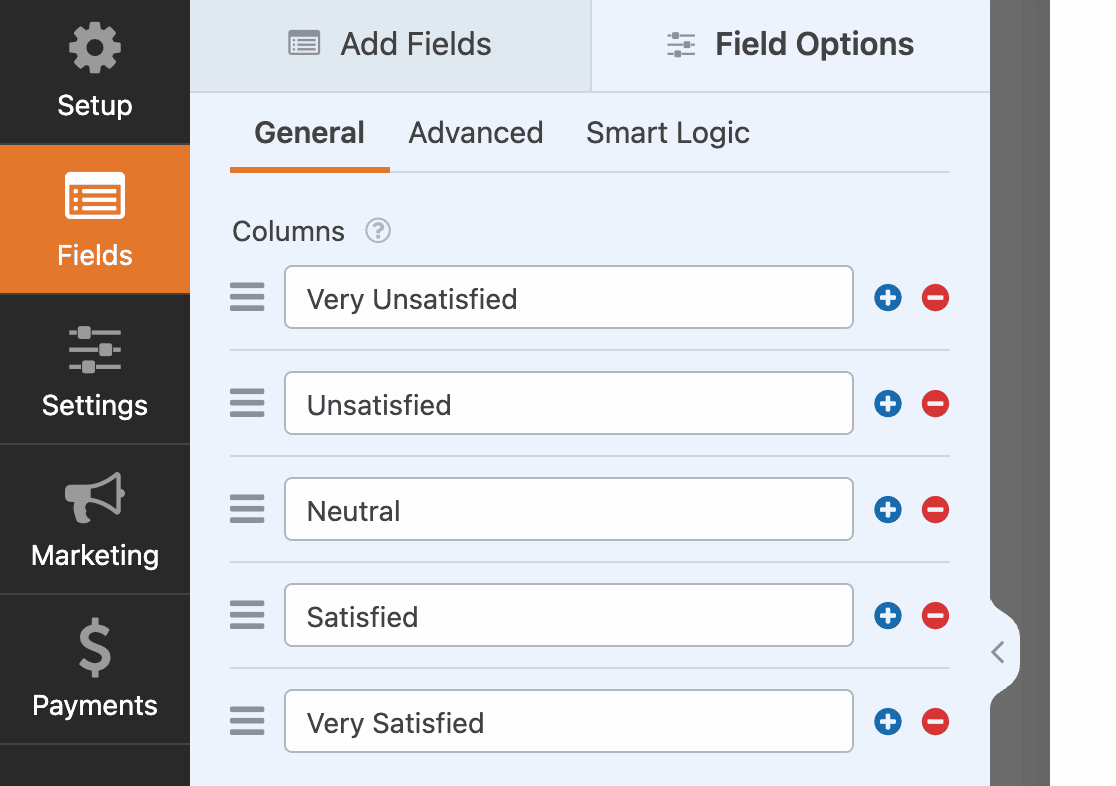
The Columns field holds the actual scale, and this is where you set the ratings themselves, running from Very Unsatisfied through to Very Satisfied.
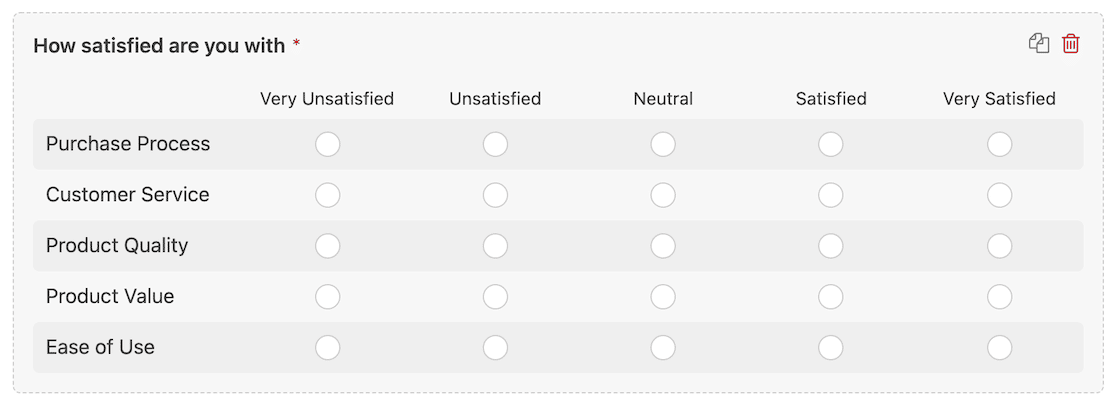
The preview updates as you edit, so you can see the grid taking shape without leaving the builder. Swapping the columns for likelihood wording turns the same field into a different measurement.
Here’s a second question built the same way, this time asking how likely someone is to do something rather than how satisfied they were.
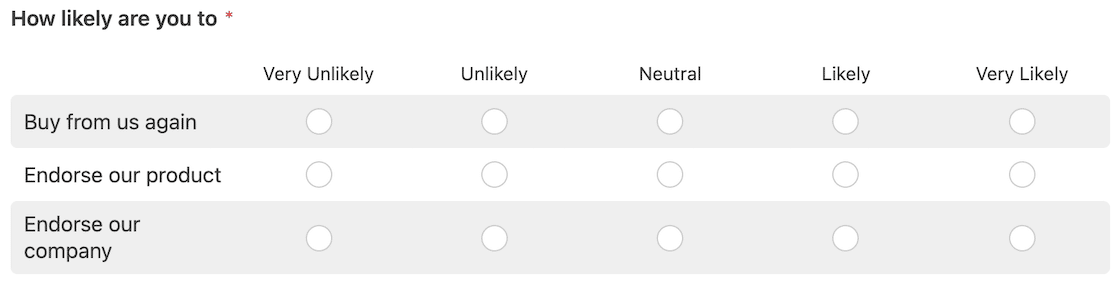
Five columns is the standard, though you’ll see seven and ten in the wild, so use only as many as you genuinely need, since every extra column is another decision you’re asking someone to make on every row.
Our step-by-step Likert scale guide goes deeper on row and column setup, including a ready-made template.
Option 3: Net Promoter Score (0 to 10 Recommendation Scale)
An NPS survey rests on a single question, asking how likely someone is to recommend you to a friend or colleague on a scale of 0 to 10.
That one answer stands in for overall customer loyalty, and the same question works for measuring how your team feels if you’re running it as one of your survey questions to ask internally.
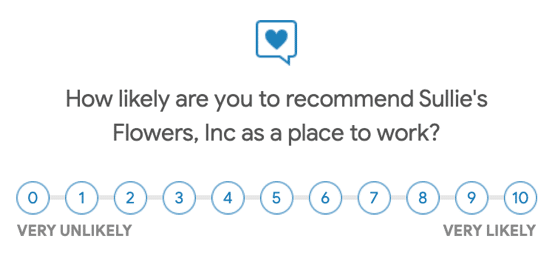
Responses sort into three groups:
- 0 to 6: detractors
- 7 to 8: passives
- 9 to 10: promoters
Your score is the percentage of promoters minus the percentage of detractors, which lands somewhere between -100 and 100.
WPForms runs that calculation for you, so the formula is worth understanding but not worth memorizing.
With the Surveys and Polls addon active, the Net Promoter Score field shows up in Fancy Fields alongside the Likert Scale.
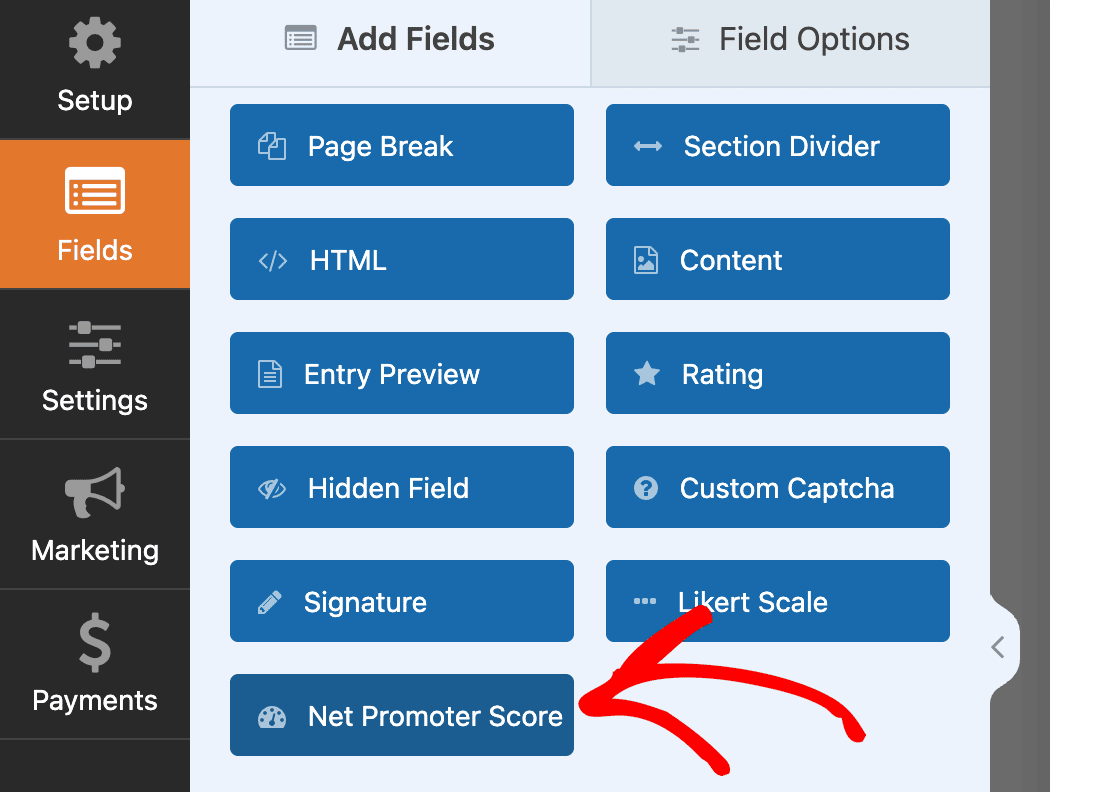
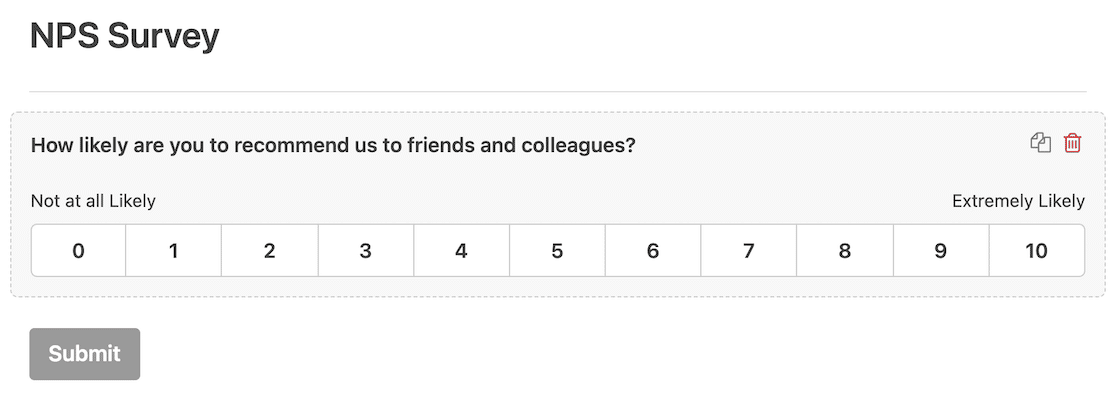
Drag it into the builder and change the field label to the question you want to ask. The 0 to 10 scale is fixed, which is the point of NPS, so there’s nothing else to configure.
Option 4: Dropdown or Multiple Choice (Text-Label Scale)
Both Dropdown and Multiple Choice live in Standard Fields. Add either one, then write your scale directly into the choices, running from Very Dissatisfied through to Very Satisfied, or whatever wording fits your question.
Multiple Choice shows every option at once, which suits a scale because people can see the whole range before picking.

Dropdown hides the options behind a click, so save it for long scales or forms where vertical space is tight.
Neither feeds the survey reporting charts the way the Likert and NPS fields do, so this route is best when you plan to read entries directly or export them.

Step 5: Turn On Survey Reporting
The whole point of a survey is the data at the other end, and WPForms has reporting built in that turns responses into charts without any spreadsheet work.
With your form open in the builder, go to Settings » Surveys and Polls and switch on Enable Survey Reporting.
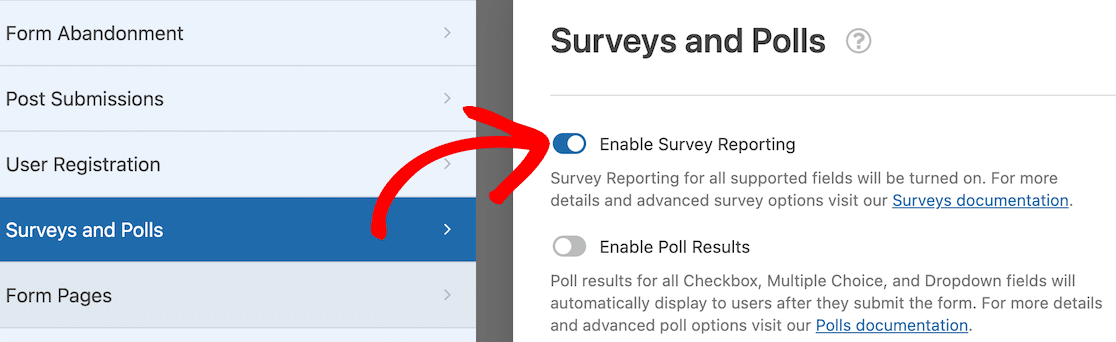
Switch this on before you publish, because reporting only charts responses collected while the setting was active, and turning it on later leaves your earliest entries out of the graphs.
Step 6: Read Your Rating Scale Results
Once responses start coming in, head to the main WPForms screen where all your forms are listed. Hover over the form title and a set of options appears underneath it, including the survey results.
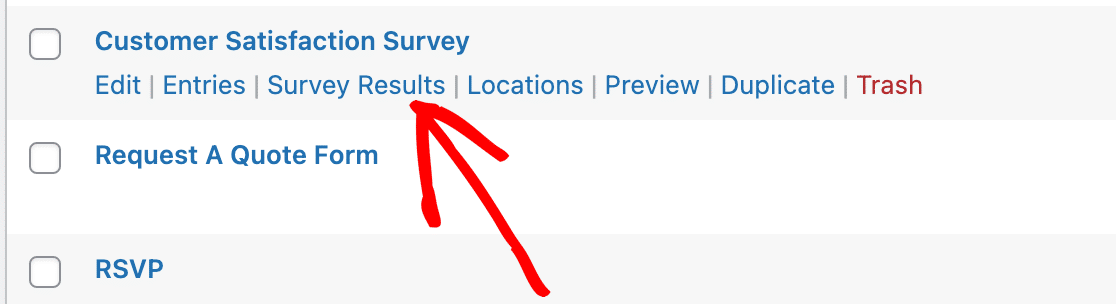
You can switch each chart between a vertical bar graph, a horizontal bar graph, and a pie chart depending on which reads better for that question.

Here’s how one of the Likert Scales from the customer satisfaction survey comes out.

Charts like this give you sentiment at a glance, and they drop straight into a slide deck if you’re reporting the data to anyone else.
FAQs on Creating a Rating Scale
Rating scales come up constantly in survey forms, and the same handful of questions come with them. Here are the ones I’m asked most often about scale length, license tiers, and reading the results.
What is the best rating scale to use?
Five points, for most surveys, and it’s the most common format in survey research by a wide margin.
That’s because it’s short enough that people answer every question instead of abandoning halfway through.
Move to seven or ten points when you need finer distinctions, like tracking small shifts from one quarter to the next.
Should I use a 1 to 5 or a 1 to 10 rating scale?
Use 1 to 5 for satisfaction and agreement questions, where nobody can honestly tell you the difference between a 6 and a 7.
Use 1 to 10 when you’re benchmarking, since NPS runs on a 0 to 10 scale and comparing your score against an industry average only works when the scales match.
In WPForms the Rating field handles either one through the Scale dropdown.
Do I need WPForms Pro to add a rating scale?
The Rating field is a Basic feature, and both the Number Slider and Dropdown routes work in the free Lite version.
Pro is what unlocks the Likert Scale and Net Promoter Score fields along with the survey reporting charts, so it matters when you want agreement grids, NPS, or visual reports.
Can I use a rating scale with no neutral middle option?
Yes. The Scale dropdown on the Rating field takes any value from 2 to 10, so choosing an even number like 4 or 6 removes the midpoint and pushes people to lean one way or the other. For a Likert grid, give it an even number of columns to get the same effect.
How do I see the average rating from my form?
Turn on survey reporting and open the survey results page, where WPForms charts the responses for you automatically.
Without reporting you can still export your entries and average the values yourself, since the Rating field stores a plain number alongside the icons.
Next, Learn the Best Customer Feedback Questions to Ask
If you want to go deeper on customer feedback but aren’t sure which questions belong in the form, don’t miss our article covering 52 customer feedback questions to ask.
And if you’re weighing up what kind of survey to run in the first place, our rundown of 14 types of surveys matches each format to the business goal it serves best.
Add a Rating Scale to Your Forms Now
Ready to build your form? Get started today with the easiest WordPress form builder plugin. WPForms Pro includes lots of free templates and offers a 14-day money-back guarantee.
If this article helped you out, please follow us on Facebook and X (Twitter) for more free WordPress tutorials and guides.