



AI Summary
Looking for customer satisfaction survey examples you can actually use on your site?
Good customer feedback tells you what to fix, what to double down on, and how close you are to losing a customer. The hard part is writing the right questions.
In this guide, I’ve pulled together 25 customer satisfaction survey examples grouped by the three survey types you’ll actually use in practice (CSAT, NPS, and CES), plus product, service, and open-ended questions.
- What Is a Customer Satisfaction Survey?
- Types of Customer Satisfaction Surveys
- Customer Satisfaction Survey Template
- CSAT-Style Customer Satisfaction Questions
- NPS and Loyalty Questions
- Customer Effort Score (CES) Questions
- Product and Service Feedback Questions
- Customer Service Experience Questions
- Open-Ended and Follow-Up Questions
- How to Create a Customer Satisfaction Survey in WordPress
- Best Practices for Customer Satisfaction Surveys
Before you start picking questions, it helps to know what a customer satisfaction survey actually measures and which framework fits your goal. So I’ll cover the basics first, then walk through the examples category by category.
What Is a Customer Satisfaction Survey?
A customer satisfaction survey is a short questionnaire that asks customers how they feel about your product, service, or a specific interaction with your business.
You use the responses to spot what’s working, fix what isn’t, and track how customer sentiment shifts over time. A good customer satisfaction survey measures four things.
- Product experience. How well your product meets expectations.
- Service quality. How your support team handles questions and issues.
- Loyalty and advocacy. Whether customers would come back or recommend you.
- Effort. How easy it was for customers to do what they needed to do.
You can run these as one-question micro-surveys after a specific interaction, or as longer multi-section surveys sent by email a few times a year.
Types of Customer Satisfaction Surveys
Most teams use one of three established frameworks. Each answers a slightly different question, and the best programs use all three together rather than picking just one. If you’re weighing different approaches, we also cover the broader types of surveys in a separate post.
CSAT (Customer Satisfaction Score)
CSAT is the classic “how satisfied are you” metric. Customers rate their satisfaction on a 1 to 5 scale, or a 1 to 10 scale, and you turn the responses into a percentage.
The formula looks like this.
CSAT = (Number of satisfied customers / Total responses) x 100
“Satisfied” usually means anyone who picked the top two scores (4 or 5 on a 5-point scale, or 9 or 10 on a 10-point scale). CSAT is great for measuring a specific moment, like after a purchase, a support ticket, or a product onboarding call.
NPS (Net Promoter Score)
NPS asks one question. “On a scale of 0 to 10, how likely are you to recommend us to a friend or colleague?” Responses get sorted into three buckets.
- Promoters (9 or 10) are loyal fans.
- Passives (7 or 8) are satisfied but not enthusiastic.
- Detractors (0 through 6) are at risk of churning or leaving bad reviews.
NPS = % Promoters – % Detractors
NPS is best for measuring overall loyalty to your brand rather than a single interaction. For a deeper breakdown, check out our NPS survey guide.
CES (Customer Effort Score)
CES measures how much effort a customer had to put in to accomplish something. The standard question is “How easy was it to handle your issue today?”, rated on a 1 to 7 agreement scale.
CES is especially useful after support interactions, checkout flows, or self-service tasks. Low effort is a strong predictor of repeat business. If customers had to fight your product or your support team to get what they wanted, they probably won’t come back.
Customer Satisfaction Survey Template
If you’d rather start from something that already works, WPForms ships a customer satisfaction survey template with the questions and field types already wired up.
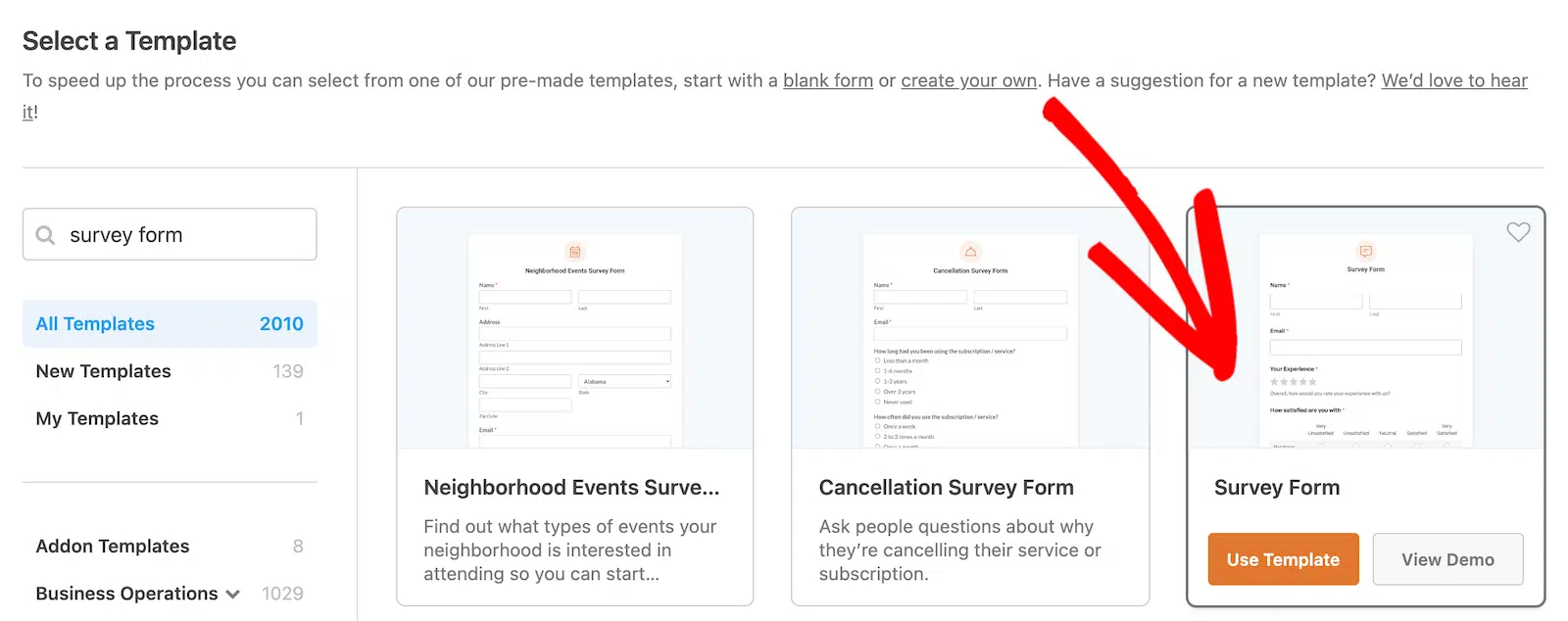
You import it from the form builder and change whatever doesn’t fit your business, so none of this has to be built from scratch.
I tend to start here rather than from a blank form, mostly because the conditional logic on the follow-up questions is already configured and that’s the part that takes longest to wire up by hand.
Here’s what you get when you open it:
- Multiple Choice for how long someone has been a customer
- Checkboxes for which of your products they’ve used
- Likert Scale for the satisfaction and recommendation ratings
- Paragraph Text capped at 300 characters for open comments
- Conditional logic already set on two questions, so the form asks a follow-up only when the first answer warrants it
The Likert Scale and Net Promoter Score fields both come from the Surveys and Polls addon, so you’ll need WPForms Pro for the ratings in this template. If a simple star score is all you’re after, the Rating field is available on Basic and doesn’t need the addon at all.
Every question in the six sections below drops straight into this template, and the table here maps the categories to survey type and field so you can pick without reading all 25 first.
| Question category | Examples | Survey type | WPForms field |
|---|---|---|---|
| CSAT-Style Questions | 1 to 5 | CSAT | Likert Scale, Rating |
| NPS and Loyalty Questions | 6 to 8 | NPS | Net Promoter Score, Likert Scale |
| Customer Effort Score Questions | 9 to 11 | CES | Likert Scale, Rating |
| Product and Service Feedback | 12 to 16 | Diagnostic | Multiple Choice, Checkboxes |
| Customer Service Experience | 17 to 20 | CSAT and CES | Likert Scale, Checkboxes |
| Open-Ended and Follow-Up | 21 to 25 | Qualitative | Paragraph Text |
CSAT-Style Customer Satisfaction Questions
These are the workhorse questions for measuring general satisfaction with a product, service, or interaction. Use them after a key moment in the customer journey, like a purchase, a first login, or the end of a support ticket.
1. How satisfied are you with our product or service?
Now comes the point where you come right out and ask your customers how satisfied they are with their experience. For this, we’re using a Likert Scale for consistency.
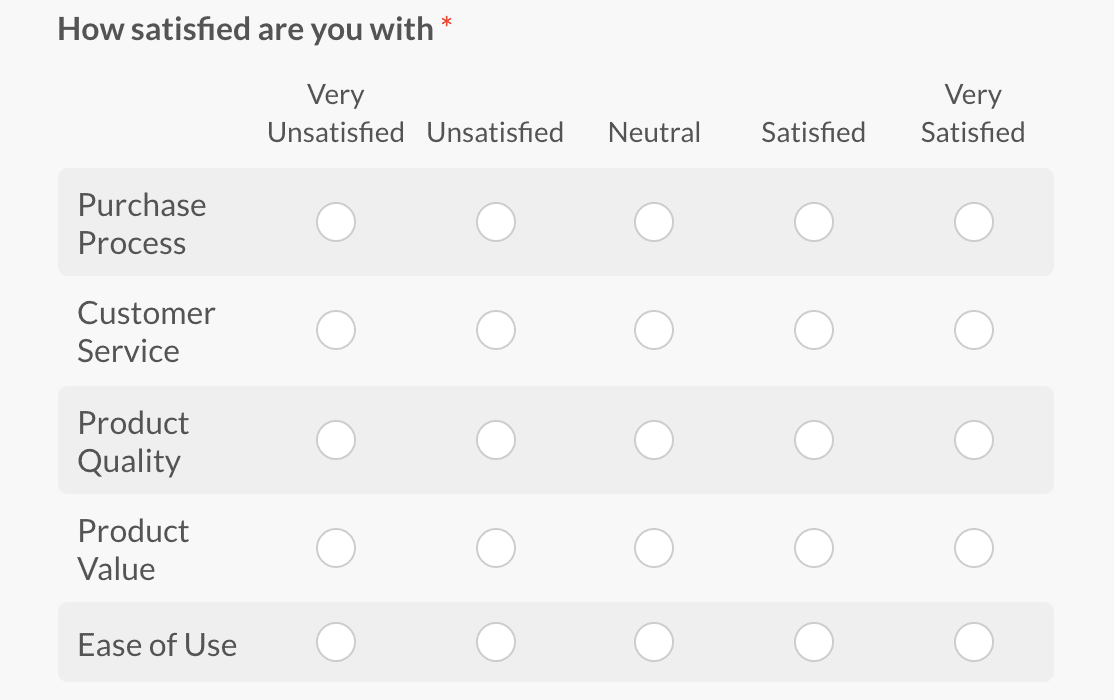
You can ask your customers to rate their satisfaction with any aspect of your business. The Likert Scale is customizable. If it doesn’t make sense for you to ask about the ease of use but you want to know their thoughts on shipping or store cleanliness, you can adjust the form to suit.
Note that you’ll need to install the Survey and Polls addon, which is available in WPForms Pro.
2. How would you rate the overall quality of our product?
This one is narrower than the general satisfaction question because it zooms in on product quality specifically. I like using a 1 to 5 star rating here because it’s fast to answer and easy to chart over time. When the score drops, you can go back to the recent responses and look for patterns in the comments.
3. How satisfied are you with the value for money you received?
Price satisfaction is a different lever than product quality. A customer can love what you sell and still feel the price was too high. Asking about value directly helps you decide whether a price change or a packaging change is what you actually need.
4. How well does our product meet your needs?
This is a fit question rather than a quality question. Sometimes your product is great, but it’s being used by people it wasn’t really built for. If this score is consistently low, you may have a marketing or targeting problem rather than a product problem.
5. How satisfied are you with our website experience?
Your site is often the first touchpoint, so it’s worth measuring on its own. You can pair this with a follow-up asking what slowed them down (navigation, checkout, search, load speed). That’s usually where the real friction lives.
NPS and Loyalty Questions
These questions measure how attached customers feel to your brand and whether they’d actively recommend you. Don’t mix these with CSAT questions on the same form. Loyalty is a bigger commitment than satisfaction, and the answers mean different things.
6. How likely are you to recommend us or buy again?
Likert Scales are great for gathering consistent ratings. That’s why they show up so often in surveys, including our customer satisfaction survey template.
Knowing how likely a customer is to give you repeat business or recommend you to friends and family is another strong indicator of customer satisfaction.
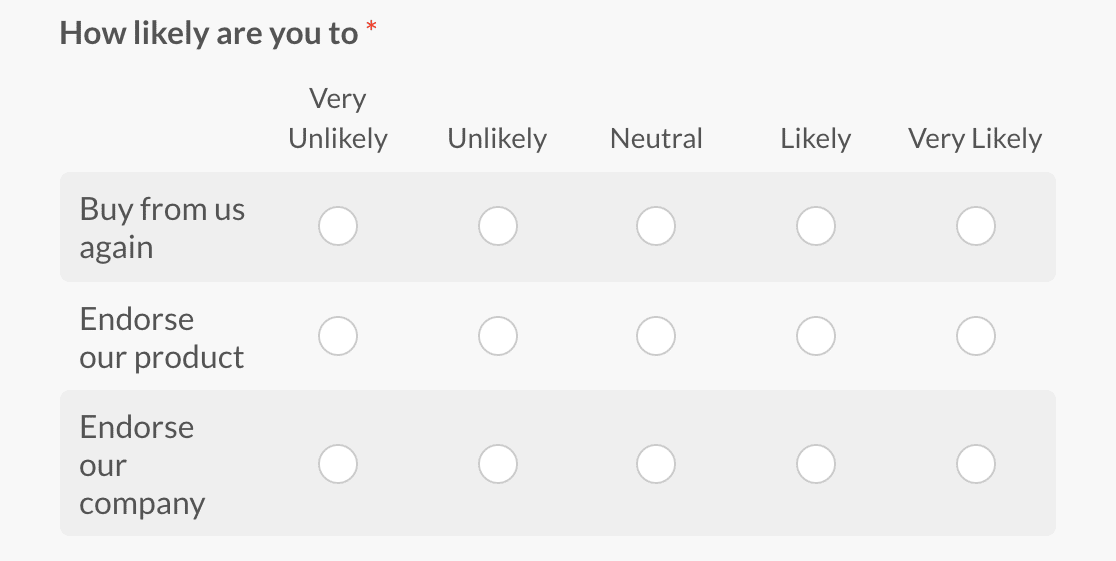
Again, if you find that you’d like the template to dig a little deeper, you can edit it and use conditional logic to ask them for more information if they’re unlikely to recommend you or your products. Satisfied customers make for strong brand ambassadors.
This framing is a lighter version of the classic NPS question. If you want strict NPS scoring, swap the Likert scale for a 0 to 10 number scale and use the formula I shared earlier. Once you have responses, here’s how to calculate your NPS score.
7. On a scale of 0 to 10, how likely are you to recommend us to a friend or colleague?
This is the textbook NPS question. Keep it on its own page or section and don’t combine it with other rating questions on the same form. The Survey and Polls addon in WPForms has a dedicated NPS field that calculates Promoter/Passive/Detractor scores automatically.
8. What’s the main reason for your score?
Always pair the NPS question with this open-ended follow-up. The score tells you what’s happening. The follow-up tells you why. I’ve found this combination gives you more usable data than three or four extra rating questions.
Customer Effort Score (CES) Questions
These measure how hard your customers had to work to get what they came for. Send them right after a support ticket, a checkout, or any self-service task.
9. How easy was it to handle your issue today?
The standard CES question. Use a 1 to 7 agreement scale (“Very difficult” to “Very easy”) or a simple 1 to 5 rating. Low scores mean something in the process is broken, even if the customer eventually got what they needed.
10. How much effort did you personally have to put in to resolve your request?
A slight reframe of the CES question that leans harder into the effort angle. Good for support contexts where you want to separate “the team helped me” from “I had to do a lot myself.”
11. The company made it easy for me to handle my issue. (Strongly disagree / Strongly agree)
The agreement statement variant. Some teams prefer this phrasing because it’s the original wording from the CES research and it’s been shown to correlate well with loyalty.
Product and Service Feedback Questions
These go deeper into specific aspects of your product or service that CSAT and NPS don’t cover directly. Use them when you want diagnostic data rather than a headline metric.
12. How long have you been a customer?
Knowing how long a customer has been with you allows you to do one of 2 things.
- If they’re relatively new, their feedback in the survey gives you insight into what it will take to keep them coming back.
- If they’ve been with you for a while, their feedback can tell you what’s worked well to build that customer loyalty.

The WPForms customer satisfaction survey template gives precise options for customer response. It’s also fully customizable. If you would rather group the response options in different chunks, you can do that by going into the Field Options.
This question uses the multiple choice form field. Not sure which kind of field to use for questions like this? Check out this article on radio buttons vs checkboxes for some tips.
Asking this as the first question helps you to better analyze the responses that follow.
13. How often do you use our product?
Usage frequency tells you how embedded your product is in your customer’s workflow. Daily users give more useful feedback than someone who logged in once and forgot about you. I often filter my survey analysis by this answer first before reading the rest.
14. Which features do you use most often?
Let customers check the boxes. This one is gold for product teams. You almost always learn that the features you spent the most on are used the least, and vice versa.
15. Which of our products have you used?
Knowing whether a customer uses one or several of your products can help you build brand loyalty. If a brand new customer is only using one of your products, how can you make that a great experience so that they want to try more?
16. Did you consider similar products during your research prior to purchasing?
Asking your customers if they considered similar products before purchasing yours is a good way to learn more about their process.
The Customer Satisfaction Survey template is set up with conditional formatting so that if the customer answers “yes” to this question, they’ll be prompted to note which similar products they considered.
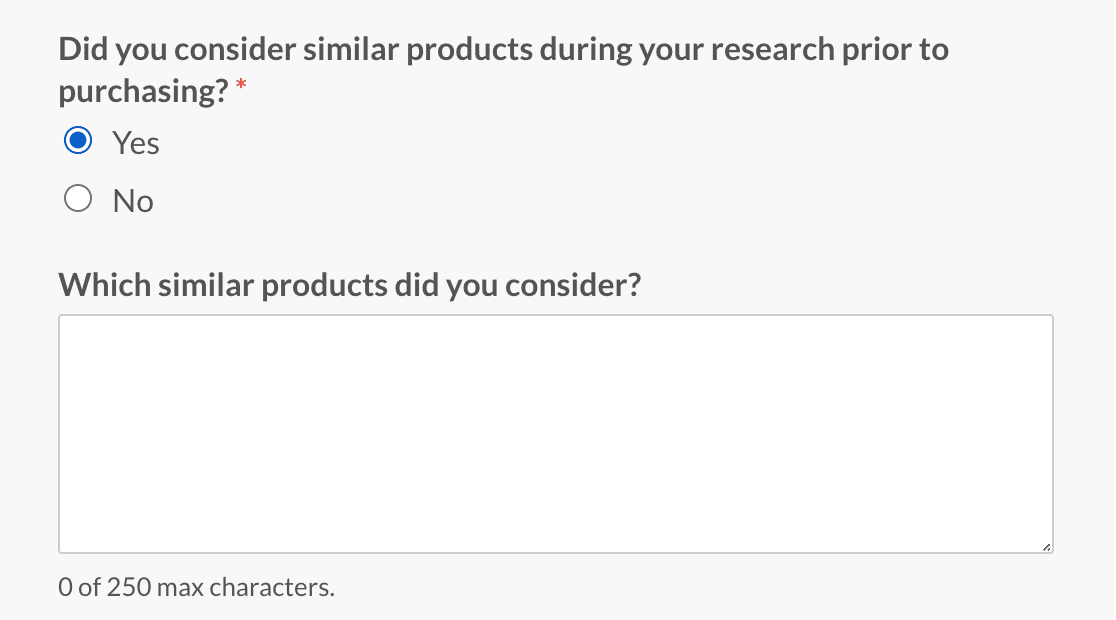
Knowing what other products and services customers researched can also help you identify features they might want. If you want more detailed responses, you can edit this question to also ask why they considered those products.
Customer Service Experience Questions
Service interactions are high-stakes moments. A great support experience can turn a frustrated customer into a promoter, and a bad one can do the opposite in less than five minutes.
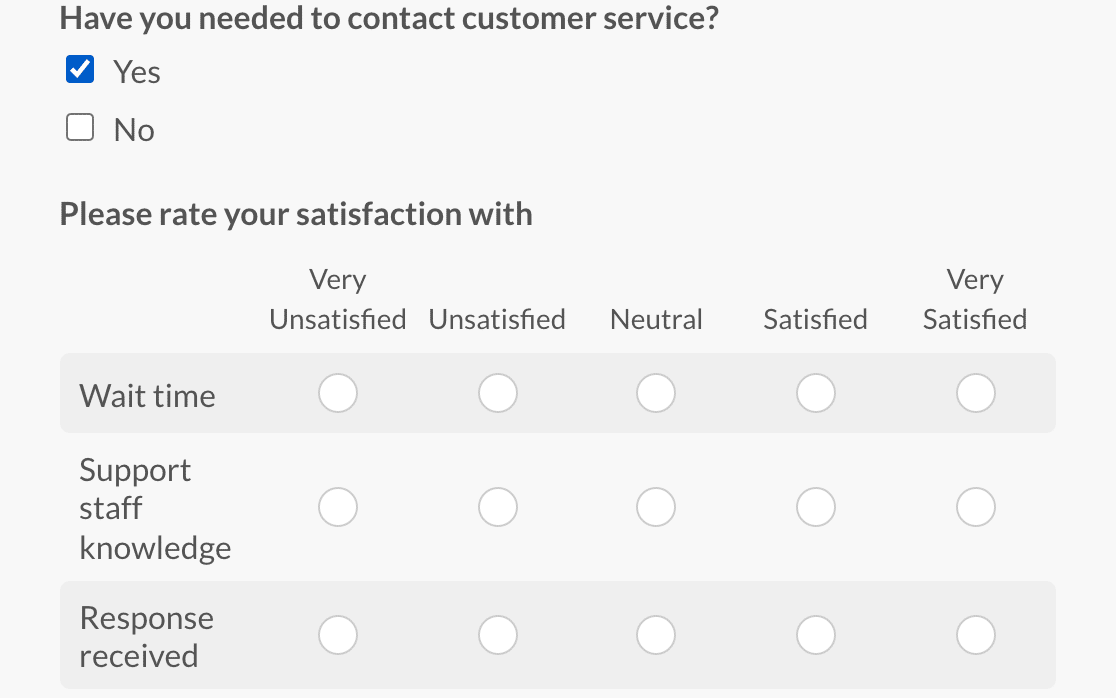
17. Have you needed to contact customer service?
Maybe you have a customer support number or a chat on your website. Maybe you’re just curious to know how the in-store customer service is with your employees. This is another question that can provide additional insight in the context of the customer’s other answers.
18. How would you rate the professionalism of our support team?
Separating professionalism from resolution gives you two data points. A team can resolve issues quickly but come across as cold, or the other way around. If your score splits here, you’ve got specific coaching you can do.
19. How quickly did we respond to your inquiry?
Response speed is one of the biggest drivers of support satisfaction. Ask about it directly so you don’t have to guess from internal logs alone.
20. Did we resolve your issue on the first contact?
First-contact resolution is a metric support leaders track carefully. Asking the customer directly gives you a view your ticket data can’t always show, because some tickets that look “resolved” in the system actually required follow-up emails or a second call the customer made themselves.
Open-Ended and Follow-Up Questions
Closed questions give you numbers you can chart. Open-ended questions give you the language your customers actually use. You need both. I usually add one or two open questions at the end of every survey, right before the thank-you screen.
21. Additional comments or suggestions?
Finish out the survey by asking customers to provide additional comments or suggestions. It gives them a way to cover anything that wasn’t specifically asked in the previous questions.
Maybe they have a great idea for a product feature. Perhaps they’ve identified a flaw that could be fixed. It’s possible they want to give just a little more information about their overall experience, in their own words.
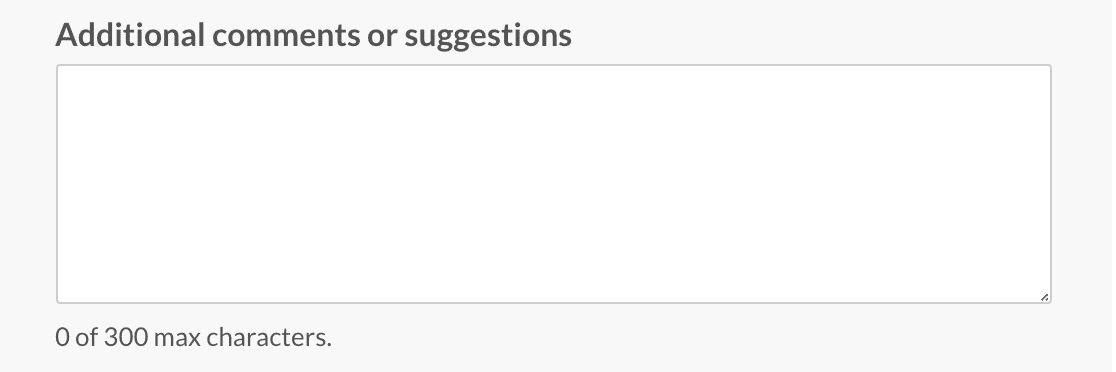
The survey template caps responses at 300 characters. You can increase or decrease that number, or remove the limit altogether. Giving a character limit helps to keep feedback concise.
22. What’s one thing we could improve?
One specific thing. That constraint matters. “Tell us what you’d improve” gets you “everything’s great, thanks” from half the responses. Asking for one thing forces a real answer and often surfaces the exact issue you hadn’t thought of.
23. What made you choose us over alternatives?
This question pairs well with example 16 (the “did you consider similar products” question). Comparing the two answers tells you which of your real differentiators are actually landing with buyers versus which are mostly internal marketing talk.
24. What almost stopped you from buying?
This is one of my favorites because it surfaces friction you’d never see in happy-path data. Customers who did buy still had doubts, and those doubts are probably stopping other customers who didn’t buy. Treat this as a treasure map for your conversion rate.
25. Is there anything else you’d like us to know?
The catch-all. Keep this optional. Not every response needs a novel, but every so often someone writes a comment that changes how you think about the product. Those are worth collecting.
How to Create a Customer Satisfaction Survey in WordPress
The fastest way to build and publish a customer satisfaction survey on a WordPress site is with WPForms and the Surveys and Polls addon. Here’s the short version of the workflow.
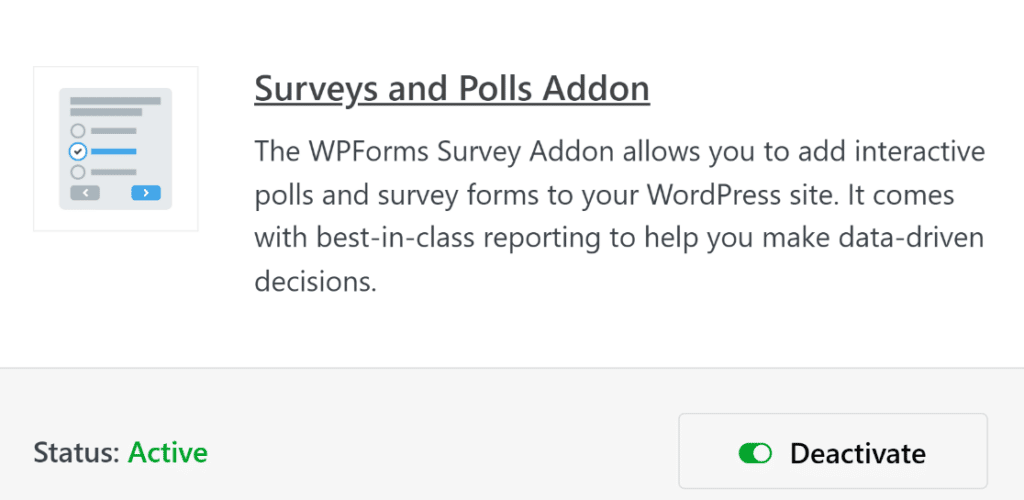
Step 1: Install and Activate the Surveys & Polls Addon
From your WordPress admin, go to WPForms » Addons. Find the Surveys & Polls addon and click Install. Once installed, click Activate.
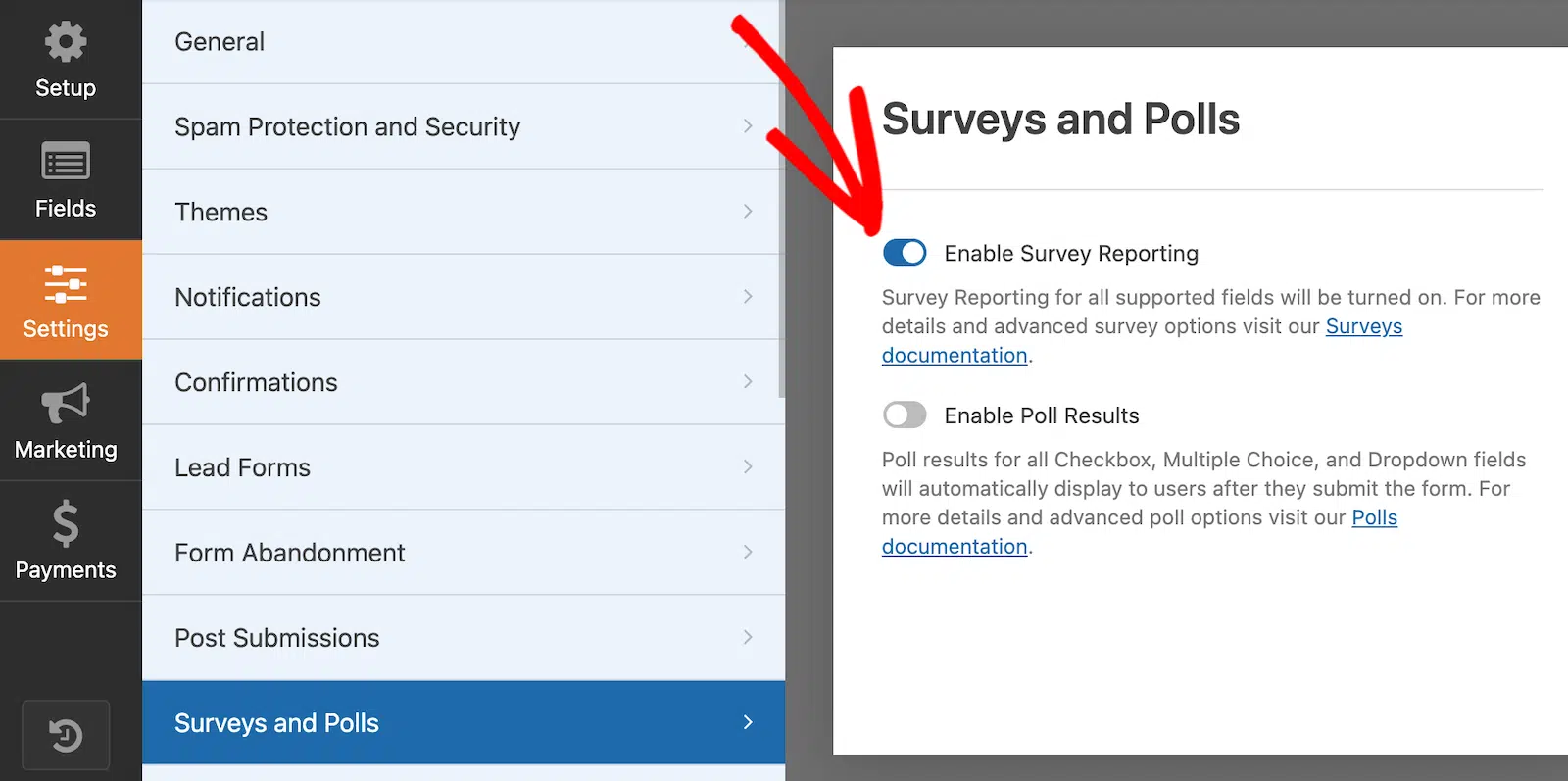
Step 2: Enable Survey Reporting on Your Form
Open any existing form in the WPForms form builder. Go to Settings » Surveys and Polls and Polls. Toggle on Enable Survey Reporting and save your form.
For a full walkthrough of the process from scratch, here’s how to create a survey form in WordPress step by step. And for deeper configuration, the Surveys and Polls addon page covers every feature in the addon.
Best Practices for Customer Satisfaction Surveys
Good survey design is the difference between 5% response rates and 40% response rates. Here are the habits that consistently work well for me.
- Send surveys at the right moment. Right after a completed purchase, a closed support ticket, or the end of onboarding. Wait a week and the memory fades.
- Keep it short. Under 10 questions for most use cases. One question is fine for a post-interaction CSAT. Long surveys kill response rates.
- Lead with easy questions. Start with simple ratings or multiple choice. Save open-ended questions for the end so people don’t abandon early.
- Use consistent scales. If question 1 is a 1 to 5 rating, don’t make question 4 a 1 to 10 rating. Consistency makes the survey faster to fill out and the data cleaner.
- Avoid leading questions. “How amazing was your experience?” isn’t a survey question, it’s a press release. Ask neutrally and let customers tell you what they actually think.
- Always follow up. A customer who took the time to answer deserves a response, especially if the score was low. Even a short “thanks, here’s what we’re doing about X” email can turn detractors into promoters.
For more question ideas outside of customer satisfaction specifically, we’ve got a longer list of survey questions by use case.
FAQs on Customer Satisfaction Surveys
Customer satisfaction survey examples and templates come up often in our support queue. Here are the questions that come up most.
What questions should I ask in a customer survey?
A good customer survey asks focused questions about specific areas of your business. These usually include questions about your customer’s opinion of your products, pricing, quality of customer support, and whether they’re likely to recommend you to their friends or purchase from you again.
When creating a customer survey, be economical with your questions. Make sure the questions you’re asking are going to get you the most valuable information and insight.
What are the 3 types of customer satisfaction surveys?
The three most widely used customer satisfaction survey types are CSAT (Customer Satisfaction Score), NPS (Net Promoter Score), and CES (Customer Effort Score).
CSAT measures satisfaction with a specific interaction or product. NPS measures overall brand loyalty and likelihood to recommend.
CES measures how easy it was for a customer to accomplish what they came to do. Most mature customer experience programs use all three together.
How long should a customer satisfaction survey be?
For post-interaction surveys, one question is ideal. For relationship surveys sent a few times a year, under 10 questions is the sweet spot. Response rates drop noticeably past that. If you need more data, split it into two shorter surveys sent at different times rather than one long one.
How can I get more people to fill out a customer satisfaction survey?
Keep the survey short, send it at a relevant moment, and make sure the first question is easy to answer. Email works well when you have a customer list, and an in-page embed captures people while the experience is fresh. A short subject line that promises how long the survey takes (“2 minutes, 5 questions”) usually beats one that promises a reward.
How can I measure the results of my customer survey form?
Using the WPForms Surveys and Polls addon, you can view the results of your survey in graphical form with easy-to-understand charts.
These charts allow you to see overall scores for each question, giving you insights into what your customers really think about your products and services.
Next, Collect Better Feedback With a Customer Feedback Form
Customer satisfaction surveys are just one part of a bigger feedback loop. If you’re looking to go wider, customer feedback forms cover everything from unstructured ideas to bug reports to product requests.
Learn how to add a customer feedback form to your WordPress site and pair it with the satisfaction survey examples above for a complete picture of how customers feel.
You can also take a look at related guides to strengthen your feedback program.
- How to create an NPS survey in WordPress
- How to create surveys that show one question at a time
- Exit survey questions to ask your customers
Create Your Customer Satisfaction Survey Now
Ready to build your customer satisfaction survey form? Get started today with the easiest WordPress form builder plugin. WPForms Pro includes the Surveys and Polls addon, 2,100+ free templates, and offers a 14-day money-back guarantee.
If this article helped you out, please follow us on Facebook and Twitter for more free WordPress tutorials and guides.