


AI Summary
Almost every Contact page on the web puts visitors in front of the same small decision. Fill out the form, or copy the email address into a fresh tab.
The page looks like it’s offering one path forward, but it’s quietly asking the visitor to choose between two very different ways to start a conversation.
That choice matters more in 2026 than it did when this debate first started. AI form fillers complete contact forms in seconds, spam patterns have shifted as bots get smarter, and rotating email aliases get easier.
When both options are on the page, 67.3% of people pick the email address. So which one belongs on your contact page now, and is this even a one-or-the-other question anymore?
Contact Form vs Email Address: Which Is Better in 2026?
The realistic answer from the form-builder side is that it depends on what you’re trying to do, and the strongest contact pages today often include both.
A contact form gives you spam protection, structured information, and automation. An email address gives you trust, simplicity, and a familiar way to reach a real person.
The cleanest pages now lead with a form for structure and include an email address for visitors who’d rather skip it. Here’s how the two stack up across the dimensions that usually drive the decision.
| Dimension | Contact Form | Email Address |
|---|---|---|
| Spam exposure | Low with proper protection | High when published openly |
| Inbox organization | Structured, filtered, tagged | Mixed in with personal mail |
| User trust on first visit | Lower (looks like a barrier) | Higher (feels like a real person) |
| Sender keeps a copy | No, unless you build it | Yes, in their Sent folder |
| Setup effort | Minutes with a form plugin | Seconds, just paste an address |
| Conversion paths | Many (lead capture, automation, CRM sync) | None built-in |
| Best for | Lead capture, structured info, team routing | Trust signals, personal contact, accessibility fallback |
Understanding Contact Form and Contact Email Address
Before getting into the case for each, it’s worth defining the terms cleanly. These two phrases get used interchangeably, and that’s part of what makes the “which is better” question confusing.
What is a Contact Form?
A contact form is a structured set of fields embedded on your website that visitors fill in to send you a message. The fields usually cover name, email, subject, and message, but you can ask for whatever you need.
When a visitor hits submit, the form sends you a notification (usually as an email to your inbox), saves the entry to a database, and can trigger anything else you’ve connected to it.
Modern WordPress contact forms include spam protection, conditional logic, CRM integrations, and analytics by default. The visitor never sees your real inbox address, which is a meaningful security win on its own.
What is a Contact Email Address?
A contact email address is a published email like [email protected] or [email protected] that you display directly on your website for visitors to write to.
The sender opens their own email client, types their message, and hits send. Many small business sites still use a free Gmail address or a business email address routed through Google Workspace.
Anyone who can see your contact page can copy that address and use it. That’s the strength and the weakness, because the form lets you control the conversation’s shape, while the email address gives the conversation away to the visitor’s preferred client and pace.
When a Contact Form Wins
There are situations where the contact form is the better tool, and most of them come down to volume, structure, or the need for some automation downstream. The five themes that come up most often when teams choose forms are below.
Stronger Spam Protection (and yes, even in 2026)
This is the reason most people lead with, and it’s the most misunderstood.
Publishing an email address openly hands it to scrapers within hours. Bots harvest the address and feed it into spam lists, phishing campaigns, and scam outreach.
A contact form doesn’t expose any address publicly. The form processes the submission server-side and then sends you a notification.
That said, an unprotected form isn’t automatically safe either, because spammers also target forms by submitting through automated scripts.
The difference is that modern form builders give you multiple layers of defense that you can’t really apply to a plain mailto link.
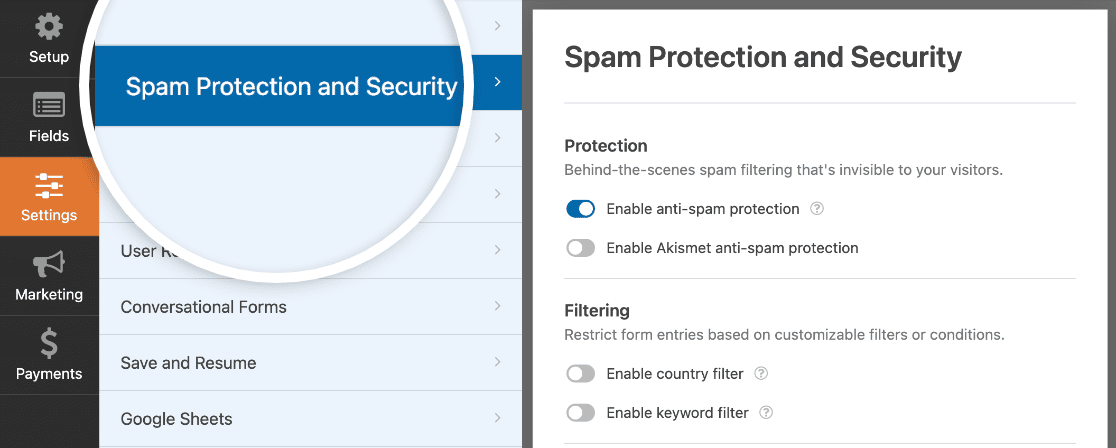
WPForms spam protection layers invisible CAPTCHAs, token validation, allow/deny lists, and country-level filtering at the Basic tier and up.
If you want to go deeper into form-side protection without resorting to CAPTCHAs that hurt UX, our guide on how to take extra measures to prevent spam walks through the modern stack.
One interesting recent finding from independent bloggers is that well-protected forms don’t actually attract more spam than exposed email addresses do.
The volume comparison is roughly even once both sides have proper filtering. The real win for forms is that you can centralize that protection in one place instead of fighting spam in your inbox.
A More Professional, Branded First Impression
A contact form looks like part of your site, as the fonts, colors, and spacing match your design.
A submission triggers a customizable confirmation message instead of dropping the visitor into their default email client mid-flow.
For business sites, that consistency reads as a sign of intention.

On the back end, the notification email the visitor receives is also under your control. You can set a custom From Name, From Email, Subject line, and template, so the auto-reply looks like a real message from your business instead of a generic plugin output.
The form’s powerful form styling features let you push the visual consistency further on the front end too. The same of course isn’t really possible with a mailto link.
The visitor lands in their own email client with a blank message and your address in the To field. Whatever happens after that is on them, and the experience is identical across every site that publishes an address.
Smart Routing and Team Coordination
A growing inbox is hard to scale across a team. Multiple people forward the same message, and sales replies step on support replies. A contact form solves this at the source by deciding ahead of time where each submission goes.
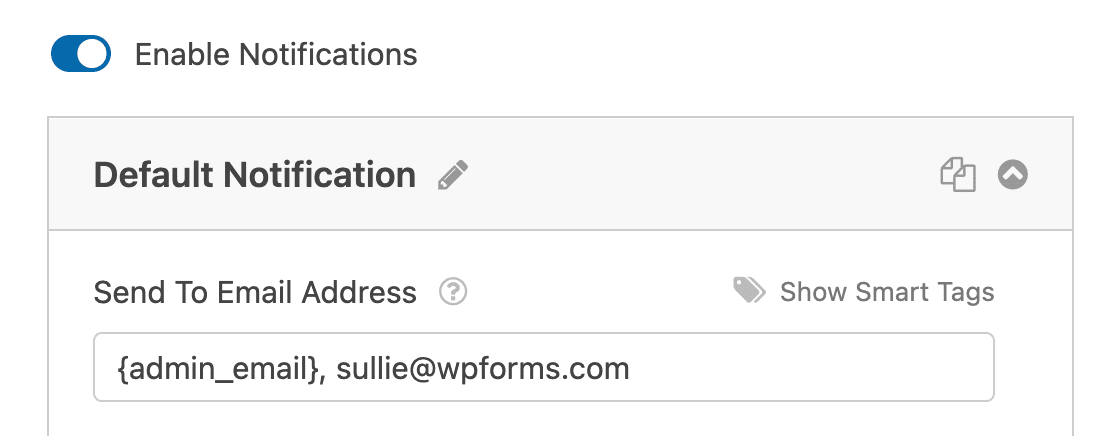
In WPForms you can set up multiple notifications per form so the same submission lands in different inboxes.
Even better, you can customize who receives each message based on what the visitor selected in the form. Someone choosing Sales question goes to one address, Tech support goes to another, and Billing goes to a third.
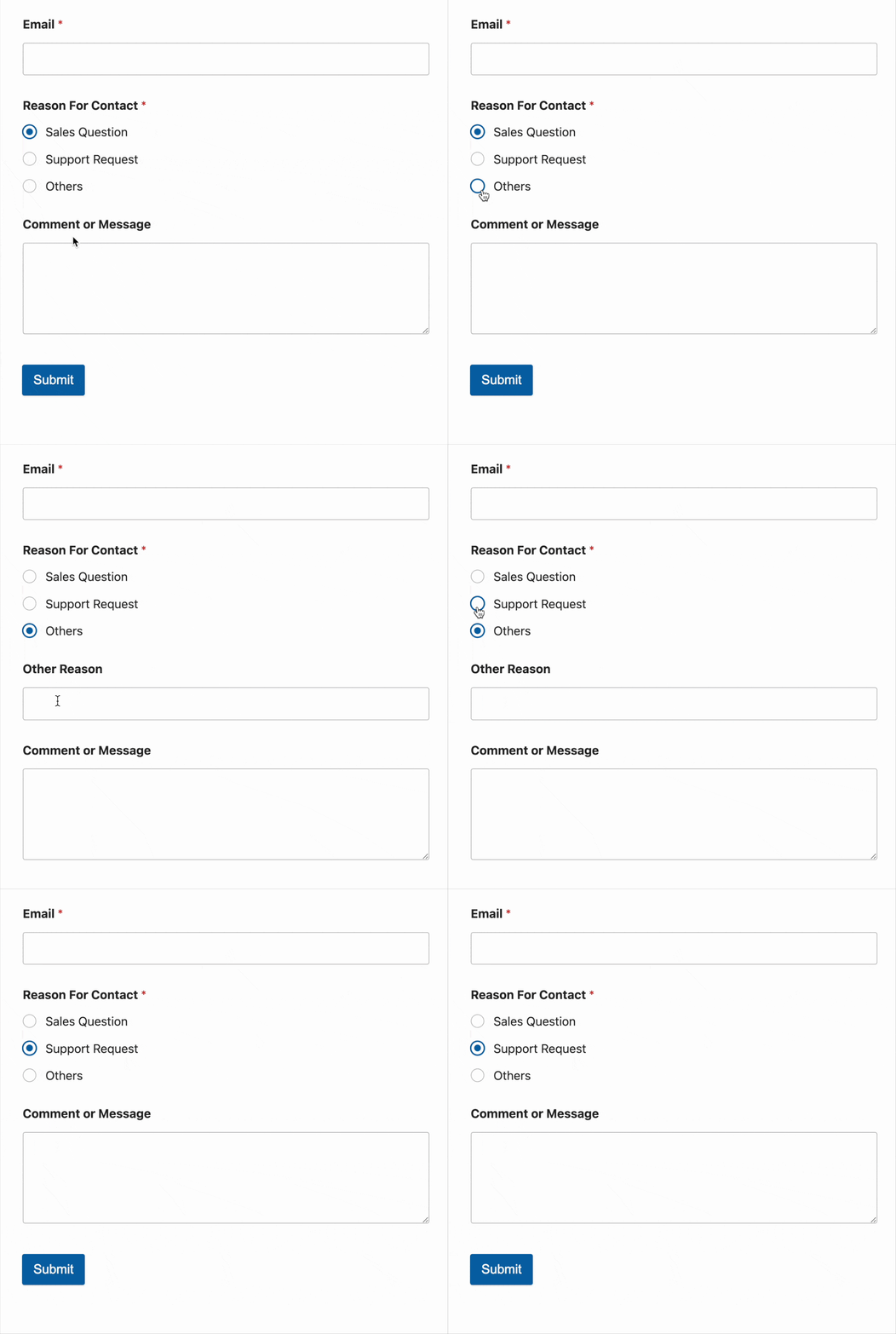
You can use conditional logic to show or hide fields based on the visitor’s answers, and that same logic can drive where the message goes, who’s CC’d, and what auto-reply they receive.
Doing any of this with a plain inbox means either a lot of folder rules or forwarding everything to a manual triage step.
Better Records, Search, and Tracking
If you only have an email address on your contact page, every conversation lives in your inbox. That works fine until you want to look something up six months later, run a report, or hand a question over to a teammate who wasn’t on the original thread.
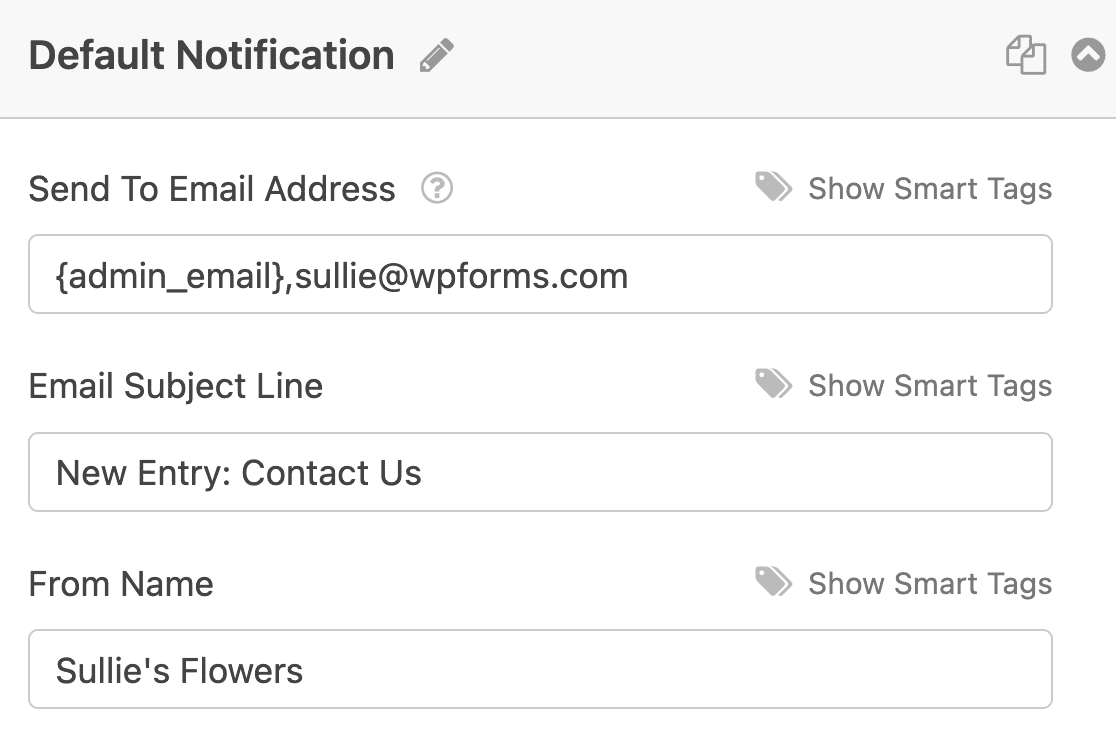
With a contact form, every submission is stored as a structured entry. You decide what the subject line of the notification reads, so messages are easy to scan in your inbox.
You also keep the original entry inside WordPress, which is searchable, exportable, and isn’t going anywhere if your email account changes.
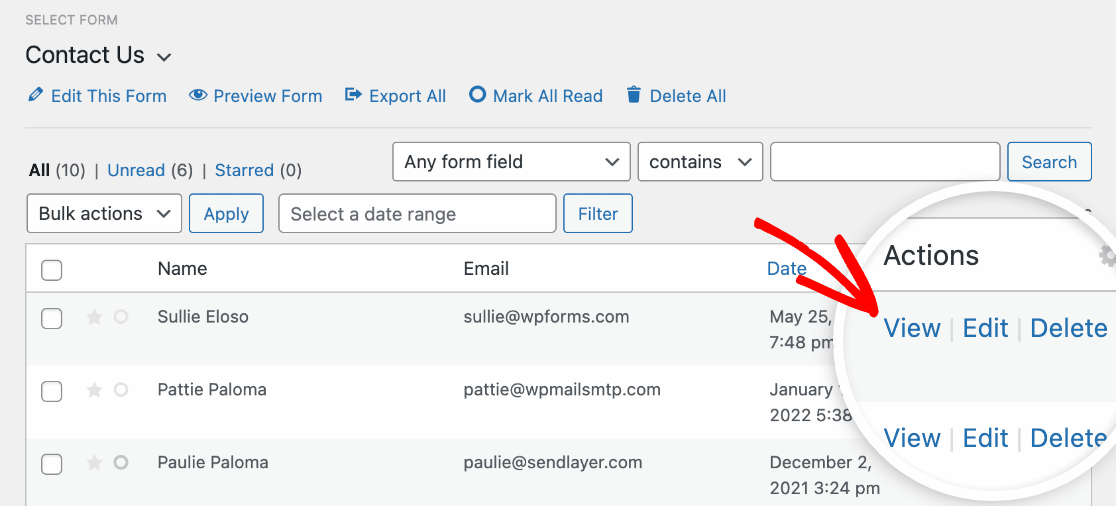
The entry view inside WordPress shows the visitor’s responses field by field, when they submitted, what page they were on, and any notes your team has added.
That’s a much faster way to handle “what did this person originally ask?” than scrolling through email threads.
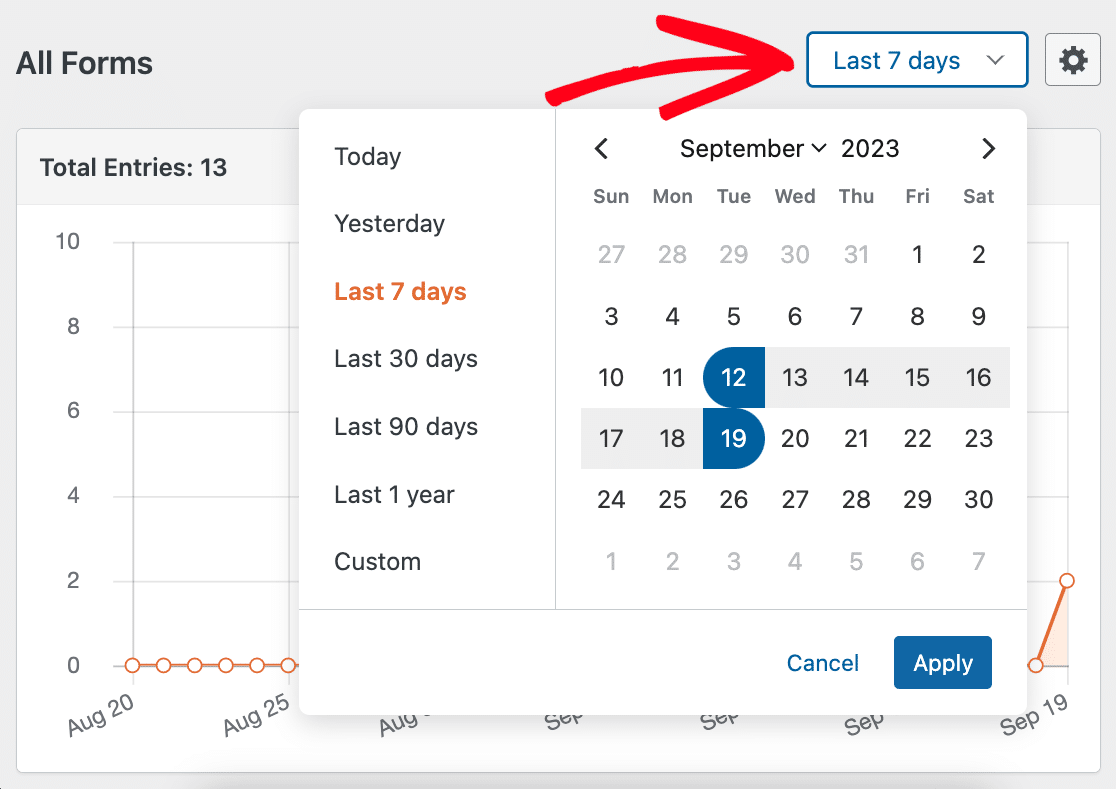
You can also filter entries by date range, status, or custom field. Tracking how many contact requests came in last month, or which type of inquiry is growing, takes a couple of clicks instead of a manual count.
Integrations and Automation Email Can’t Match
A plain email goes to your inbox and stops there. A contact form submission can do quite a bit more on the way.
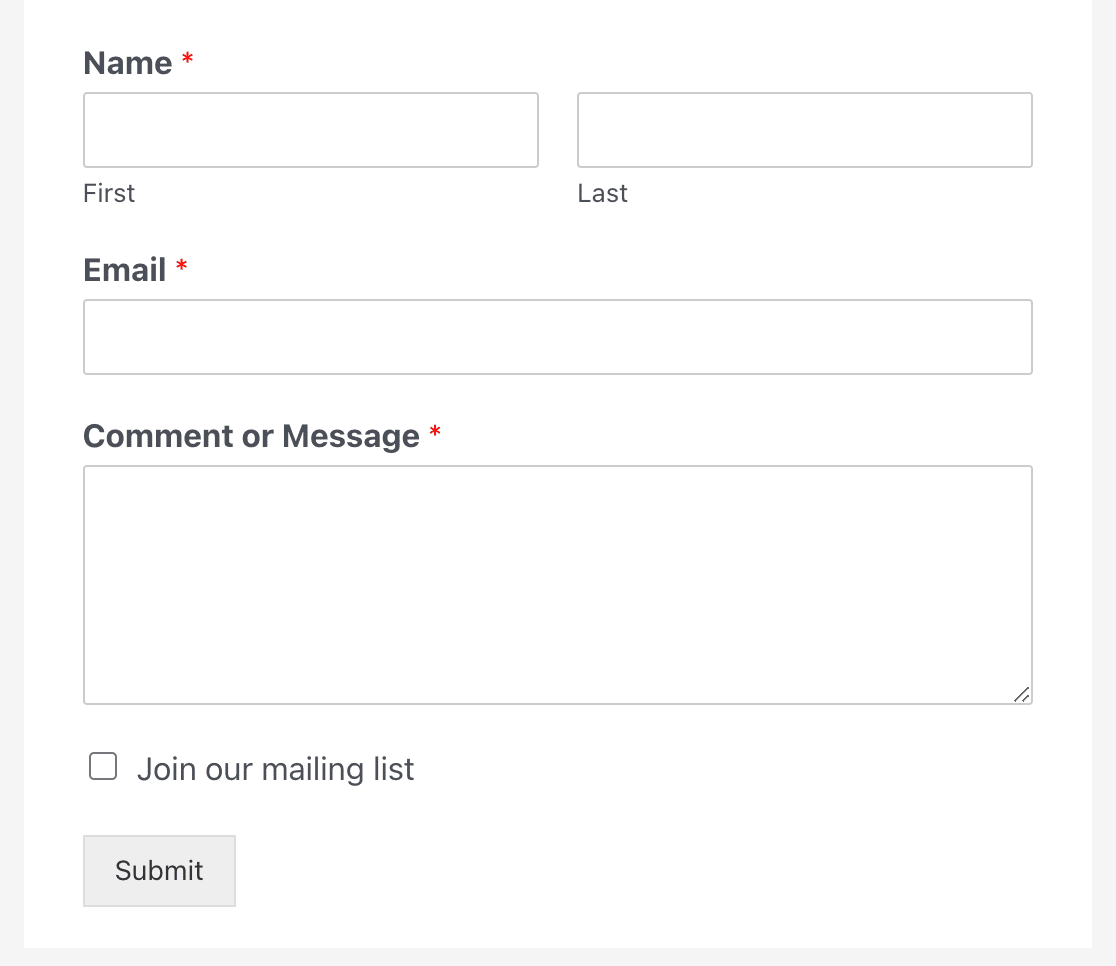
If the visitor checks a Subscribe me to your newsletter box, the form can add them to your email list automatically through any of the popular email marketing services.
The same submission can create a CRM contact, fire a Zapier or Make automation, route to Slack, post to Notion, or sync to a Google Sheet, all without anybody on your team copying and pasting data.

For higher-intent contact pages, you can swap the standard form for interactive lead forms that break the questions across steps with progress indicators.
Multi-step forms typically convert better than long single-page forms because each step feels lighter than the whole. Email addresses simply can’t carry any of this kind of automated workflow.
Why Most Sites Should Use Both
The contact-form-or-email debate is mostly a false binary, and the cleanest contact pages I see in 2026 give visitors both options.
Lead with the form because it filters spam, captures structured information, and gives you the data layer to follow up well. Include the email address visibly below it, or in the page footer, for visitors who prefer to write on their own terms.
A simple rule of thumb works here. If your contact page is doing one job (let people get in touch), offer both and let visitors choose.
If your contact page is doing two jobs (let people get in touch AND capture leads for marketing follow-up), the form is the workhorse and the email address is the trust signal.
If the page is mostly about credibility (a freelancer or specialist who replies personally), the email address can lead with the form as a fallback.
FAQs About Contact Forms vs Email Addresses
Contact form vs email address is one of the longest-running debates in WordPress contact page design. Here are the questions that come up most often when people are deciding between the two, with answers grounded in current UX research and the form-builder side of how these tools actually work.
Do contact forms reduce spam?
Yes, in most cases. A contact form hides your inbox address from public scraping, which kills the most common source of spam. The form itself can still be targeted by automated scripts, but layered defenses like invisible CAPTCHAs, token validation, and allow/deny lists block most of that traffic.
If your form is sending notifications but they keep landing in junk, that’s usually a deliverability issue rather than a spam-volume issue. Our guide on where contact form emails go to spam covers the fixes.
Why don’t people trust contact forms?
The two most common reasons are uncertainty and a lack of feedback. A visitor fills out the form, hits submit, sees a “Thanks, we’ll be in touch” message, and then has no way to verify the message actually went anywhere.
There’s no Sent folder, no read receipt, no thread to follow up on. Older or poorly designed forms also fail silently when something breaks, and the visitor never knows. You can soften this by sending an immediate auto-reply email that confirms the submission and sets clear response-time expectations.
Should I use a contact form, email, or both?
Most sites should use both. Lead with a form for spam filtering, lead capture, and routing. Include an email address as a backup for visitors who prefer it, who hit form errors, or who need an option that works without JavaScript.
The exception is a high-credibility solo site (freelancer, specialist) where the email address itself is the trust signal. There, you can lead with the email and offer the form as a fallback.
Are contact forms better for SEO than email addresses?
Contact forms and visible email addresses are roughly equivalent for SEO directly. What matters more is whether your contact page itself loads quickly, displays clear contact information, and signals trust through schema markup and consistent NAP (name, address, phone) data.
Google’s helpful content systems care about whether the page actually helps visitors get in touch, not which specific method you offer.
What information should a contact form collect?
Keep it short. NN/g’s research recommends three to five fields for general contact forms. Name, email, subject or category, and the message itself is usually enough.
Asking for phone numbers, addresses, or company sizes up front tends to lower submission rates without improving the quality of what comes in. Add more fields only when you genuinely need that data for routing, qualification, or compliance.
Next, Build a Smart Contact Form with WPForms
If you’ve decided to add a form to your contact page, the build itself is one of the lighter lifts in WordPress.
WPForms is what I reach for here, as even the free version handles a standard contact form with built-in spam protection, and you can scale up to conditional logic, multiple notifications, and CRM sync as your needs grow.
If you’d like a step-by-step walkthrough, our guide on how to create a contact form covers the build end to end. If you’re still picking a plugin first, our roundup of the best free contact form plugins compares the realistic options.





I run a web site which is a basically a portal for third parties to show hire space. Prospective renters can contact these space owners direct using our contact forms but we have found that some service providers are blocking or dropping the emails. iCloud and virgin media being 2. How can avoid this happening?
Hi Mike,
If you’re having issues with email notification deliverability, we’d recommend installing and using the WP Mail SMTP plugin. Often times email notifications can either be filtered out as spam or are blocked entirely from being sent. The WP Mail SMTP will help with authenticating these emails to allow them to be sent through and avoid missing any important messages. For more information, please check out our WP Mail SMTP setup guide.
I hope this helps! 🙂
Keep up the great work, I read a few content on this site and I believe that your site is very interesting and contains sets of fantastic information.
Hi! Thanks for your feedback!
We are glad to hear that you like what we do here.
Have a good one 🙂
I stumbled upon this page because of my frustration with contact forms. I have multiple inquiries off our website go to our junkmail and I have the majority of our replies go to prospective costumer’s emails. You guessed it, I’m using WPforms. I’ve set up SendGrid, given WPforms access to our backend WP sites and still haven’t resolved the problem. I figured spending the money on a professional form service would negotiate some of these issues and it has not. It has been incredibly frustrating, I’d rather filter through some spam then have to deal with this again.
Hey Tom – Sorry for the trouble you are facing. If you are using Sendgrid, and still emails are going to Junk, that means you should contact Sendgrid support because emails will be going to Junk if the sending IP is somehow marked as spam on various email servers. In that case, Sendgrid might change the IP for you or help to troubleshoot it further. If all other types of emails are going fine via Sendgrid and just form notifications are going to Junk, I would suggest contacting our support team for further help.
If you are a paid user, you can create a ticket here or if you are using Lite version we provide complimentary support here
I see you mentioned that you contacted our team already, I could not find any ticket with your name and email address though. Maybe, after contacting Sendgrid support, you can post back on your existing WPForms ticket with all the findings and our team can help further?
Thanks 🙂
we don’t have an email address @ourdomain.com – how can we use a contact form with an outside email address like [email protected]?
Hi Laurie,
In that case, feel free to add your email address in the “Send to Email Address” field under the Notification Settings. Please refer to this guide for more details.
Thanks 🙂
I am having nothing but nightmares with my form. When the spammer contacts me via the form, the email comes to me from my website via, ME!! Not via the senders email… because the form is hosted on my website, my website sends it to me, which is me.
So when I report it as phishing, I’m actually reporting myself.
Installing captcha helped for about an hour.
I have received over 100 spam emails today alone and they’re still coming… from the same sender with slight variations in their email.
This is horrible and was the reason I left WordPress in the first place.
Using your email is a horrible idea.
Using forms is a horrible idea.
In 2024 this is ridiculous!
I’m so frustrated.
Hi Sherry, I’m sorry you had to experience spam entries on your site.
If it helps, you can integrate our Custom Captcha solution to improve your form’s security. Also, you can add the sender to your denylist to prevent emails from such addresses. Our guide on preventing spam in WPForms explains all the steps in detail.
“This means you’ll likely be messaging people back to request more information.”
For me, this is a bigger issue with most contact forms than regular email, and the reason is that many if not most contact forms don’t allow attachments like screenshots. Website issues are a huge reason for contacting companies, and a screenshot often makes it infinitely easier to explain the issue. In some cases, it’s basically impossible to explain the issue without a screenshot. This annoys some customers enough that they look elsewhere for what they want. Since many contact forms do include an attachment option, I can’t imagine it’s that difficult or to include one. But you don’t even mention attachments except in the context of why they’re dangerous is standard email:
“You’re also vulnerable to receiving malicious attachments that could jeopardize the security of your whole company.”
Since many contact forms do include an attachment option, I can’t imagine it’s that dangerous to include one.
Hi Thomas,
Thanks for your feedback! You’re absolutely right – attachments like screenshots can be incredibly helpful for certain inquiries.
The good news is that WPForms makes it easy to add a File Upload field to your contact forms. This allows your visitors to safely attach images, documents, or other files. You have full control over the allowed file types and sizes to maintain security. Please check out our guide on File Upload Field for all the details.
Hope this helps. Thanks!