


AI Summary
Are you looking to add a contact form on your WordPress website? If so, you might be wondering whether to use the popular contact form plugin WPForms or the Mailchimp Form Builder that comes with your Mailchimp account.
In this article, we’ll compare both WPForms and the Mailchimp Form Builder so you can decide which one is the better option for you.
The criteria we’ll use to evaluate are:
- Ease of Use
- Features
- Support
- Price
Quick verdict: WPForms wins all four categories. The Mailchimp Form Builder is fine for a basic signup form, but WPForms gives you an easier builder, more features, real support, and better value as your site grows.
So, let’s take a look at each and see how they stack up against each other.
Ease of Use
Mailchimp is one of the most popular and highly reliable email marketing services on the market today. And there are plenty of ways to connect it to WordPress, including the Mailchimp addon for WPForms.
So, it should come as no surprise that people using Mailchimp to grow their email lists would think that using the built-in Mailchimp Form Builder would be the easiest way to build contact forms on their WordPress sites.
In fact, you can create signup forms, embedded forms, and subscriber popups right from your Mailchimp account. You can also create a signup form using one of Mailchimp’s integrations.
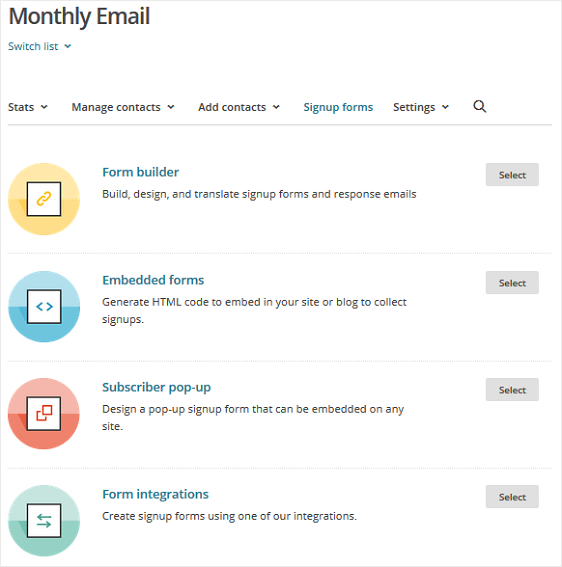
Once on the form builder screen, you can choose from the types of forms or response emails you want to create before you actually build your form.
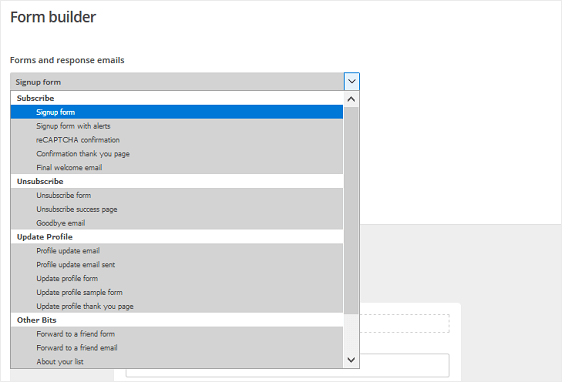
To customize your signup form, you’ll need to follow Mailchimp’s progress bar, Build it » Design it » Translate it.
Unfortunately, there are a limited number of form fields and the design section will apply all changes you make to your form to your other pages and response emails.
Worse yet, according to Mailchimp, customizing the style of your forms may require HTML experience or a developer or Mailchimp expert. In addition, to embed the form onto your site, you have to experiment with the HTML code to make sure your form appears on your site the way you want it to.
WPForms on the other hand, is a user-friendly WordPress contact form plugin that puts usability first so people of all skill levels needing any kind of form will be able to easily create, customize, and embed forms on their sites.
And anyone can use the free version, WPForms Lite.
To start, WPForms comes with a library of pre-made form templates, over 2,100 of them on paid licenses, to help you build all kinds of forms.
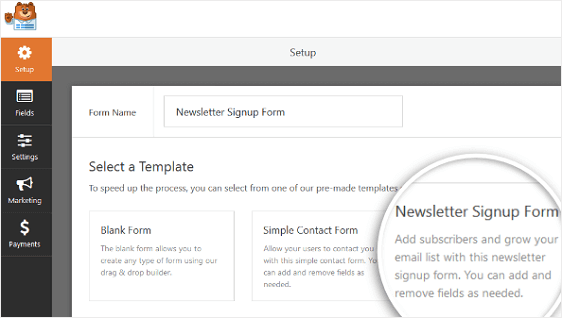
For example, create a simple contact form, user registration form, poll or survey form, and even a donation form using the ready-made templates.
From there, adding new fields, changing the order, and customizing them are all done using a simple drag & drop interface. And if this is your very first form, the guided onboarding wizard added in WPForms 2.0 walks you through setup from install to publish.
No HTML skills are needed to design your forms and there are plenty of standard and fancy form fields to add.
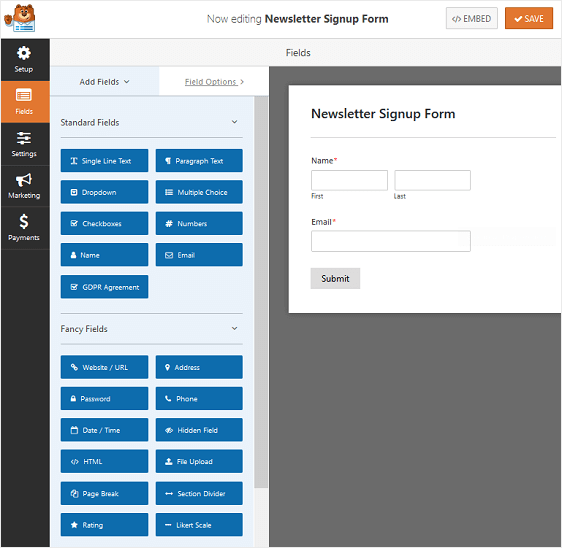
If you’re looking for a contact form plugin that’s easy to use, works right out of the box, and doesn’t require the help of a professional, WPForms is the way to go.
Winner: WPForms
Features
The Mailchimp Form Builder offers very little by way of features, especially because most of the features you might want to add to your form require coding experience.
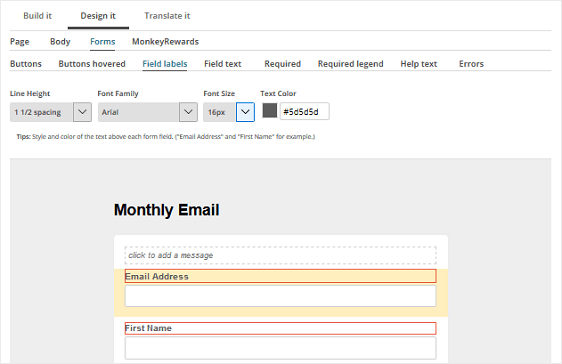
That said, you can change some things using the Design tab in the form builder. For example, customize the font and button sizes, background and colors, and form field text.
When it comes to WPForms, there is no shortage of features. In fact, even WPForms Lite has more features than the built-in Mailchimp Form Builder, including an AI form builder that creates a working form for you when you describe what you need.
But if you’re looking for more, you can upgrade to a paid version of WPForms and access neat features like:
- Smart conditional logic
- The ability to create multi-page forms
- GDPR enhancements to help create compliant forms
- Instant notifications and confirmations
- The ability to collect payments with Stripe, PayPal Commerce, and Square
- WPForms Analytics, which tracks form views, conversion rates, and abandonment right in your WordPress dashboard (new in WPForms 2.0, available with a Pro license)
- Spam protection
- And so many more
Just note that the Mailchimp addon itself, the one that sends your form entries straight to your Mailchimp audience, requires a WPForms Plus license or higher. WPForms Lite beats the Mailchimp Form Builder on form building, but it won’t manage your Mailchimp subscriber list for you.
If features are what you’re after, clearly WPForms is the winning option.
Winner: WPForms
Support
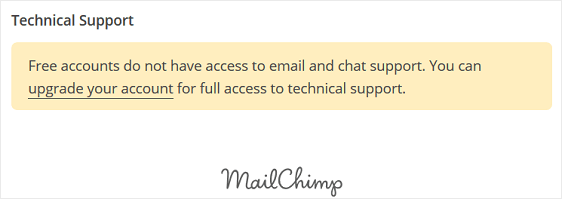
If you have a free Mailchimp account, you’ll get email support for your first 30 days. After that, you’ll have no access to email or chat support, and you’ll need to rely on the self-service Help Center.
WPForms on the other hand, offers a support ticket system for customers on every paid license, plenty of in-depth documentation outlining how to configure settings, a regularly updated blog for tips and tricks, and official tutorials with step by step instructions so you always know what you’re doing.
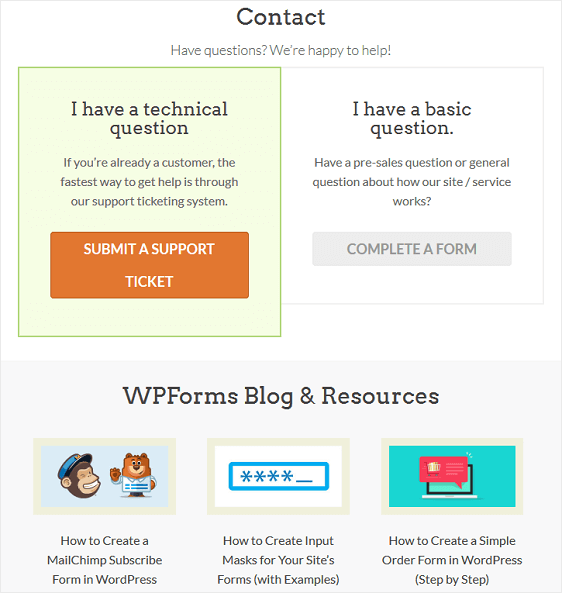
For times you need help, or want to learn more, take advantage of the exceptional support WPForms offers users.
Winner: WPForms
Price
Both the Mailchimp Form Builder and WPForms Lite are free to get started.
However, Mailchimp’s free plan has shrunk quite a bit over the years. As of February 2026, it’s capped at 250 contacts and 500 email sends per month. So if you want to grow your list beyond that, no matter what solution you use to create your contact forms, you’ll need to upgrade your Mailchimp account.
This does not, however, upgrade the form builder. In fact, the form builder will remain the same no matter how much money you invest in your Mailchimp plan.
That’s why if you’re looking for additional contact form features, and still want to use Mailchimp as your email marketing service provider, you should invest in WPForms Plus or higher.
The Plus license is $99.50 per year (introductory pricing for your first year) and includes the Mailchimp addon, along with 9 other email marketing integrations like Kit (formerly ConvertKit) and Brevo. It lets you easily create beautiful, fully functioning, and unique contact forms throughout your WordPress website.
Check out this tutorial on how to upgrade WPForms Lite to a paid license.
Winner: WPForms
There’s no denying that the Mailchimp Form Builder can help you get functioning contact forms onto your website. And, since Mailchimp is one of the most popular email service providers out there, it makes sense that so many people may question using a separate contact form plugin.
However, as you can see, the Mailchimp Form Builder doesn’t cut it across the board. This makes WPForms the obvious choice when it comes to WPForms vs Mailchimp Form Builder.
Next, Connect Your WordPress Forms to Mailchimp
Now that you’ve settled the form builder question, you can get the best of both tools. Follow our step-by-step guide on how to create a Mailchimp signup form in WordPress to start growing your email list with WPForms handling the forms and Mailchimp handling the emails.
So, what are you waiting for? Get started with the most powerful WordPress forms plugin today.
Connect Your Forms to Mailchimp with WPForms Plus
Ready to build your form? Get started today with the easiest WordPress form builder plugin. WPForms Pro includes lots of free templates and offers a 14-day money-back guarantee.
If this article helped you out, please follow us on Facebook and Twitter for more free WordPress tutorials and guides.





This post is misleading because WP Forms Lite does not include the Mailchimp Addon (that’s only available in Pro), so the Lite version is not a potential replacement for Mailchimp form builder as suggested in this article!
Hi Chris! Thank you for pointing out how our article could have been misunderstood, and you’re absolutely correct, our Lite version does not include our Mailchimp addon. This article was meant to compare Form Building features and not Newsletter/Subscription features, and I can see how the misunderstanding came about.
We’ll certainly take your feedback and make some adjustments so that it is more clear.
Thanks!