


AI Summary
If you’re trying to choose between Everest Forms and WPForms for your WordPress site, you’re weighing two of the most popular form builders around, and the right pick isn’t obvious.
I’ve built forms in both, so rather than repeat the marketing claims, I want to walk through what actually stands out when you sit down and use them. And since you’re reading this on the WPForms blog, I’ll keep it honest and point out the spots where Everest Forms genuinely does well.
By the end, you’ll know which form builder fits the way you work, the features you actually need, and the budget you have to work with.
- Full Comparison: Everest Forms vs WPForms
- First Impressions: Everest Forms and WPForms
- Getting Started: Installation and Setup
- The Core Stuff: Features and Functionality
- Building Forms With AI
- Tracking Form Performance With Built-In Analytics
- Pricing: Everest Forms vs WPForms
- Help When You Need It: Support and Documentation
- Everest Forms vs WPForms: Which Option Suits You Better?
- First Impressions: Everest Forms and WPForms
Quick Summary: Everest Forms vs WPForms
Everest Forms and WPForms are both top-rated WordPress form plugins with capable free versions.
WPForms leans into ease of use, a huge template library, built-in form analytics, and a full AI form-building suite. Everest Forms counters with a strong free tier and lifetime licensing.
The table gives you the short version, but below I’ll break down each area in more detail so you can see how these two form builders compare where it counts.
| Everest Forms | WPForms | |
|---|---|---|
| Free version | Yes | Yes |
| Form templates | A small handful | 2,100+ |
| No-code form styling | Paid (Style Customizer addon) | Free and paid |
| Rich-text content field | No | Yes |
| AI form builder | Yes | Yes, plus Smart Edit and AI assistant support |
| Built-in form analytics | Entries and conversion rate | Field-level tracking, conversion goals, AI insights |
| Payment gateways | PayPal, Stripe, Razorpay | PayPal Commerce, Stripe, Square, Authorize.Net |
| Spam protection | reCAPTCHA, hCaptcha, honeypot, Custom Captcha | reCAPTCHA, hCaptcha, Cloudflare Turnstile, Akismet, and more |
| Licensing | Annual or lifetime | Annual subscription |
| Embed wizard | No | Yes |
Full Comparison: Everest Forms vs WPForms
Now let’s get into the detailed comparison, going area by area and starting with a quick look at each plugin before moving into the interface, features, AI, analytics, pricing, and support.
First Impressions: Everest Forms and WPForms
Before comparing specific features, here’s a bit of background on each plugin.
Everest Forms
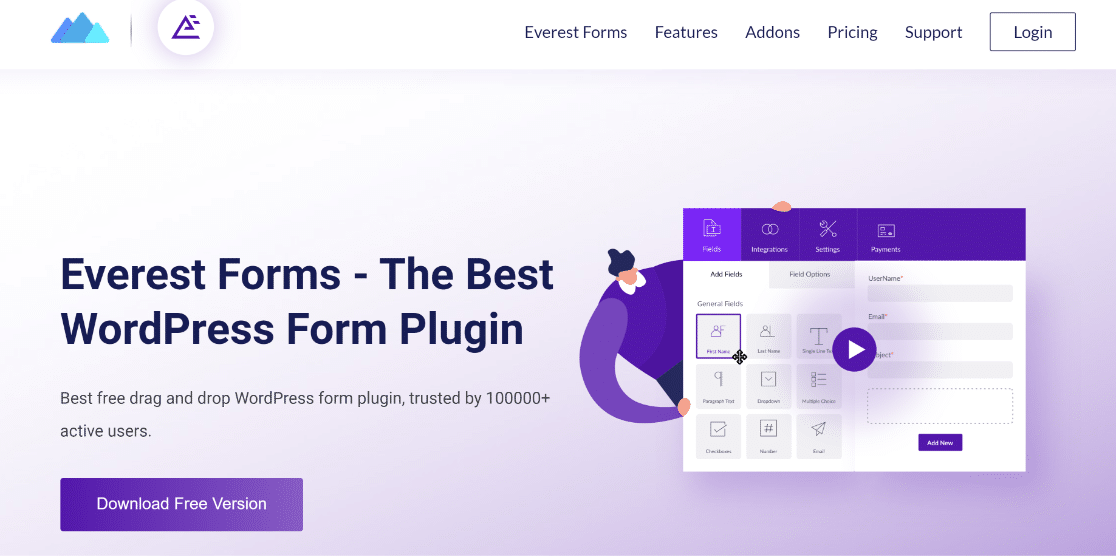
Everest Forms is a well-regarded form plugin for WordPress. Unlike most form builders, Everest Forms has an excellent free version that includes enough functionality for building basic kinds of forms quickly.
The Pro version of the form adds various advanced features and addons, allowing you to create survey forms, user registration forms, file upload forms, and more. It’s easy to set up and very beginner-friendly to use.
WPForms
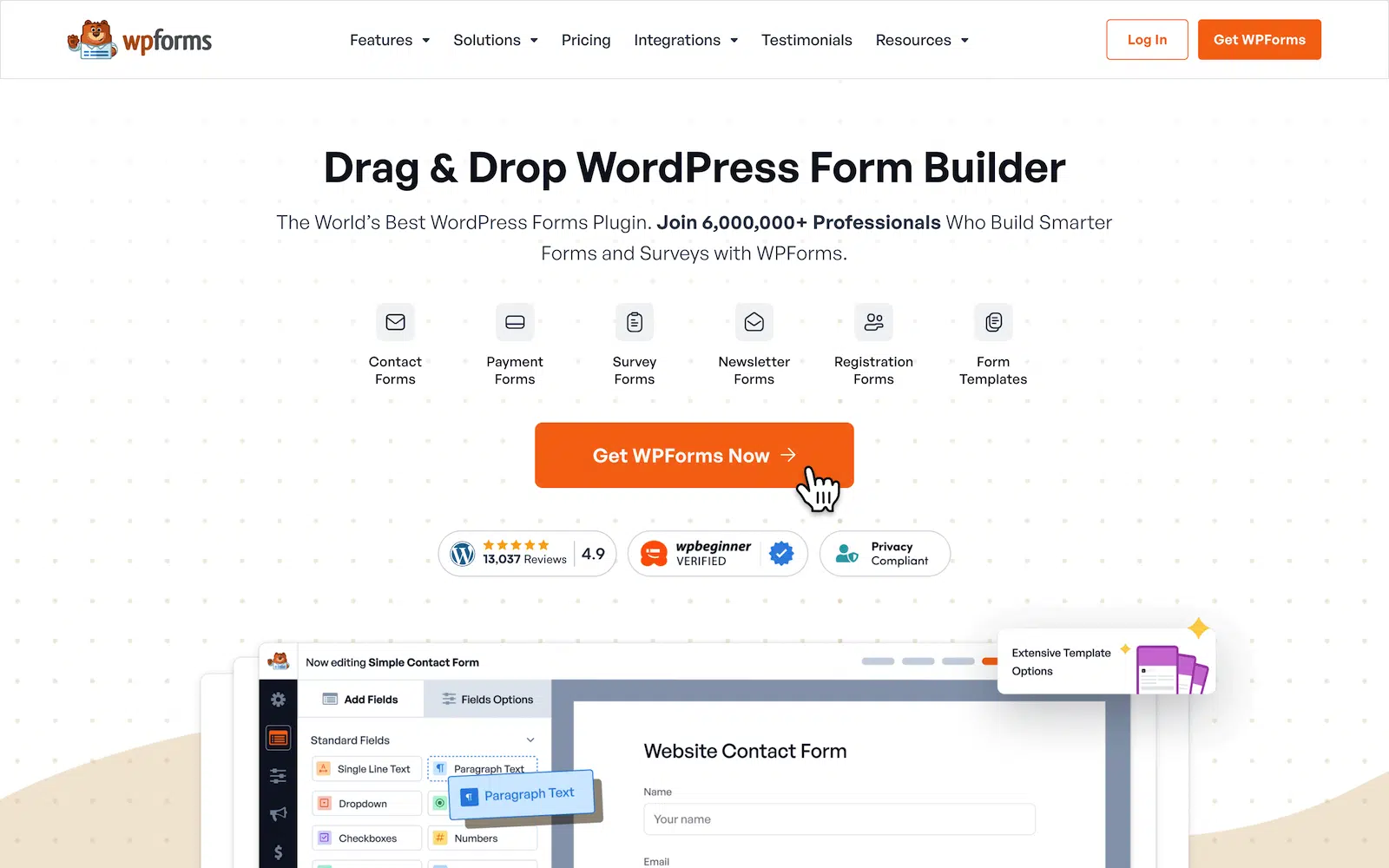
WPForms is the top-rated form builder for WordPress with 13+ thousand 5-star reviews on WordPress.org and is trusted by many businesses thanks to its user-friendly interface and a powerful set of features.
Like Everest, WPForms has a free version that offers tons of useful features usually only available in the paid versions of other plugins. You can create and customize forms for any purpose using WPForms.
Whether you need a simple contact form, an advanced NPS rating survey form, or a high-converting lead form, WPForms has got it all.
Getting Started: Installation and Setup
Both plugins use drag-and-drop builders that don’t need any code, so day-to-day building feels familiar in either one. The differences show up in the smaller details.
Everest Forms
Everest Forms uses a two-pane builder, with your available fields and their options on the left and the area where you drop fields to build the form on the right. Click any field once it’s added and you can edit its label, placeholder, and description without hunting through menus.
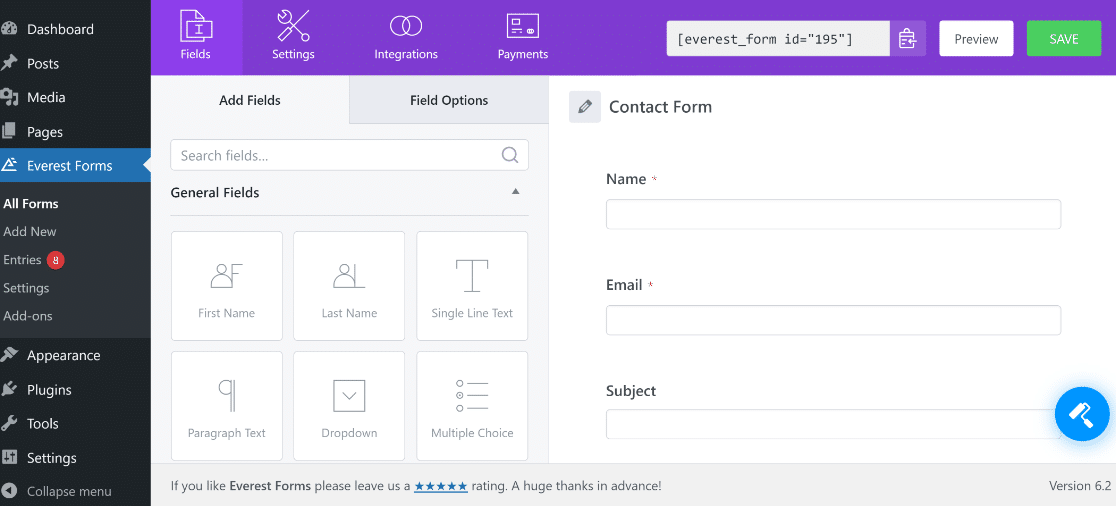
You can access options for each field by clicking on it once it’s been added to your form. Need to change labels and placeholder text or add a description for each field? All of these settings can be easily changed in the field options.
Everest Forms also lets you change your general form settings from the same form builder interface. You can use the Settings tab at the top to access general options.
In addition, you can configure your email notification settings, success message and redirections, submit button text, anti-spam options, as well as any addons that you may have installed.
Preview and Embed
There’s a preview button at the top that enables you to see how your form will actually look on the frontend once it’s live. This is a great way to test your form and make any changes before publishing.
When you’re ready to launch your form, you can use the shortcode displayed at the top of the form builder. You can also use the Everest Forms block from the WordPress editor to directly embed any form to your page or post.

It’s safe to say that Everest Forms is a plugin that’s clearly designed with usability in mind. The form builder is easy for beginners but also gives an outstanding range of customization. CSS is also supported for advanced users if you want to make additional customizations.
That said, the Everest Forms interface slightly hurts the user experience because it doesn’t occupy the whole screen. Because the WordPress sidebar menu remains visible, there’s less space for you to work with when editing your forms in Everest.
But this is a minor complaint from an otherwise very easy to use form builder interface.
WPForms
WPForms uses a similar two-pane layout, so if you’ve used Everest, you’ll feel right at home.
When you create a form, you can start from a template or a blank canvas, and you can switch templates at any point while editing. In Everest, changing templates means starting a new form, which is a bit inconvenient.

One cool little detail in WPForms is that you can change templates any time while editing a form. In Everest, you’ll have to create a separate form if you want to change your template, which is a bit inconvenient.
Like Everest Forms, the form builder screen in WPForms is split into two sections: one where the settings and fields and the other where you can add fields in order to create your form.
However, there’s a small but crucial difference. WPForms gives you a bigger area to work with because its form builder occupies your complete screen.
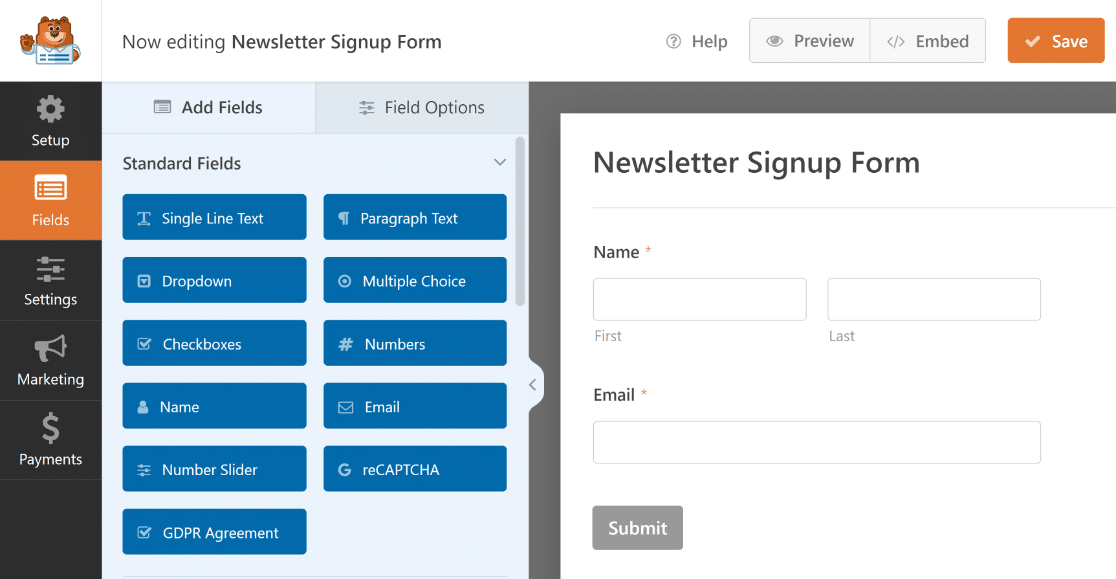
You can add fields and customize their options in much the same way as in Everest Forms. The settings for each form field can be customized directly from the form builder.
The general settings are accessible from the Settings tab on the left-hand sidebar. Opening the Settings tab shows various other options organized into separate categories.
For instance, the general settings enable you to change the form name and description, edit submit button text, add form tags, and access other miscellaneous options.
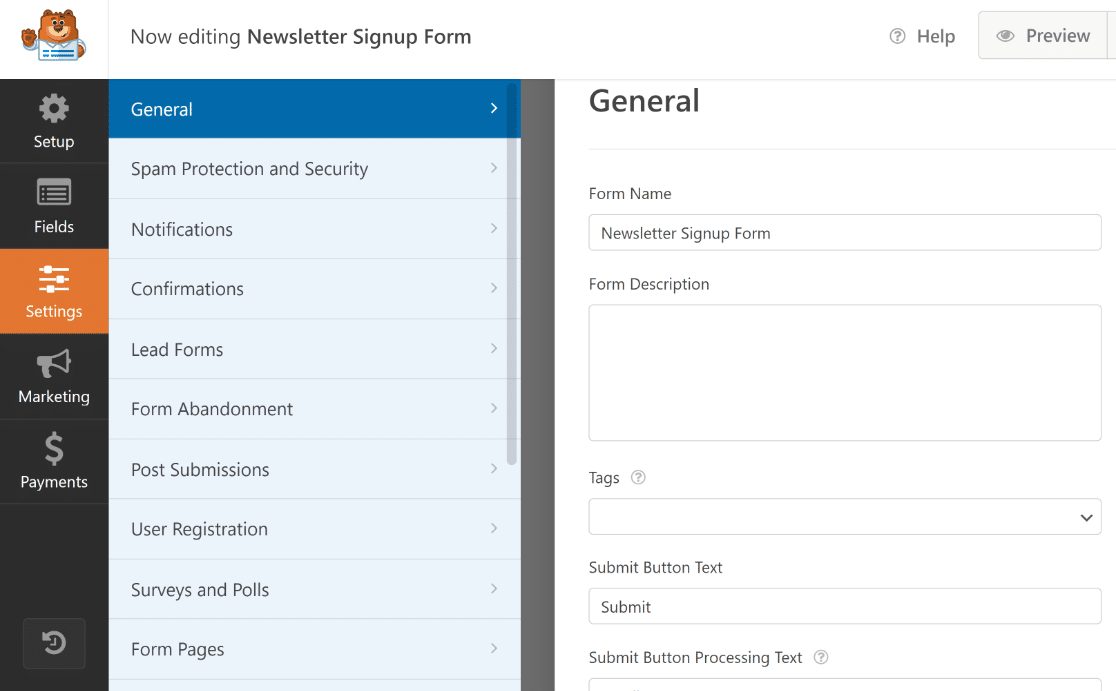
In Everest Forms, the options for success message and spam filters are all lumped together inside general settings. As a result, the settings become a bit too cluttered and overwhelming to navigate through.
WPForms makes things a lot more manageable by giving separate tabs for success message (called confirmations), notifications, and spam filter settings.
Preview and Embed
As with Everest, you can check a preview of your form from the frontend by pressing the Preview button at the top of the WPForms form builder.
WPForms offers the most straightforward embedding system out of all WordPress plugins. There’s no need to copy-paste shortcodes or create a new page separately.
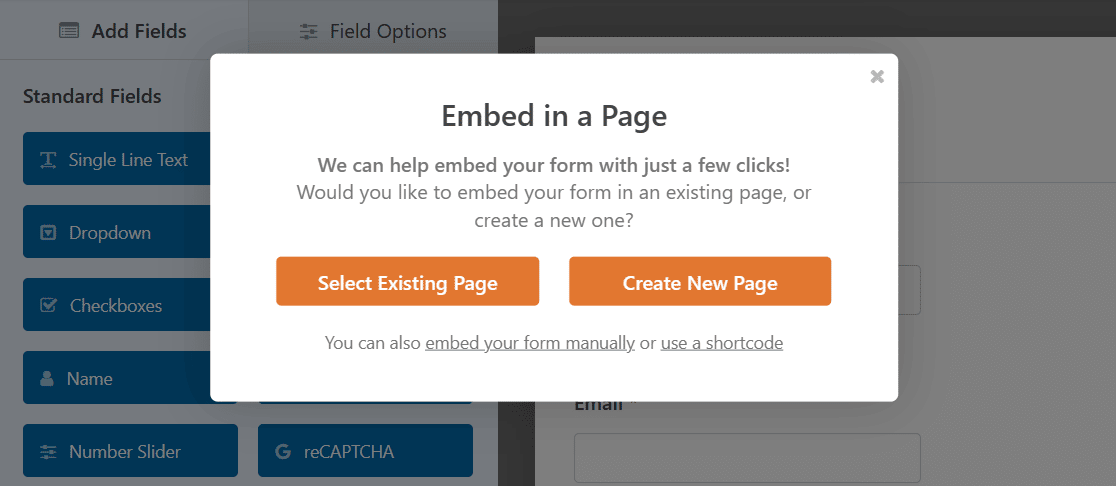
Instead, you can simply press the Embed button at the top, and WPForms will directly take you to your WordPress editor with the form already embedded in it.
It’s the small conveniences like these where WPForms really stands out from its competitors.
The Core Stuff: Features and Functionality
Both WPForms and Everest Forms share many similarities in their features and addons. But there are severable notable differences as well.
Form Templates
WPForms is one of the few WordPress form plugins that focus on offering a huge variety of templates. Currently, there are 2,100+ form templates to choose from in the Pro version of WPForms.
In fact, WPForms stands out for having over 45 form templates for free in the Lite version.

There are multiple categories of form templates including business operations, customer service, registrations, nonprofits, and more. There’s something for everyone.
In contrast, Everest Forms only has 9+ templates in its highest tier plan and 5+ templates in the free version.
As a result, WPForms’ templates serve a much wider range of purposes for businesses, individuals, and nonprofits than Everest Form templates.
Form Styles and Design
Everest Forms and WPForms are two of the best form builders on the market when it comes to their form styling features.
WPForms enables you to customize the appearance of your forms without touching a single line of CSS code. This means that even if you’re a beginner, you can design visually appealing forms in no time.
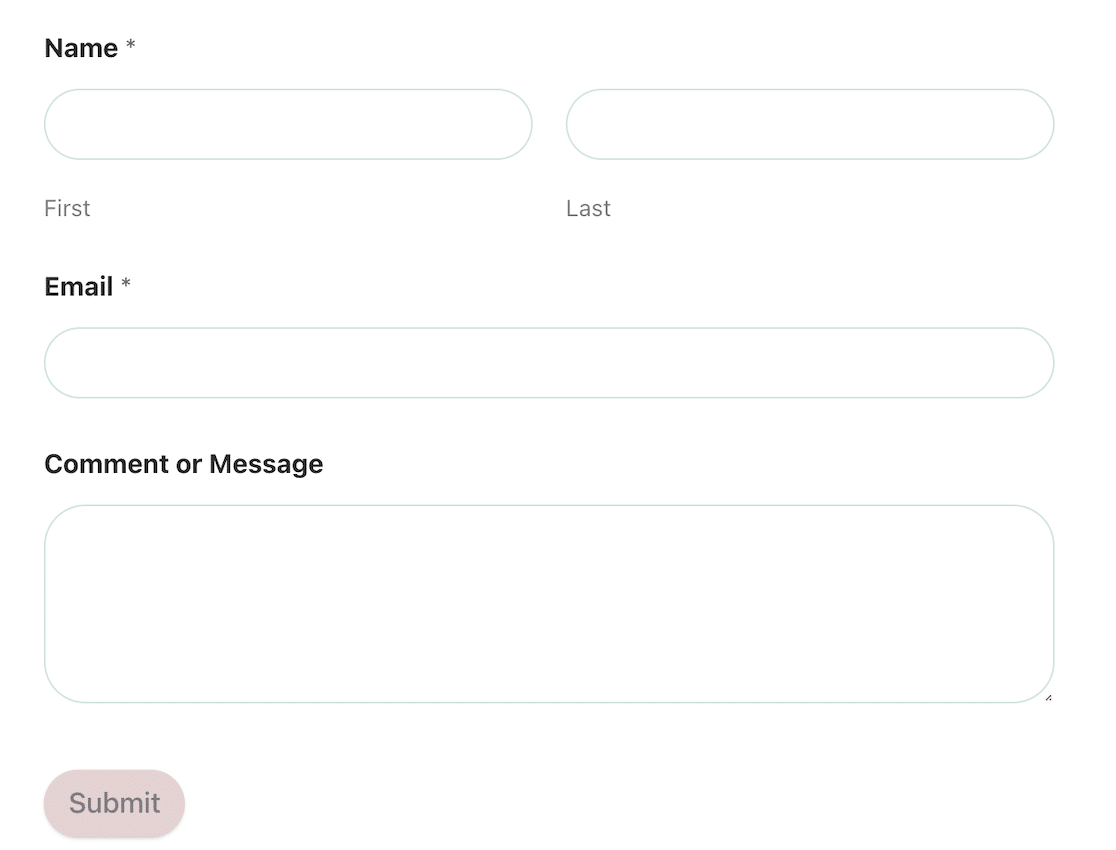
The form styling options are accessible from the WPForms block in the WordPress editor. You can customize styles for your form fields, labels, and buttons using these options in just a few clicks. This is dramatically easier and faster than customizing styles with complicated CSS.
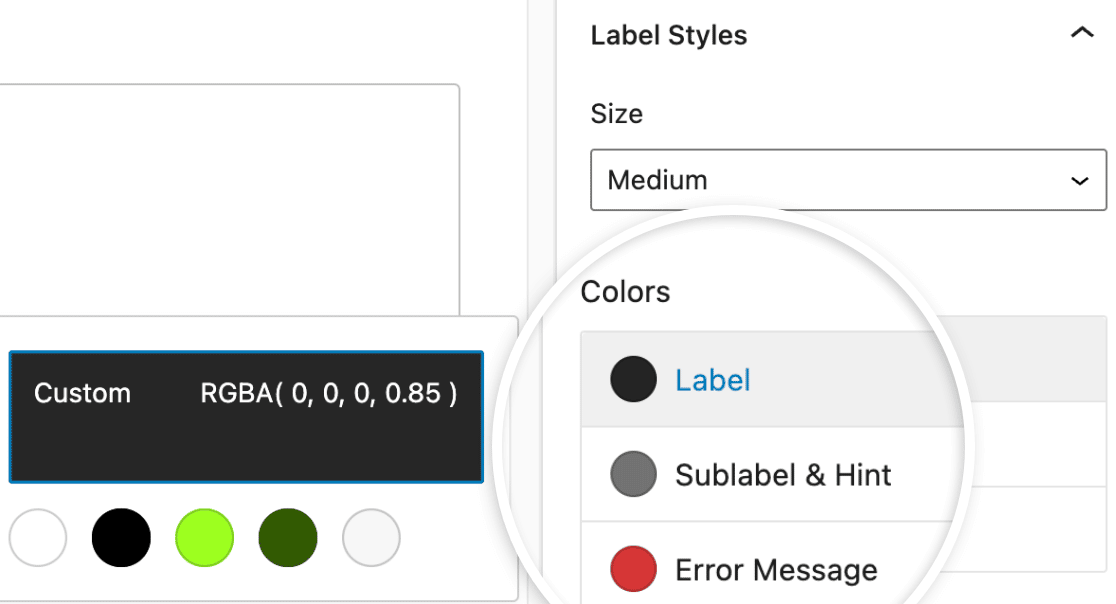
Everest Form also includes impressive form styling features. But unlike WPForms, you need the paid plan to access this feature, and then you’ll have to activate the Style Customizer addon to use form styling options.
The Everest Forms Style Customizer uses the default WordPress theme customizer tool, allowing you to edit styles directly from the frontend.

You can change the color of the background, fields, and buttons, and even the alignment of different form elements without any code.
That said, Everest Form’s form design capabilities have a couple of drawbacks.
First, it’s only available for paid users, whereas WPForms’s form styles are available for both free and paid users right out of the box.
Secondly, even though Everest’s Style Customizer is very flexible, there are still some limitations.
WPForms covers this limitation superbly with its Content field. And this is the focus of our next section.
Adding Media and Text in Forms
Customizing colors and styles is an important component of form design. But what if you also want to add instructional details or provide added context to your form using visuals and text?
In Everest Forms, the only way to add textual and media content to your forms is by using the HTML field. In fact, this is the supported method in most form builders for WordPress.
But WPForms has a faster and simpler way. The Pro version of WPForms includes the Content field that lets you insert text and images using a WYSIWG editor.
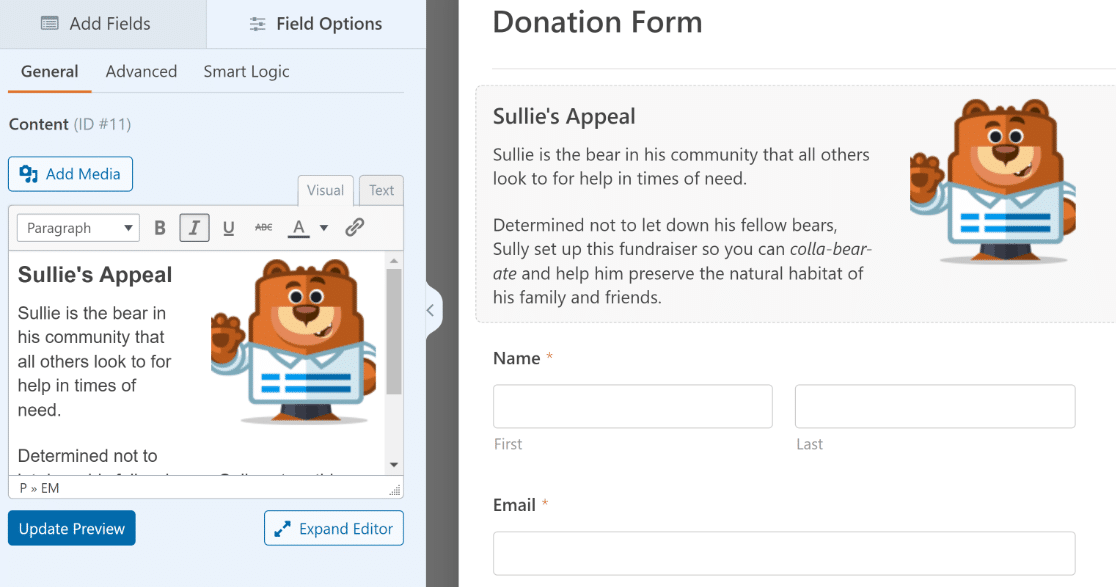
You’re not limited to just entering text either. The editor attached to the Content field also gives you formatting options, so you have full control over how your written text and uploaded media appear within your form.
Together with form styles, the Content field can make your forms highly visual. And it takes zero coding knowledge to achieve this.
Multi-Step Forms
Everest Forms and WPForms both enable you to break up longer forms into multiple steps or parts. This is an effective strategy for improving conversions, especially for lead forms.
WPForms includes the functionality to build multi-step forms by adding page breaks manually.
But if you want to take your multi-step forms to the next level with visually striking styles, then you’ll love the Lead Forms addon.
Enabling the Lead Forms mode automatically adds a page break after every field in your form. But that’s not all. The Lead Forms addon also unlocks additional styling options, including the ability to add and style a container to make your form stand out even more.

It’s only a matter of pressing toggle switches to add cool container effects like drop shadows, rounded corners, and change colors for the background, buttons, labels, and other elements.
These styling options are available from the Lead Forms settings in the form builder and are completely code-free. Everest Form users can use the Multi Part Forms addon to create forms with multiple pages.

You can customize the container and other elements of your multi part form from the Everest’s frontend Style Customizer tool.
Form Layouts
Breaking apart your form into multiple steps is one way of reducing form fatigue and boost conversions. But it’s not the only way.
You can also make your forms more compact by organizing fields into multiple columns. WPForms has a Layout field designed exactly for this purpose. You can choose from various layout presets.
For instance, you’re not only limited to creating 2 equal-sized columns. You can also pick a preset that makes one column wider than the other or go as high as 4 columns to create more advanced form layouts.

Everest Forms includes different field layout options as well. You can create 2, 3, or 4 columns to arrange your fields into. But Everest Form only supports basic layout types.
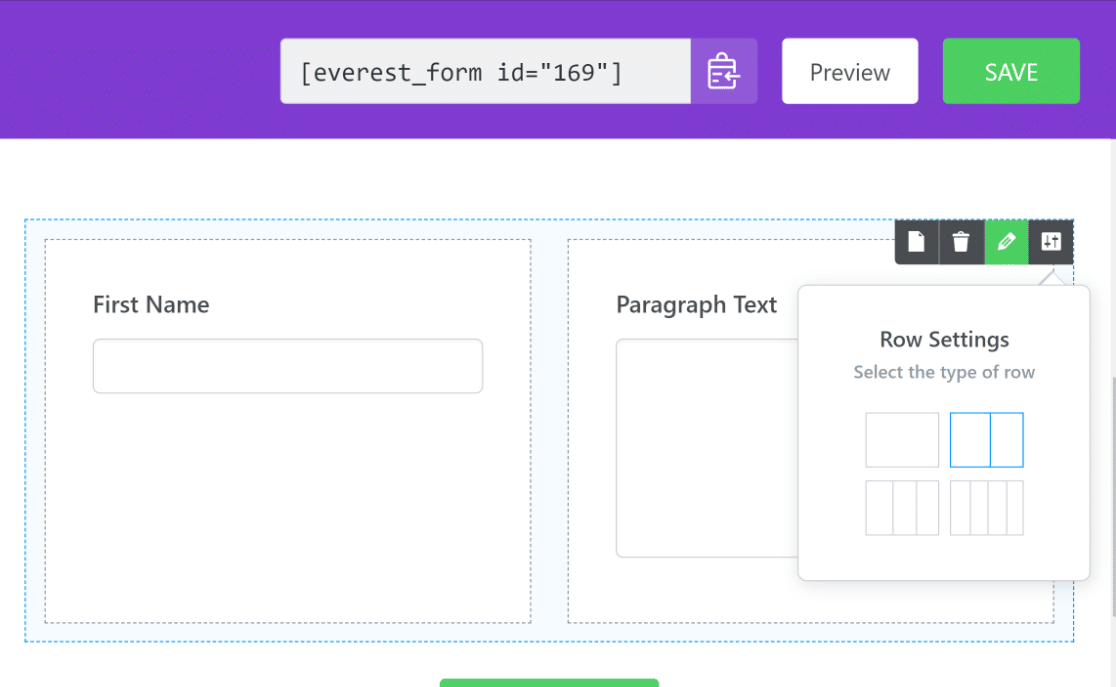
Unlike WPForms, you can’t choose columns of unequal widths (which can be helpful when you want to add bigger fields like paragraph fields next to smaller fields like email). This is another limitation in Everest Forms.
Spam Protection
Contact form spam is a huge problem for almost every website that uses forms. This is why it’s imperative for a good form builder to have strong spam filter options.
Everest Forms supports integrations with major anti-spam captcha services like reCAPTCA and hCaptcha. Its built-in anti-spam features include an email domain whitelist, anti-spam honeypot field, and a Custom Captcha addon.
While these spam protection options are adequate, they’re a bit limited when compared to WPForms.
This is because WPForms integrates not only with reCAPTCHA and hCaptcha, but also supports popular tools like Akismet and even the newer Cloudfare Turnstile (both of which offer a superior user experience to reCAPTCHA and hCaptcha).

On top of that, WPForms comes with built-in spam protection features such as anti-spam tokens, keyword filters, country filters, and email allowlist/denylist.
And if you want to design your custom captcha questions with math sums or other questions of your choice, you can use the Custom Captcha addon.
Payment Fields
If you’re selling products or running a nonprofit fundraiser online, you need forms with top-notch payment processing capabilities. WPForms supports top payment gateways including PayPal, Stripe, Square, and Authorize.net.

WPForms is one of the only few form builders that provides the Stripe integration for both free and paid users. That means every WPForms user can create Square, Stripe, and PayPal payment forms on their site to collect online payments.
The Lite, Basic, and Plus users are charged a 3% processing fee in addition to Stripe’s fixed fee per transaction. But when you upgrade to Pro, the 3% charge is removed for all transactions, so you only pay regular fees.
The best thing about Stripe is that it enables you to take payments from over 25 different options, including Apple Pay and Google Pay. The flexibility with Stripe is simply enormous.

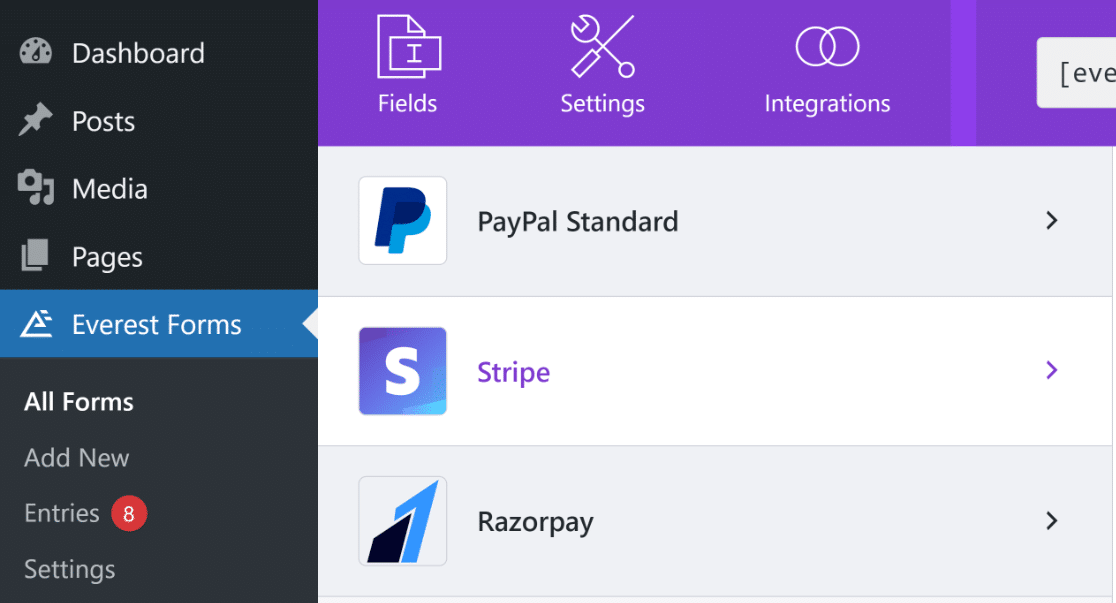
In contrast, Everest Forms only supports PayPal standard, Stripe, and Razorpay (for Indian customers) integrations. While these will work just fine for your payment needs, they don’t offer the flexibility of WPForms’ payment addons.
Marketing Integrations and Automation
Integrations with other marketing platforms and productivity apps are massively helpful for improving your efficiency. Everest Forms supports native integrations with various popular marketing platforms and CRMs, including Mailchimp, HubSpot, Constant Contact, Campaign Monitor, and more.
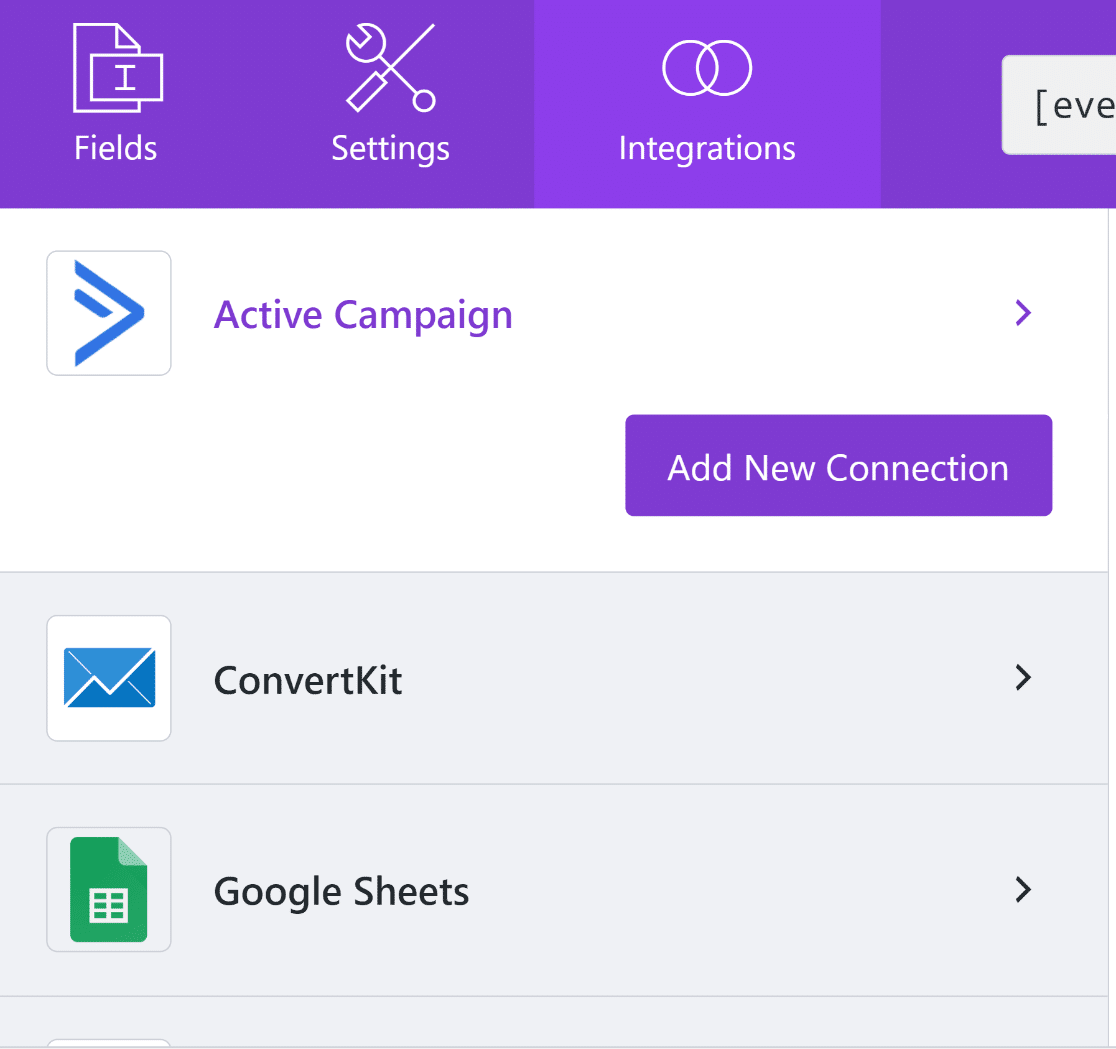
WPForms supports integrations with all popular CRMs and marketing services. With both plugins, you can even set up an integration with Google Sheets and send your entries automatically to a spreadsheet.
However, WPForms goes even further. Because it integrates with Uncanny Automator, you can expand your automation possibilities to a greater extent with WPForms as compared to Everest Forms.

For instance, WPForms can be connected with ChatGPT using Uncanny Automator. You can create smart, autogenerated form notifications with ChatGPT.
While Everest Forms has a Zapier addon that lets you automate tasks between different apps, it requires you to use webhooks. As such, the process is slightly more complicated.
WPForms is available as a ready-to-use app for triggers and action events in Zapier, so the process is still super easy if you want to use Zapier instead of Uncanny Automator.
Other Features and Addons
WPForms and Everest Forms are both feature-rich form builders. Some of their other features are as follows.
Everest Forms

- Frontend post submissions
- User registration forms
- Conversational forms
- Coupon fields
- Calculator fields
- … and more
WPForms
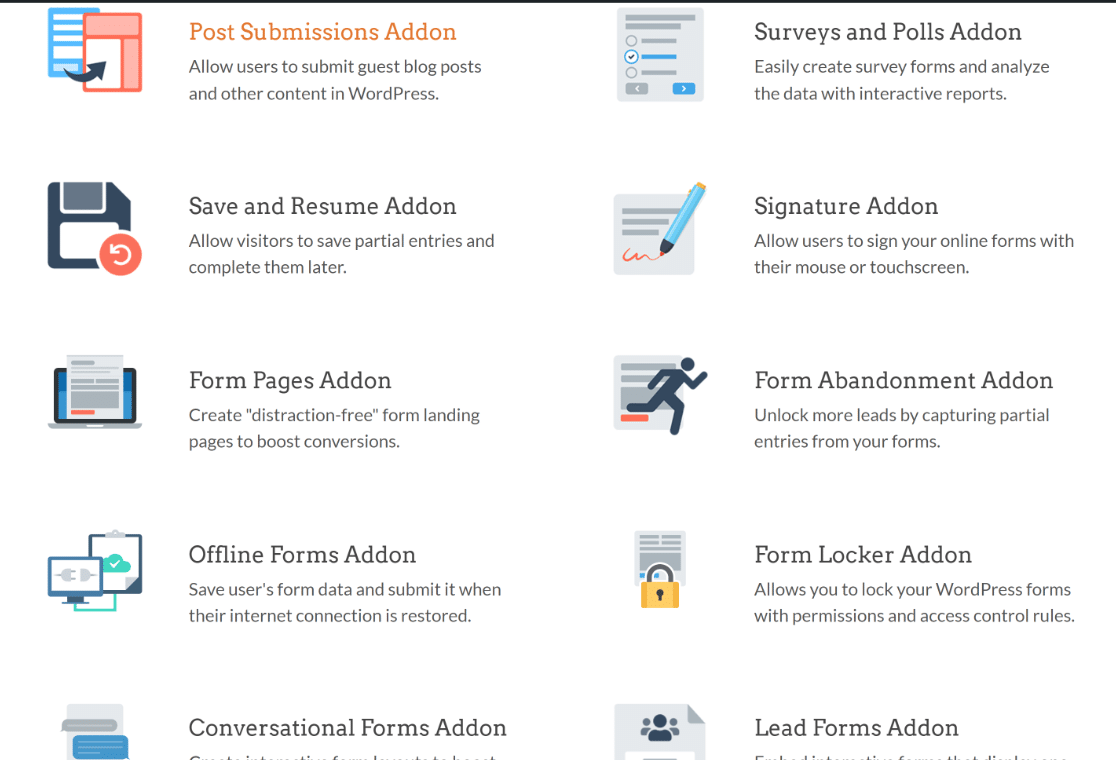
- Frontend post submissions
- User registration forms
- Conversational forms
- User Journey addon
- Form Abandonment addon
- Radio field icons
- Form revisions
- … and more
Both form builders share many similarities. However, they each have some extra features that the other lacks.
Building Forms With AI
The biggest change since this comparison first went up is AI, and it’s now one of the clearest differences between the two plugins.
Everest Forms
Everest Forms has added an AI form builder that lets you describe the form you want and generate it automatically. It’s a helpful head start, and it saves you from dragging every field into place by hand.

WPForms
WPForms gives you more than one way to build with AI, depending on how much you want it to do. The first is WPForms AI, where you describe the form you need and it builds the whole thing, fields, labels, and all.
It handles trickier requests too, like a form with built-in calculations or one translated into another language. I compared it against the other options in my roundup of the best AI form builders for WordPress if you want to see how it holds up.

Editing is just as easy with a feature called Smart Edit. Instead of clicking through settings, you open a chat box inside the builder and tell it what to change.
It can update fields, build conditional logic, write calculation formulas, and set up notification emails from a plain-language request.

The newest addition is the one I find most useful. WPForms supports WordPress’s Abilities API, which means you can connect an AI assistant like Claude, ChatGPT, or Cursor directly to your site and have it build and edit your forms for you.
You ask for the form you want, and the assistant creates it, adds the fields, and adjusts the settings without you opening the builder at all.

I wrote a full walkthrough on how to build WordPress forms with Claude if you’d like to try it. Because it works in the free WPForms Lite version, you don’t even need a paid plan to test it, which is something Everest Forms can’t match right now.
Tracking Form Performance With Built-In Analytics
Building a form is only part of the work, because getting more submissions depends on seeing how people actually interact with it. That’s an area where WPForms has invested heavily.
Everest Forms
Everest Forms includes form analytics that track entries, submissions, and the conversion rate for each form. That gives you a useful top-level view of how a form is performing.

WPForms
WPForms has built-in form analytics that go a good deal deeper, and the setup cost is zero. Every published form is tracked automatically, with no code and no need to connect Google Analytics.

Alongside views, conversion rate, and abandonments, it breaks performance down field by field. You can see views, interactions, and drop-offs for each field, plus the average time people spend on it, so you can spot the exact question where visitors give up.

You can also set conversion goals and export the data to CSV. And, there’s an AI layer on top as well, so you can ask WPForms AI about your data in plain language and get suggestions, or compare one time period against another.
Just as important is what it doesn’t do, since the tracking uses no cookies, sends nothing to third-party services, and keeps all the data inside your WordPress database, so you’re not adding another privacy policy to worry about.
Once you have the numbers, you can use those insights to improve your forms and recover the submissions you were losing.

Pricing: Everest Forms vs WPForms
WPForms and Everest Forms both have paid plans available at competitive pricing.
Everest Forms
Everest Forms offers 4 different pricing plans:

- Personal ($49/year): One site, with the Style Customizer, conditional logic, and additional form fields.
- Plus ($99/year): Five sites, adding surveys, user registration, marketing integrations, and conversational forms.
- Agency ($199/year): Unlimited sites with all premium features.
Renewals run higher than the intro prices, with Personal at $69, Plus at $149, and Agency at $299.
Everest Forms also offers lifetime licenses, which is its standout pricing feature. You pay once, starting at $199 for Personal, and never renew.
WPForms
WPForms has four paid plans, also billed annually.
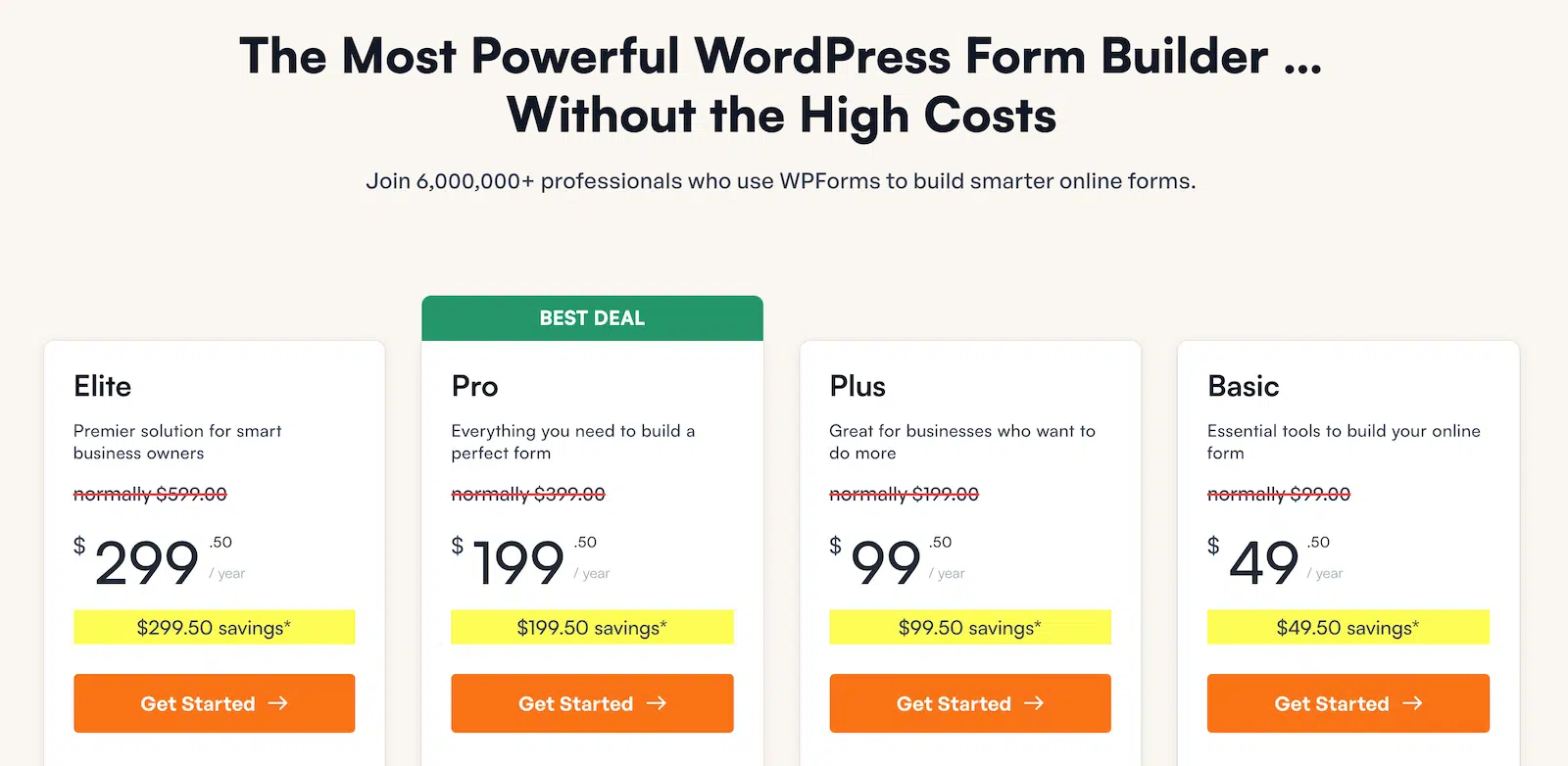
- Basic ($49.50/year): One site, with advanced fields, entry management, multi-page forms, file uploads, conditional logic, and Stripe payments.
- Plus ($99.50/year): Three sites, adding marketing integrations like Mailchimp and Klaviyo.
- Pro ($199.50/year): Five sites, adding PayPal Commerce, Square, the full analytics suite, surveys, conversational forms, Lead Forms, and 2,100+ templates.
- Elite ($299.50/year): Unlimited sites, adding HubSpot, Salesforce, Authorize.Net, and webhooks
The free version of WPForms doesn’t give you entry management, though all your entries are safely stored in the cloud. So you can easily recover all entries with a single click if you decide to upgrade.
But the free version has a lot more features than Everest Forms. For instance, you get 45+ form templates, form styles for customizing the appearance of each form without code, form revisions to undo mistakes with a single click, and various other free features.
Help When You Need It: Support and Documentation
Everest Forms offers two main channels of support: tickets and doc guides. They have a knowledgeable support team with an impressive response rate to queries and technical questions.
And if you need to learn more about using different Everest Forms features, you can check out their doc guides. Currently, Everest Forms has over 120 documentation articles, which is quite impressive.

WPForms offers three channels of support: tickets, doc guides, and a Facebook group with over 20k active members.
The support team strives hard to maintain time-to-first-response under 60 minutes. The quality and timeliness of support ticket responses is one of the reasons behind the high ratings of satisfied WPForms customers.
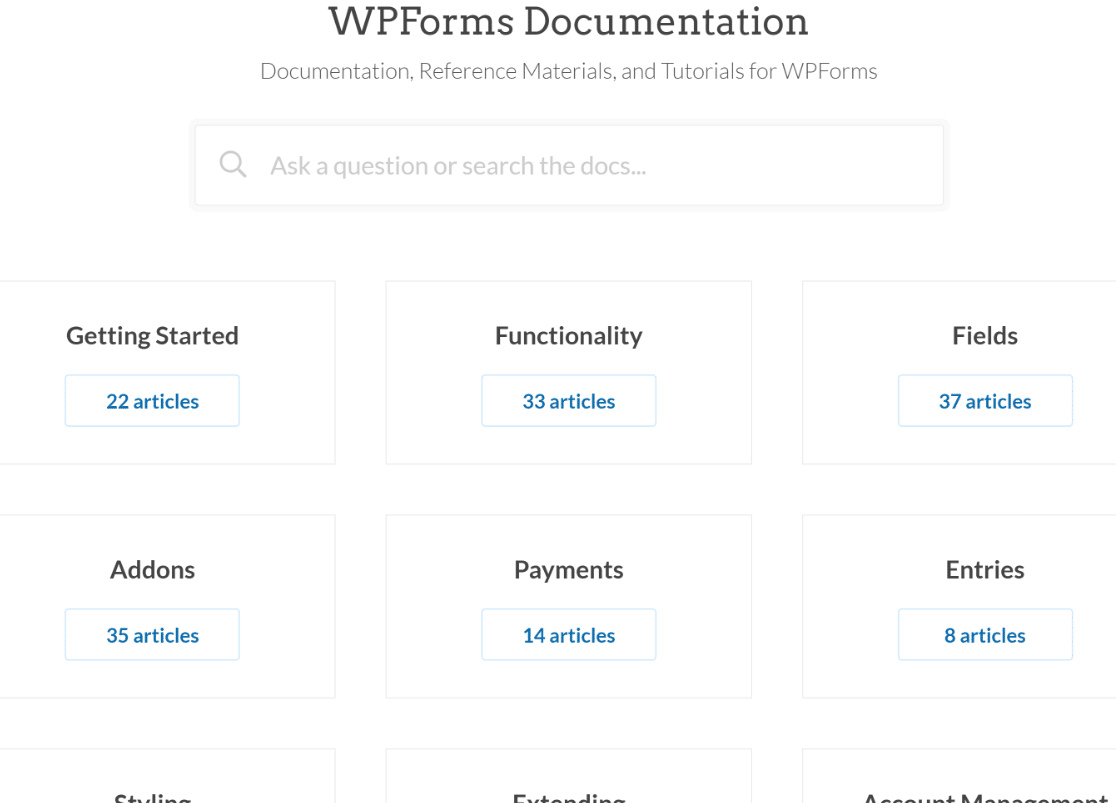
The doc guides contain detailed information on every feature and aspect of WPForms. Currently, there are over 200 doc guides offering in-depth product knowledge for both new as well as existing customers.
Finally, the WPForms VIP Circle on Facebook is an excellent place where both customers and team members contribute to discuss issues and provide helpful suggestions and solutions.
Everest Forms vs WPForms: Which Option Suits You Better?
Both Everest Forms and WPForms are among the best-rated form plugins on WordPress, and you can build a solid form with either one. But if you’re choosing just one, here’s how I’d think about it.
Everest Forms is a good fit if a lifetime license is important to you, or if you want form entries visible in your dashboard on the free plan. Those are two areas where it genuinely does well, and I won’t pretend otherwise.
For most people, though, WPForms is the one I’d recommend. It’s easier to get started with, its form builder uses the full screen so it never feels cramped, and it offers free no-code styling that Everest keeps behind a paid addon.

On top of that, WPForms gives you 2,100+ templates to Everest’s small handful, a Content field for adding rich text and images without touching HTML, and the Lead Forms addon for turning any form into a styled, multi-step lead capture.
The built-in analytics and AI tools then take it further than Everest can right now, letting you see exactly where forms lose people and build or edit a form just by describing it. So if you want the best mix of ease of use, features, and room to grow, WPForms is the form builder I’d pick.
FAQs on Everest Forms vs WPForms
Everest Forms vs WPForms is a common comparison for anyone choosing a WordPress form builder. Here are quick answers to the questions I hear most often.
Is Everest Forms better than WPForms?
Both are strong plugins, but for most users WPForms comes out ahead thanks to its larger template library, free form styling, built-in analytics, and AI form building. Everest Forms is a good choice if you specifically want a lifetime license or dashboard entries on the free plan.
Does Everest Forms have a free version?
Yes. Both Everest Forms and WPForms have free versions on WordPress.org. Everest’s free plan shows form entries in your dashboard, while WPForms stores your entries and unlocks the dashboard view once you upgrade to a paid plan.
Which form builder has better analytics and tracking?
Both include form analytics, but WPForms goes deeper. It tracks performance field by field, shows where visitors abandon a form, supports conversion goals, and even offers AI-powered insights, all without needing Google Analytics.
Does WPForms offer a lifetime license?
No. WPForms is a yearly subscription, which keeps your updates and support current. Everest Forms does offer lifetime licenses, so if a one-time payment is your priority, that’s a point in its favor.
Can I switch from Everest Forms to WPForms?
Yes. You can set up your forms in WPForms and rebuild what you need using its templates and drag-and-drop builder. Since WPForms keeps all your entries stored, you won’t lose data as you make the move.
Next, Capture More Email Addresses With Forms
Now that you’ve got a form builder in mind, you might want to get more out of the forms you build.
One easy win is offering a free download in exchange for an email address you collect through your form, which is a simple way to grow your list.
Get Started With WPForms Today
Ready to build your form? Get started today with the easiest WordPress form builder plugin. WPForms Pro includes lots of free templates and offers a 14-day money-back guarantee.
If this article helped you out, please follow us on Facebook and Twitter for more free WordPress tutorials and guides.