

AI Summary
Are you trying to think of the best student survey questions to collect insightful feedback for your class? The best student survey questions ask what students enjoy, where they struggle, and whether they feel supported.
Two good examples are “Which subjects are you struggling with?” and “How accessible is your teacher for questions and assistance?” You can build all 14 in WPForms, starting from its class survey template.
For this post, we’ve put together a list of survey questions examples for students to ensure your survey is successful and show how to create one for your WordPress site.
Create Your Student Survey Form Now
How Do You Make Survey Questions for Students?
Online survey forms are ideal in a variety of different contexts including distance learning or traditional classrooms. For WordPress websites, the easiest way to prepare a student survey is by using the plugin WPForms.
This is because WPForms has 2,100+ WordPress form templates, including a whole category of education forms.
We’ll be using WPForms’ class survey form template in this example, which has some great questions that allow students to participate in course evaluation.
Plus, we’ll be adding a bunch of other questions to the form to gather comprehensive responses regarding different aspects of class and coursework.
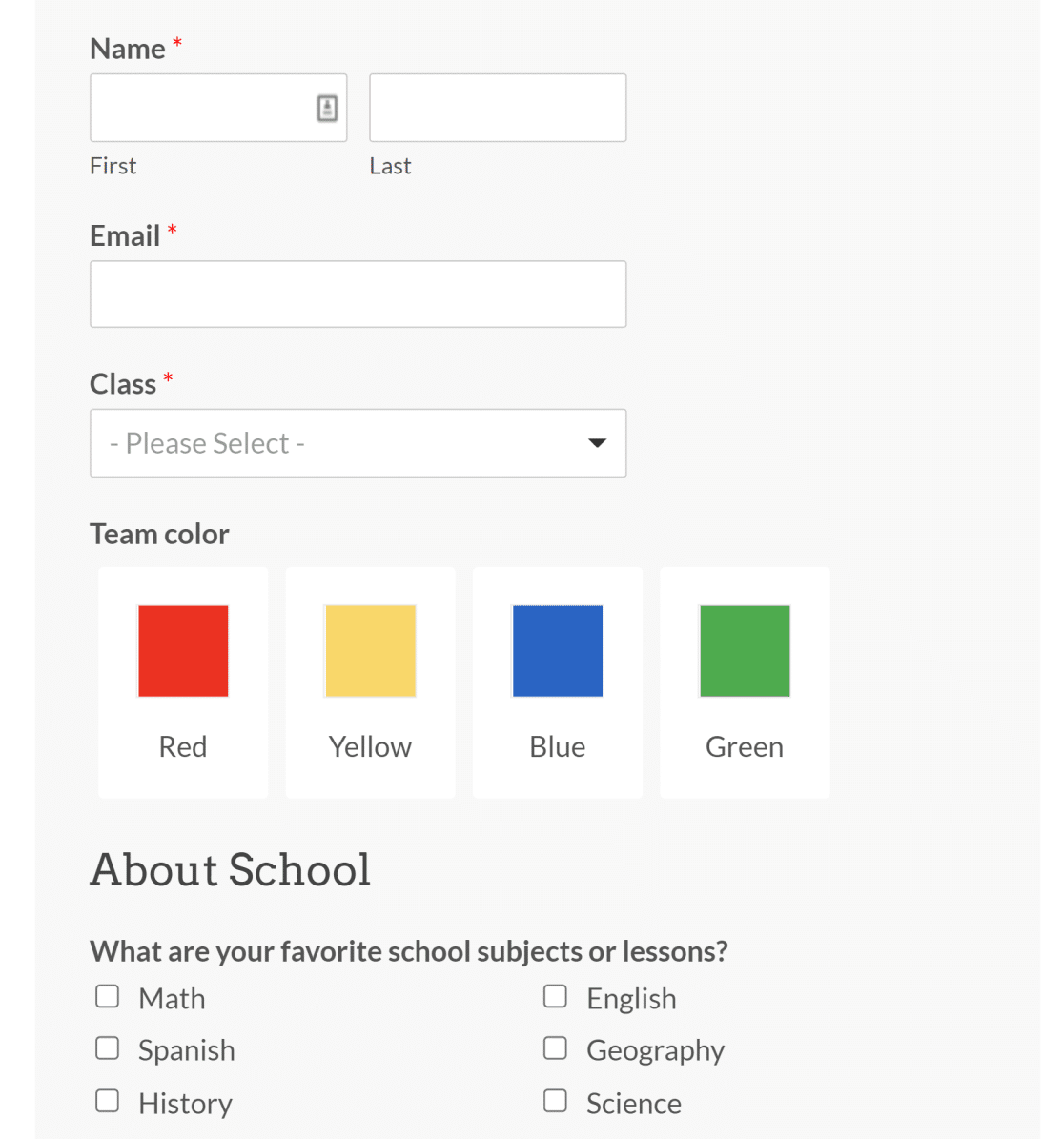
You can use this format to prepare different kinds of student surveys depending on your goals. For instance, you can create questionnaires that focus on student engagement and student perception.
Make sure you have a WPForms Pro license and then install the WPForms plugin on your site. You’ll also need the Surveys and Polls and Form Locker addons to create this student survey form.
Questionnaire Sample for Students
A good online survey for students consists of a mix of close-ended and open-ended questions. The common aim of a student survey is to gather feedback about your educational institute and teaching methods.
The questions below focus on a number of different topics and issues in the context of schools. These questions are suitable for high school, middle school, or a university class survey. You can use these ideas as a sample questionnaire to gain meaningful insights from your students.
Each of the 14 questions below fits a specific survey goal. The table shows which ones to use for each goal and when to ask them.
| Survey goal | Questions to use | What you’ll learn | When to ask |
|---|---|---|---|
| Get to know a new class | #1 Favorite subjects, #7 Teaching methods, #14 Hobbies | Interests and how each student learns best | First week of term |
| Check learning and support | #2 Struggling subjects, #3 Teacher accessibility, #4 Help from classmates, #5 Learning resources | Where students are stuck and whether help is easy to reach | Mid-term |
| Gauge workload and engagement | #6 Classroom activities, #10 Homework hours | Which activities work and whether homework is balanced | After a unit or mid-term |
| Check classroom climate and well-being | #8 Speaking up in class, #9 Teacher care | Whether students feel safe to speak up and supported | Twice a year |
| Reflect and plan changes | #11 Proudest achievements, #12 What to change, #13 Likes and dislikes | What worked and what to change next | End of term or school year |
- 1. What Are Your Favorite/Least Favorite Subjects
- 2. Which Subjects Are You Struggling With?
- 3. How Accessible Is Your Teacher for Questions and Assistance?
- 4. How Comfortable Are You Seeking Assistance From Classmates?
- 5. Is the School Providing Adequate Learning Resources?
- 6. Which Classroom Activities Do You Find the Most Enjoyable?
- 7. What Teaching Methods Help You Learn Best?
- 8. How Comfortable Do You Feel Expressing Your Thoughts in Class?
- 9. Do You Feel Like Your Teachers Care About Your Well-Being?
- 10. How Many Hours Do You Spend on Homework Each Day?
- 11. What Are Your Proudest Achievements This Year?
- 12. What Would You Like to Change About Class or the Lessons?
- 13. What Do You Like Most/Least About School
- 14. After School Activities and Hobbies
- How to Write Effective Student Survey Questions
- How to Increase Student Survey Response Rates
Remember that writing a good summary of survey results is just as important as running the survey in the first place, so we have a few tips for you.
1. What Are Your Favorite/Least Favorite Subjects
Every student is different with their own unique interests. But as a teacher, it’s important for you to be well aware of the academic interests of your students.
You can only prepare a good teaching strategy for your students if you understand where their interests truly lie and what subjects they enjoy in the syllabus.
WPForms’ built-in class survey template includes this question. It is a close-ended question that has all the subjects listed as possible options for your students to choose from. You can see our guide on creating your first form for instructions on making a form and customizing it.

If you want to add more options or edit existing ones to this field, you can easily do it by going into Field Options. For more information about the Checkboxes field, see our doc on customizing the Checkboxes field in WPForms.
By default, WPForms’ class survey template only inquires about your student’s favorite subjects. But you can also easily add another question to identify their least favorite subjects, which can help provide a fuller understanding of your student’s likes and dislikes.
The easiest way to add another field for least favorite subjects is to duplicate the pre-made favorite subject field. You can do that in WPForms by hovering your mouse over an existing field and pressing the duplicate icon.
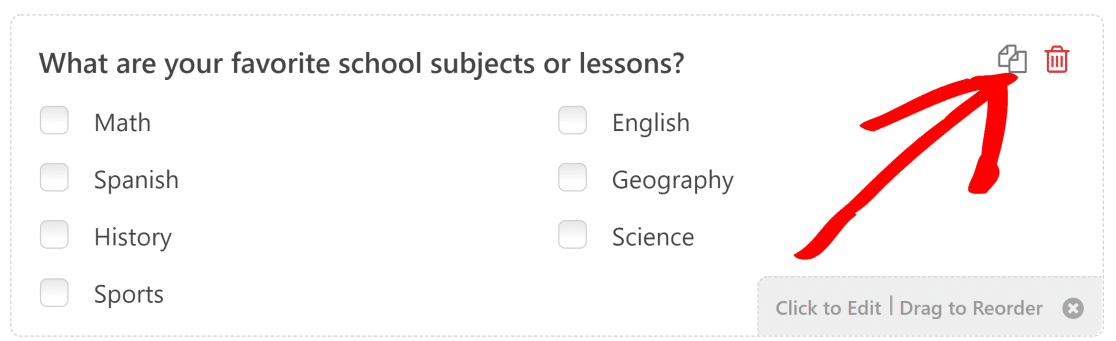
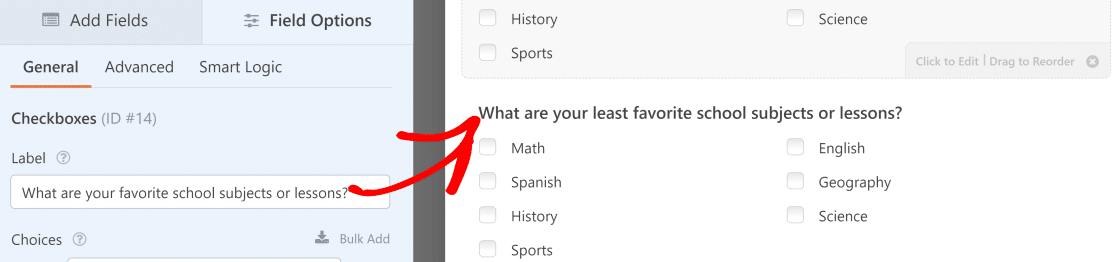
This will add a new field with the same name and options right below the original field. You can then simply click on the new field to open Field Options, edit the field name, and type in an appropriate phrasing for the question as shown below.
2. Which Subjects Are You Struggling With?
Just as every student has different subject preferences, they also have different struggles when it comes to academics. Although good teachers can often tell which students are struggling in certain areas, it’s always helpful to hear directly about a student’s struggles.
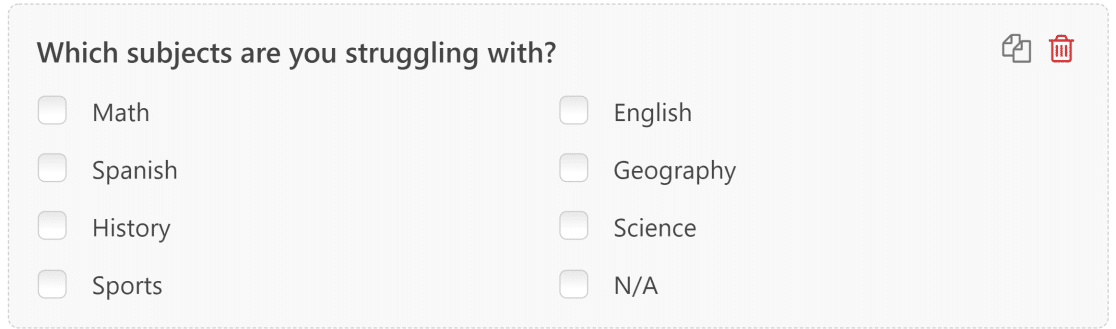
Like before, you can simply duplicate one of the fields you used earlier and edit the field label to match this new survey question. This will save you from having to add all the subject options all over again.
3. How Accessible Is Your Teacher for Questions and Assistance?
One of the most critical survey questions for students is whether they’re able to reach their teachers for any questions or help.
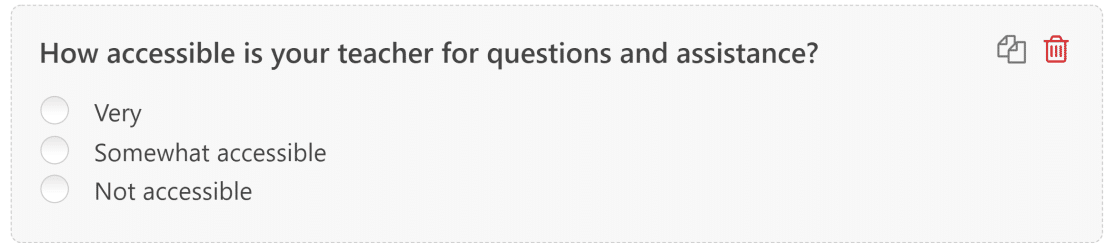
When your students feel comfortable asking questions, it helps foster a positive learning environment for everyone in the class. Many topics require repeated and sometimes alternative explanations before students can fully grasp a concept.
This is the kind of question that you should always include in your student satisfaction survey, as it allows you to gauge the comfort level of your students around your teaching staff.
4. How Comfortable Are You Seeking Assistance From Classmates?
Every school year poses different sets of challenges for young students. The struggles that they might have faced last year may no longer be a big concern today, which is why it’s important to conduct surveys frequently as conditions change.
The teacher-student interaction is only a tiny part of a student’s overall learning experience. Peers and classmates also play an important role in a student’s learning and development.
The following is an example of a Likert scale type question.
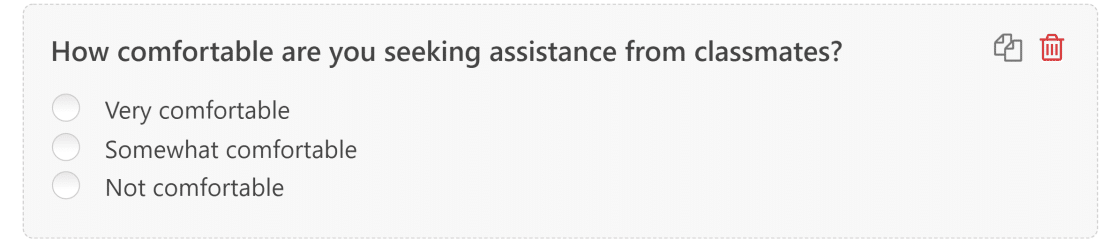
But some students may have a harder time connecting with others, making learning even more challenging for them.
With this question, you can identify students that might have issues socializing and provide them with the help they need.
5. Is the School Providing Adequate Learning Resources?
A student survey is an excellent opportunity to find out how students actually feel about the learning resources you’re providing. Are the majority of the students happy with it? Or is it the other way around?
You can only know your student’s opinions for sure if you ask. Some constructive criticism and feedback can go a long way in improving your systems and methods throughout the school year.

But what does it really mean if a student responds “no” to this question? To pinpoint the reason why a student thinks the learning resources aren’t adequate, you can ask a follow-up question. Ideally, this question should only appear in your student survey form when their response is “no”.
Thankfully, WPForms lets you hide such questions for all students except those responding with a “no”.
For example, you can add a Single Line Text field to ask for suggestions to improve your learning resources. Then, you can apply WPForms’ Conditional Logic so that the follow-up question only shows for students that chose the “no” option in the preceding question.

If you want to learn more about Conditional Logic, see this guide on how to use Conditional Logic with WPForms.
6. Which Classroom Activities Do You Find the Most Enjoyable?
Classroom activities are highly effective in building greater interest and engagement for a subject. If you’re a proactive teacher, you’ve probably tried different approaches to learning to keep your students more engaged.
But which classroom activities are your students enjoying the most? There’s only one way to find out.
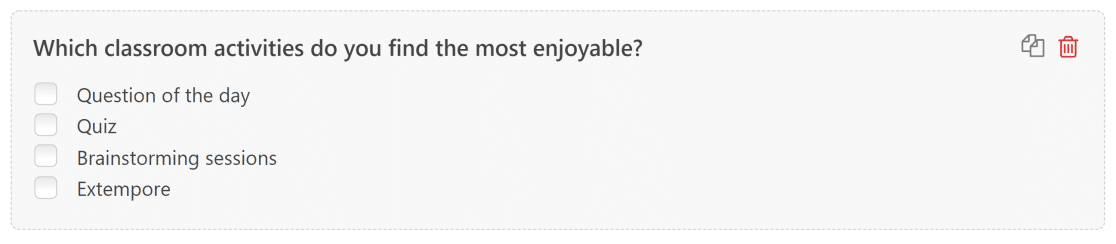
Hopefully, you’ll be able to focus more on including those activities that your students are loving for better learning outcomes.
If you’d rather see how students rank the activities against each other, the Ranking field in the Surveys and Polls addon lets them drag the options into order.
7. What Teaching Methods Help You Learn Best?
Student surveys should be about students. That means asking questions that offer insights into student’s preferences and needs.
It’s always a good idea to include a question about teaching methods in your student questionnaire. You might find interesting trends about what the majority preference really is when it comes to teaching styles.

8. How Comfortable Do You Feel Expressing Your Thoughts in Class?
Classroom discussions are often dominated by the more socially confident and outspoken students. But if you know exactly which students struggle to openly express themselves, you can make active interventions to make your classroom space more accessible for everyone.

This is why including this question in your student questionnaire is so helpful, allowing you to identify students that might require a bit more encouragement to participate in discussions.
9. Do You Feel Like Your Teachers Care About Your Well-Being?
When teachers actively show they care about students’ well-being, it creates a more inclusive and positive learning environment. By asking questions like this one, teachers can assess whether students feel emotionally supported at school.

10. How Many Hours Do You Spend on Homework Each Day?
Homework load is one of the most useful things a student survey can measure. Although some homework is necessary to reinforce learning, too much of it can take a toll on the students’ health. Research suggests that more than two hours of homework a day can lead to stress and make for poor balance in life.
This is why it’s very important for school administration to carefully consider their homework policies.
You can use WPForms’ Number Slider field to allow respondents to quickly specify how much time they’re spending on homework.

Or you can simply use a Multiple Choice field.
Either way, it’s critical to discover how busy your students are with homework each night. You might have to rethink the length or amount of homework assignments you’re giving students to redress some balance.
11. What Are Your Proudest Achievements This Year?
Don’t forget to ask your students about their achievements and what makes them proud. Letting your students express their thoughts on their own accomplishments helps you assess their self-image.
Plus, they’ll appreciate you for letting them have a moment of spotlight focused entirely on their achievements in your survey.

This is the perfect type of student survey question to leave open-ended, allowing your students to freely speak their minds.
12. What Would You Like to Change About Class or the Lessons?
An open-ended question about what students would change gives you valuable insight into how to improve classes and lessons.

Sometimes, sourcing ideas for improvements from a group of people who are most likely to benefit from these is the best way to move forward. So if you’re looking to obtain high-quality zero-party data from your students, it’s a good idea to ask more questions like these.
13. What Do You Like Most/Least About School
The WPForms’ class survey template includes two open-ended questions focusing on what students like the most and also the least about school. These are two of the broadest questions on this list, but they’re not any less valuable than the ones listed above.
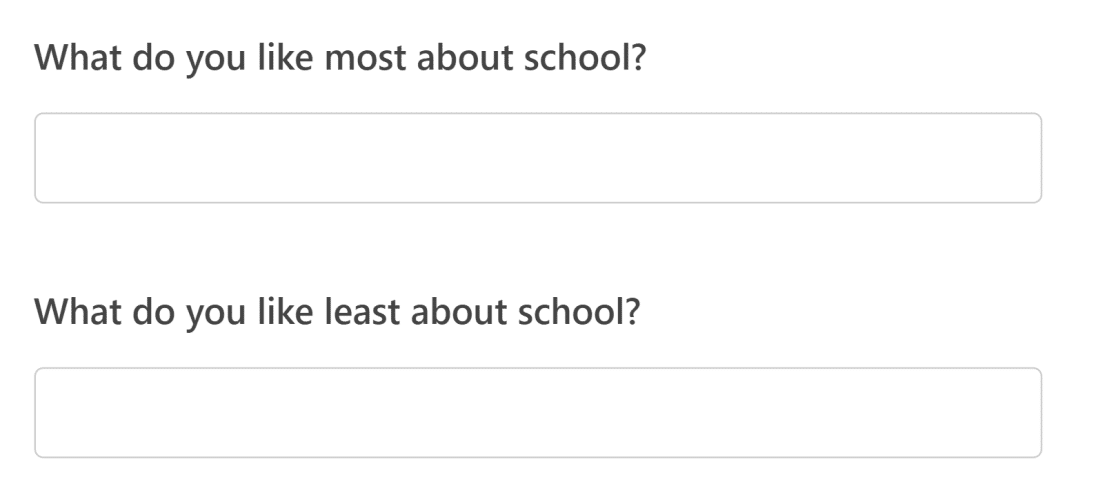
You might be surprised by how students respond to these questions. The responses can range all the way from the most trivial of complaints to small things your school does very well that students wholeheartedly appreciate.
14. After School Activities and Hobbies
Extra-curricular activities have a place of their own. But teachers aren’t always aware of the hobbies and after-school interests of their students.
Learning about the non-academic passions of your students may help you connect with your class in a better way. It’s one of those survey questions for students that they’ll definitely enjoy responding to.
The class survey form template has a series of pre-written questions concerning your student’s after-school activities.
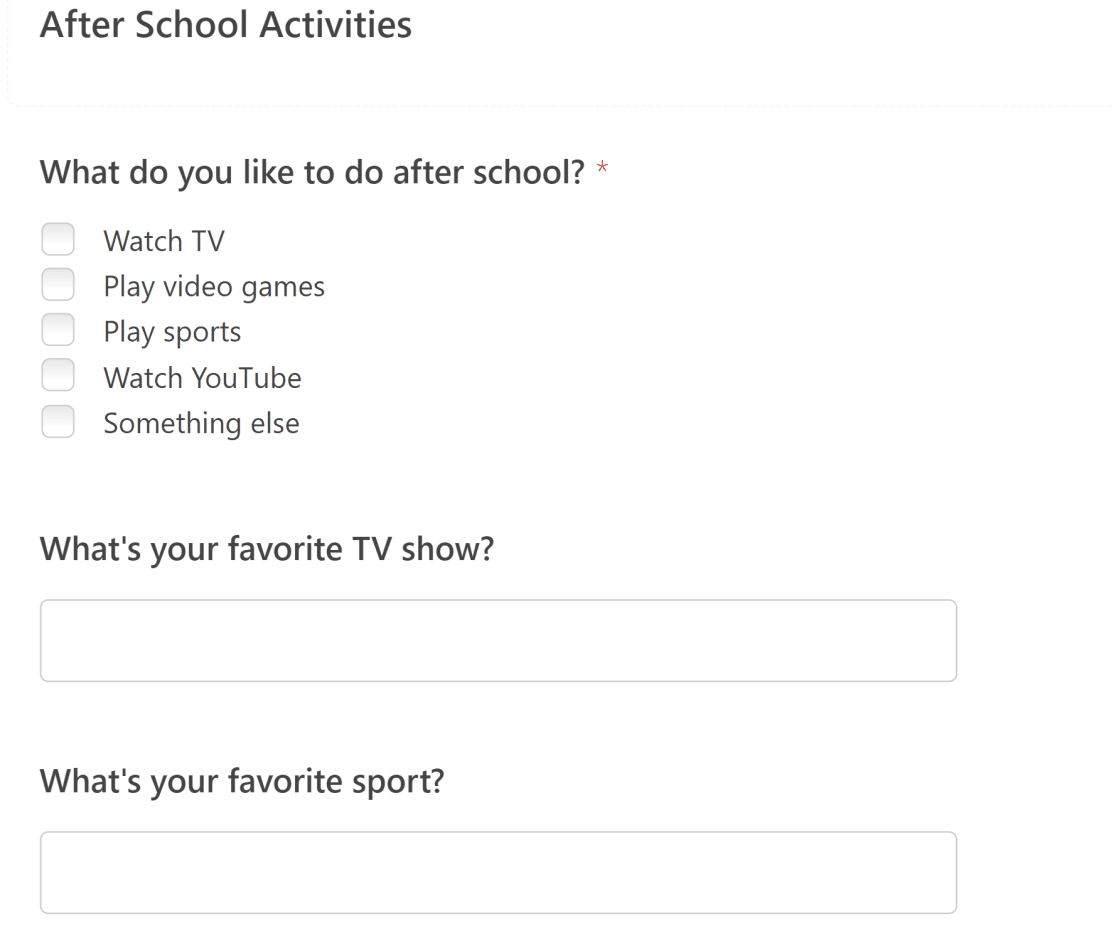
You can edit options in existing fields or add new fields entirely if you’d like to learn more about your students.
And there you have it! You now know the best student survey questions to ask and how WPForms lets you easily create a class survey form.
Remember that you can easily translate your forms if English isn’t the language of your school.
How to Write Effective Student Survey Questions
The questions above are a starting point, but you’ll almost always want to tweak them or write new ones for your specific class. These rules keep a new student survey clear and quick to answer.
- Keep the wording neutral: Avoid leading phrasing like “How great was today’s lesson?” Use “How would you rate today’s lesson?” instead. Loaded questions pull skewed answers.
- Match the language to the age group: Read every question out loud and ask whether the youngest student in your class would understand it without help.
- Mix close-ended and open-ended: Close-ended questions (rating scales, checkboxes, multiple choice) give you something to chart. Open-ended ones (short text, paragraph) catch the things you didn’t think to ask about.
- Avoid double-barreled questions: A question like “How clear and engaging were the lessons?” is actually two questions in a trench coat. Split it into two so each one can be answered cleanly.
- Keep the survey short: Aim for 10 to 15 questions max. Anything longer and the response rate drops off a cliff. If you need more data, run a second survey later instead of stretching this one.
- Use rating scales consistently: If you use a 1-to-5 scale on one question, use the same scale on every rating question in the survey. Changing scales mid-survey confuses respondents.
If you want to add a quantitative loyalty measure, the Net Promoter Score (NPS) survey format works well for school satisfaction. You ask “How likely are you to recommend this school to a friend?” on a 0 to 10 scale, then group the answers into promoters, passives, and detractors.
How to Increase Student Survey Response Rates
Writing the questions is only half the work. Getting students to actually fill the survey out is the other half. These are the small choices that consistently lift response rates.
- Make it anonymous: Remove the name and email fields, then turn on Disable storing user details (IP address and user agent) under Settings » General » Advanced in the form builder.
- That toggle needs GDPR Enhancements, which new WPForms installs have on by default, and our guide to anonymous student feedback walks through every setting.
- Give students dedicated time in class: “Spend the last ten minutes of class on this” gets far more responses than “Fill this out at home this week.”
- Tell students what the survey is for: A short paragraph at the top of the form explaining what you’re trying to learn and how the answers will be used makes a real difference.
- Share what changed last time: If you ran a survey last term, mention one or two things that changed because of it. Students are more likely to answer again when they can see their last answers led somewhere.
- Send a short reminder: A single follow-up reminder, sent two or three days into the survey window, picks up the students who meant to fill it out and forgot.
FAQs on Student Survey Questions
Student survey questions come up often when teachers and administrators start planning a feedback cycle. Here are short answers to the most common ones.
Why should I use student surveys?
Student surveys give educators and educational institutions a direct read on the student experience. After collecting responses, you can use the data to make informed decisions about policies, curriculum, and school activities so students get more out of their time at school.
How often should we conduct a student survey?
At least once a year. Twice a year or quarterly works too, but you may not see meaningful change in shorter windows. Annual surveys are the sweet spot for year-over-year comparison.
Should student surveys be anonymous?
Yes, in almost every case. Anonymity protects student identity and gets you more honest answers about their actual experience.
How can I encourage students to participate in our school survey?
Run the survey during class so students have dedicated time. Keep it short. Loop parents in so the survey shows up at home too. A small incentive (a name drawn from respondents) helps when participation has been low in the past.
What do schools do with the survey data?
Most schools review the data, identify a handful of changes worth making, and then track those changes against the next survey to see whether they worked.
What is the best way to administer a student survey, paper or online?
Online almost always wins. Online surveys are faster to fill out, easier to analyze, and you don’t have to manually enter responses into a spreadsheet. Paper still has a place in early grades where students aren’t using devices regularly, but for middle school and up, online is the better default.
How many questions should be on a student survey?
10 to 15 is a strong range for most classroom surveys. Shorter (5 to 8) works well if you’re running the survey frequently. Longer (20+) is fine for a once-a-year review, but expect a lower completion rate.
What are some good survey questions for students?
Good survey questions for students are short, neutral, and about something you can change, like workload, teaching methods, or classroom climate. Five strong ones from this list are:
- “Which subjects are you struggling with?”
- “How accessible is your teacher for questions and assistance?”
- “What teaching methods help you learn best?”
- “How many hours do you spend on homework each day?”
- “What would you like to change about class or the lessons?”
What are some fun survey questions for students?
Fun survey questions for students ask about life outside the lesson plan, like hobbies, favorite class activities, and what they’re proud of. From this list, “Which classroom activities do you find the most enjoyable?” and “What are your proudest achievements this year?” work well, along with the after-school hobbies questions. You can also add a light prompt like “If you could teach the class for a day, what would you teach?”
What are some good topics for a student survey?
Good topics for a student survey are learning and subjects, teaching methods, workload, classroom climate and well-being, and activities outside class. Each one has a matching question on this list, from “Which subjects are you struggling with?” for learning to “How comfortable do you feel expressing your thoughts in class?” for classroom climate.
Next, Let Your Students Preview Forms Before Submitting
Once your survey is built, it’s worth letting students preview their answers before they submit. WPForms has an entry preview feature that adds a confirmation step so students can catch typos or change their minds before the response is locked in.
WPForms also covers a wider set of education forms and solutions if you need more than surveys, like registration, enrollment, and parent communication forms.
Create Your Student Survey Form Now
Ready to build your form? Get started today with the easiest WordPress form builder plugin. WPForms Pro includes lots of free templates and offers a 14-day money-back guarantee.
If this article helped you out, please follow us on Facebook and X (Twitter) for more free WordPress tutorials and guides.