



AI Summary
A WordPress map plugin lets you embed interactive maps on your site, from simple location pins and store locators to full address-autocomplete fields inside your forms.
However, the problem with map plugins in WordPress is that these come and go very frequently. Some are also not maintained and updated very well.
Besides, different map plugins are designed for different purposes, so there’s really no ultimate map plugin that covers all possible map-related functionalities.
So I wanted to explore the hazy world of WordPress map plugins and try a bunch of these myself. In this post, I’ll be sharing the map plugins I discovered during my testing and describe what I like about them.
Create Contact Forms With Interactive Maps
Best WordPress Map Plugins I’ve Tested
Different plugins solve different problems, so I’ve grouped them by what they do best. Let’s start with the easiest solution for address autocomplete with maps. But first…
1. WPForms
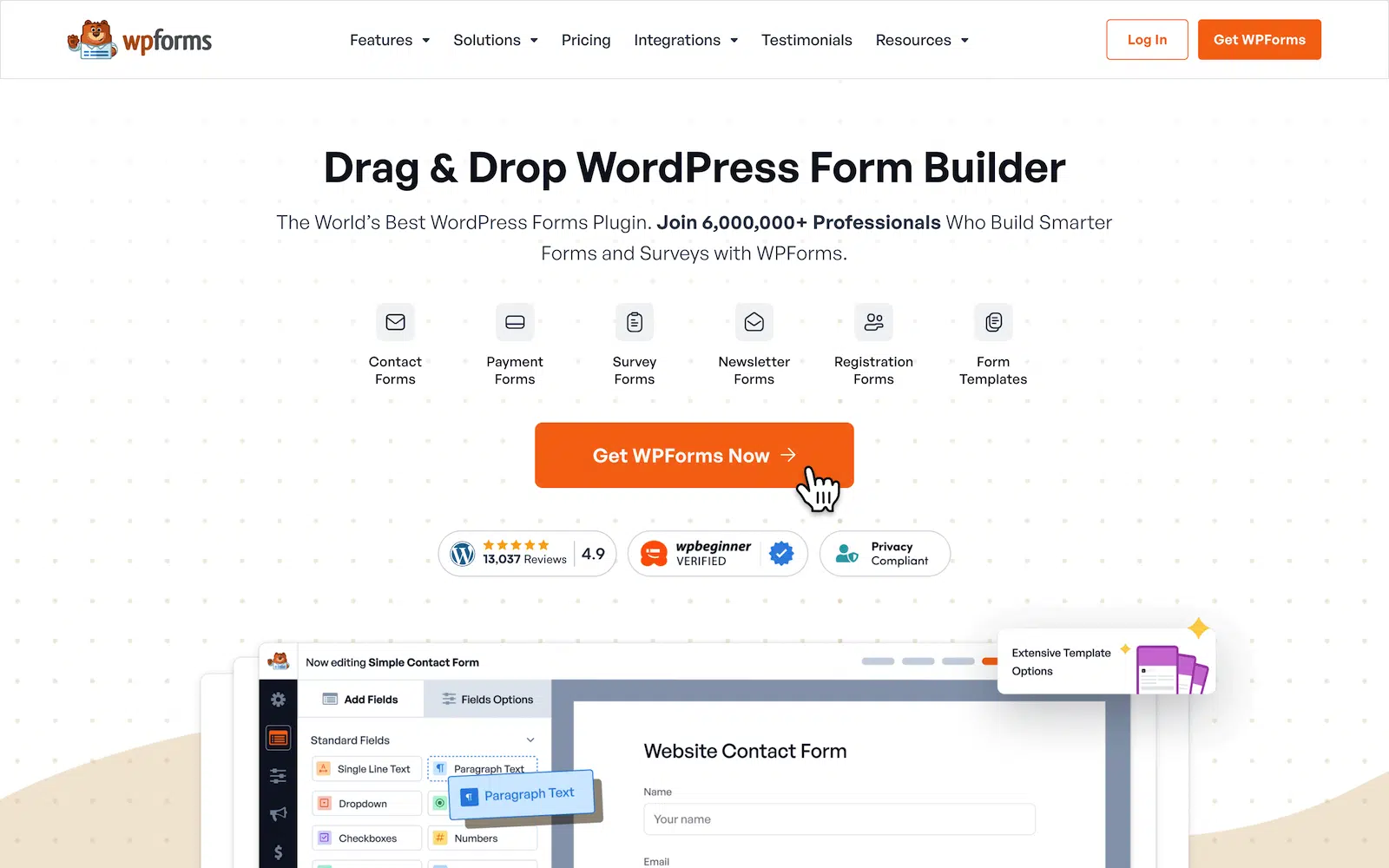
WPForms is popular as a form builder, but being a versatile plugin, it also includes powerful geolocation features that let you insert an interactive map into your form in multiple ways.
Address Autocomplete
The first way is through address autocomplete. Visitors can easily fill out the Address field by using a location pin on a map or allowing the form to autocomplete their address as they start typing it in.

You can also pre-fill the user’s address automatically as soon as the form loads. And I can tell you from experience that visitors appreciate nothing more than a dynamic form that smartly assists them in completing it faster.

Embedded Map Field
The second way is through WPForms’ Map field, which embeds a fully interactive Google Map or Mapbox map directly inside your form. With the Map field, you can:
- Display Multiple Locations: Show your store locations, office branches, event venues, or service areas on a single map.
- Enable Location Selection: Let form visitors choose their preferred location using radio buttons, perfect for appointment booking, store selection, or pickup point forms.
- Customize Markers: Use icons from the built-in Icon Library with custom colors, or upload your own marker images in small, medium, or large sizes.
- Control the Experience: Adjust zoom levels, enable “Find Nearby Location” to use browser geolocation for biasing results, and customize which map controls appear.
- Show Location Lists: Display a text list of all locations below the map for easy reference.

You have two options for map integrations using WPForms. You can connect your forms with Google Maps or Mapbox via their APIs. If you want to see the full setup walkthrough, the Map field documentation covers every configuration option in detail. Also read our guide: Best Mapbox plugins for WordPress.
Entry Tracking and Geolocation Data
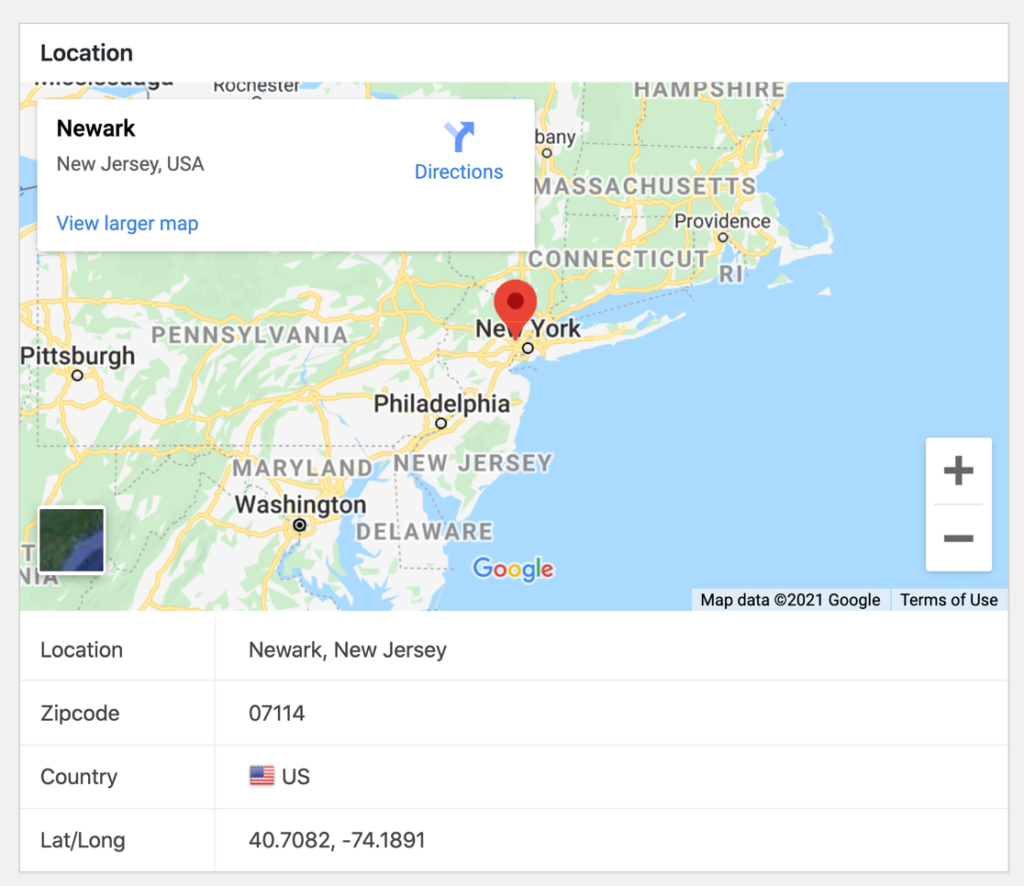
The WPForms Geolocation Addon also displays a map in your Entries area, where you can see the pin location selected by the person who submitted the form along with location details such as country, state, city, zip code, and even their approximate latitude and longitude.
In fact, you can collect location information (with visitor permission) for every person who fills the form, even if you don’t need it displayed on the form itself. You can install the Geolocation Addon in a few clicks from your WordPress dashboard.
My favorite part is that you can enable or disable the map display on any form with a single toggle switch inside the form builder. So there’s no tinkering with custom code to embed your maps.
Create Contact Forms With Interactive Maps
Geolocation Restrictions
Apart from the Geolocation Addon, WPForms also gives you ways to add georestrictions to your forms. For instance, if you’re a local business, it would only make sense for you to accept submissions from your country and block visitors outside of your area of operations.
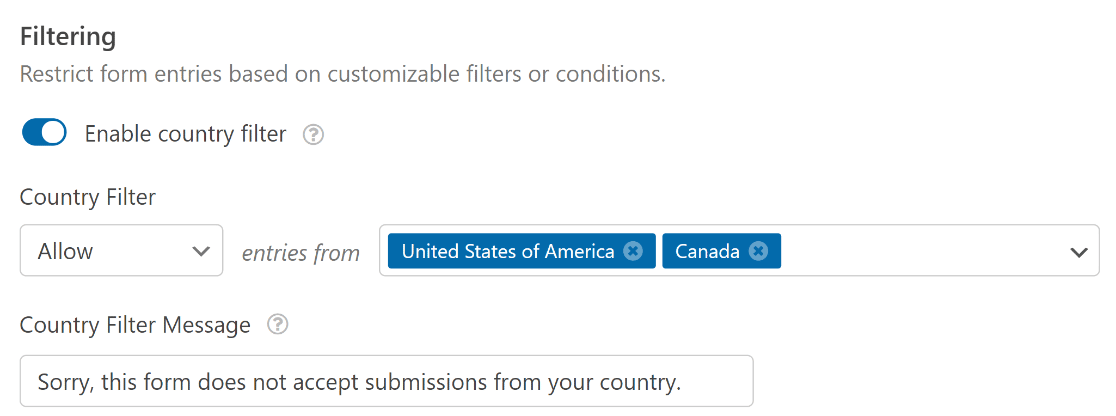
The country filter is also a great tool for blocking spam. Spambots often attack websites from similar IP addresses connected to the same country.
If you’re seeing high rates of spam from a specific country, I recommend using the country filter to restrict form submissions from that country.
Using WPForms is a pleasure thanks to its user-centric and simple design. And when you add conveniences like a huge library of 2,100+ WordPress form templates, building an address-aware form takes a few minutes instead of an afternoon.
In my opinion, you can’t find a better WordPress map plugin than WPForms if you want to enable geolocation features for a better user experience on your website.
What I Like:
- Faster form completion enabled by address autocomplete in WordPress.
- Interactive embedded Map field with multiple locations and custom markers.
- Location selection feature with radio buttons for visitor choice.
- Automatic collection of user location with every form submission.
- Visual address filling by dragging the map pin.
- Country filter for reducing location-based spam.
- Integration with Google Maps and Mapbox.
- No coding required for any map features.
Pricing: Starts at $199.50/year
2. SeedProd

SeedProd is the best landing page builder for WordPress, and it comes with a built-in Google Maps Block that lets you drop a map onto any page without writing any code.
What I’ve found handy is how much control you get inside the block itself. You can set the zoom level, adjust alignment, tweak width and height, and even add styling touches like borders and spacing, all from the block sidebar. Drag the block in, add your location, customize to taste, and you’re done.
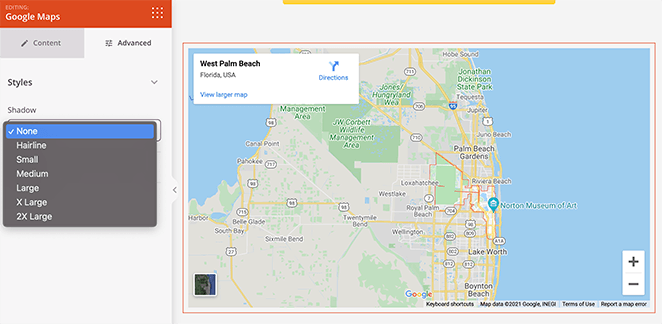
You can use SeedProd’s map features to visually indicate your business location, so it’s ideal for About Us or Contact Us pages. If you’re a physical business that serves customers on-premises, make sure you have a map on your website so customers can find you easily.
SeedProd includes tons of useful blocks that help you create high-converting landing pages. You can use the SeedProd plugin for lots of other purposes, too, not just adding maps to your website.
To learn more about SeedProd features, check out our detailed SeedProd review.
What I Like:
- No code required for embedding Google Maps on your site
- Flexibility to define zoom level, alignment, and width of the map
- Different border styles and spacing for your map
Pricing: Starting at $39.50/year.
Alternative: Thrive Architect.
3. Maps Marker Pro
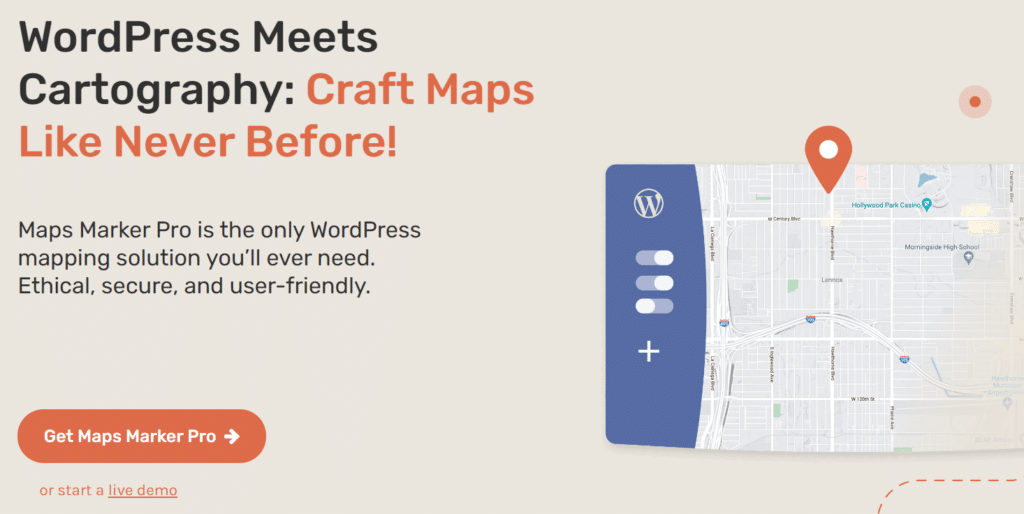
Maps Marker Pro is a popular premium WordPress mapping plugin, and it’s one of the most flexible on this list when it comes to the type of map you want to build.
It allows you to create a map with multiple locations and custom markers, and you’re not locked into Google. Maps Marker Pro supports multiple base maps including Google Maps, Bing, Mapbox, and OpenStreetMap, so you can pick the one that fits your budget and your privacy preferences.
On top of that, you can also create multilingual maps using Maps Marker Pro. It’s fully compatible with popular translation plugins like WPML translation and the Polylang plugin.
What I Like:
- Allows you to create multiple types of maps
- Supports different geocoding providers such as TomTom Geocoding, Google Geocoding, and others
- Filtering feature for easy map navigation
- Create animated marker clusters for each map
- Supports GPX tracking
- Sort markers by date, name, and distance
- Provides an option to share maps offline via QR codes
Pricing: Starts at $49/year.
4. WP Go Maps (formerly WP Google Maps)
WP Go Maps is probably the most popular map plugin in the entire WordPress space. With well over 25 million downloads and thousands of five-star reviews on WordPress.org, it’s the plugin most people end up with when they search for a free option.
One of my favorite things about WP Go Maps is how it handles API keys. It includes an OpenLayers map engine in its free version, so you can create a fully working interactive map without a Google Maps API key at all. Given how often Google’s pricing and policies shift, that’s a real plus.
The free version already lets you create maps with multiple markers, custom descriptions, and basic styling. If you upgrade to Pro, you get marker clustering, custom marker icons, heatmaps, marker categories and filtering, and a store locator feature. Pro is sold as a one-time payment rather than an annual subscription, which is unusual (and welcome) in this space.
What I Like:
- Supports 4 Google Maps types: terrain, roadmap, hybrid, and satellite
- OpenLayers option means no Google Maps API key required for the free version
- Flexibility to define map color, height, width, alignment, and zoom level
- Pre-built map templates for a store locator, directional map, and more
- Allows you to add descriptions, links, and images to map markers
- Advanced filtering option for map categories
Pricing: Offers both free and paid versions, with paid plans starting at $39.99 (one-time payment covering the current major version).
5. MapGeo – Interactive Geo Maps

MapGeo (officially listed as “MapGeo – Interactive Geo Maps” on WordPress.org) is a freemium plugin that takes a different approach than the Google-centric options on this list. Instead of dropping pins on a street map, it lets you highlight countries, regions, and continents on a clickable world map.
That makes it really useful if you’re showing something like service coverage areas, office locations across countries, sales territories, or event destinations. It comes with more than 250 pre-built region maps ready to use, so you rarely have to draw your own from scratch.
The free version gives you enough to build genuinely good-looking maps. Pro unlocks more interactive behaviors, advanced tooltips, and extra map templates.
What I Like:
- Easily create maps of continents and regions
- 250+ pre-built region maps
- Extensive customization options
- Define the center of the map and zoom level
- Export map as an image or PDF
Pricing: Offers a free version as well as paid plans with annual pricing of $39.99/year.
6. MapifyPro

MapifyPro is a powerful mapping solution for WordPress, and it’s available in both Lite and Pro versions.
With MapifyLite, you can create standard maps with images, videos, and custom map markers. For more advanced map features, you can move up to the Pro version.
The piece I find most useful is that MapifyPro uses its own mapping API instead of the Google Maps API. So you don’t have to worry about Google policy changes or API billing surprises, which is a real plus for sites that embed lots of maps.
What I Like:
- Add a video and photo gallery to any map
- Cluster feature for multiple locations
- Display customized map tooltips and popups
- Provides an option to share map locations on social media
- Add a location directory under the map for better interaction
Pricing: Starts at $193.80/year.
7. Easy Google Maps
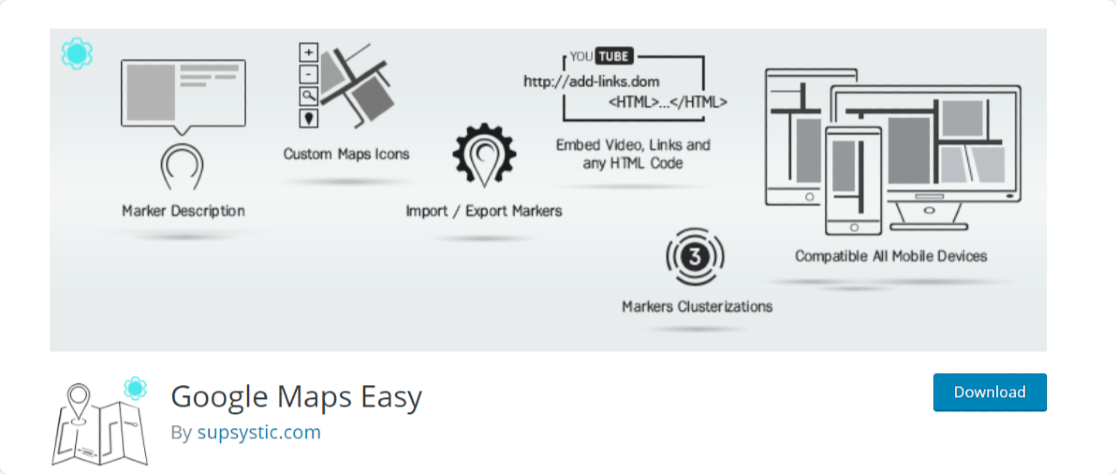
Easy Google Maps is one of the popular plugins for creating online Google maps in WordPress. As the name suggests, it really is easy, and it comes in both Free and Paid versions.
Easy Google Maps provides 3 embedding options. You can add Google Maps with a shortcode, open it in a pop-up, or use the Google Maps widget.
The Free version of Easy Google Maps includes enough features to create working Google Maps on your WordPress websites. If you don’t want to invest in a map plugin yet, this one is worth trying.
What I Like:
- Create Google Maps with an unlimited number of map markers and locations
- Add an image, video, email, text, or phone number as a map marker description
- Customize Google Maps with colorful skins and beautiful pictures
- Flexibility to import and export map markers
Pricing: Free plugin with paid plans starting at $49/year.
8. Maps Widget for Google Maps
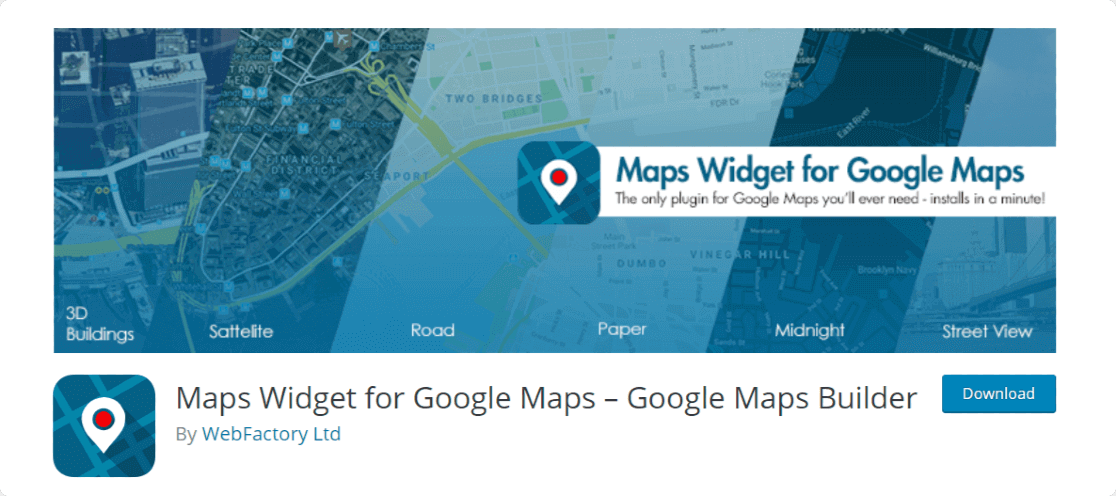
If you want to display a map in your website footer, header, sidebar, or inside a widget area, Maps Widget for Google Maps is a solid option. It’s a freemium plugin built specifically for widget-style placement, and it works with the classic widgets and as a Gutenberg block, so you can drop a map just about anywhere.
It hides a lot of customization under the hood, like map color schemes, label styles, and pin designs, so the map on your page matches the rest of your theme instead of looking like an afterthought.
Features:
- Create unlimited maps and add as many pins as you’d like
- Advanced map customization options such as zoom level, colors, fonts, map type, and map size
- Display maps in a lightbox for a better view
- Gutenberg block for adding maps to any post or page
Pricing: Free plugin with paid plans starting at $29/year.
9. MapPress Maps for WordPress
MapPress has been around for more than a decade and has 60,000+ active installs on WordPress.org, which tells you something about how reliable it is. You can create interactive Google and Leaflet maps with MapPress, and the Leaflet option means you can skip the Google API key entirely if you want to.
Its Lite version lets you create unlimited maps and lets you add map markers using the modern and classic editors. There’s a lot you can do with MapPress, with its fairly advanced range of customizations. There were more settings than I knew what to do with, but it was still simple to use just the settings that mattered to me (such as customizing pin icons, map alignment, and size).
What I Like:
- Create a map with latitude and longitude coordinates or address
- Define the zoom level for the map
- Add custom map markers
- Leaflet support means no Google Maps API key required
Pricing: Free map plugin with paid plans starting at $39/year.
FAQs About WordPress Map Plugins
WordPress map plugins come in a lot of flavors, so here are quick answers to the most common questions readers ask when picking one.
What is a map plugin?

A WordPress map plugin helps you embed and display Google maps on your website without writing a single line of code (in most cases).
Generally, a map plugin offers multiple features that you can use to create and showcase customized maps on your website. With a powerful map plugin, you can change map themes, add multiple locations, create custom markers, and much more.
Of course, you can add custom HTML code to embed Google Maps on your site, but doing so will limit many of the customization options you’d get with a map plugin.
What is the best free WordPress map plugin?
For most sites, WP Go Maps is the best free map plugin because its OpenLayers engine works without a Google Maps API key, and it still supports multiple markers, custom descriptions, and basic styling. MapPress is a strong runner-up if you want Leaflet support, and Easy Google Maps is a good pick if you prefer sticking with Google’s base maps on the free tier.
How do I add multiple locations to a WordPress map?
If you want customers to pick between locations inside a form (for booking, pickup, or appointments), use the WPForms Map field and enable the location-selection option with radio buttons. For a standalone map with many pins, WP Go Maps and Maps Marker Pro both support multi-location maps with marker clustering and custom icons.
How do I create an interactive map in WordPress?
The simplest way to create interactive maps in WordPress is to use a map plugin. A plugin opens up lots of customization and styling options for your map display. You can change the look of your map and match it with your website’s brand and design.
Styling and customizing maps with HTML and CSS is time-consuming and requires advanced coding knowledge. If you’re a beginner, using a map plugin is a much faster path.
How do I add a Google Map to WordPress?
You can embed Google maps in WordPress using 2 methods:
- Add Google Maps in WordPress with a map plugin
- Add Google Maps in WordPress manually
We recommend using a Google Maps plugin for the process. Many map plugins are integrated with easy embedding options that let you quickly add maps on any page or post on your website.
Does WordPress have a built-in map feature?
WordPress does not have a built-in map feature. You need to install and use a third-party plugin if you want to use or display a map on your website.
Will using a map plugin slow down my site?
Using a map plugin shouldn’t slow down your WordPress site because most of them are pretty lightweight. That said, if you embed multiple maps on a page, especially if they’re complex in nature and include a lot of features, that could potentially slow down your page load time.
Next, Start Collecting Location Data From Your Visitors
Now that you’ve picked a map plugin, the next logical step is to put it to work inside your forms. If you want to track user locations with form submissions, WPForms makes the whole setup a matter of a few toggles.
If you’re planning an online store on the side, you might also want to check out our post on the best WordPress eCommerce plugins for your next build.
Create Contact Forms With Interactive Maps
Ready to build your form? Get started today with the easiest WordPress form builder plugin. WPForms Pro includes lots of free templates and offers a 14-day money-back guarantee.
If this article helped you out, please follow us on Facebook and X (Twitter) for more free WordPress tutorials and guides.