



AI Summary
Are you looking for a SendLayer review to help you decide if this is the right option for you?
SendLayer is an affordable transactional SMTP email provider that’s very easy to set up and ensures excellent deliverability.
But is this the right mailer for you?
In this SendLayer review, I’ll take a close look at the main features of this mailer.
Is SendLayer the Best SMTP Service?
SendLayer is the SMTP service I recommend for most WordPress sites, because it authenticates your domain properly, sets up in about fifteen minutes, and starts at $5 a month.
SendLayer Review
I went through SendLayer feature by feature and checked every plan against its current pricing page. Here’s the full breakdown and why you should consider SendLayer:
- What Is SendLayer?
- 1. The SendLayer Dashboard
- 2. SMTP Relay and the Email API
- 3. Domain Authentication and Deliverability
- 4. Email Logs
- 5. Email Analytics
- 6. Suppression and Bounce Management
- 7. Webhooks and the SendLayer MCP Server
- 8. Integrations and WordPress Setup
- SendLayer Pricing
- Using SendLayer With WPForms
- My Verdict on SendLayer
What Is SendLayer?
SendLayer is a transactional email provider, which means it handles the automated messages your site sends in response to something a user did.
Order confirmations, account verifications, password resets, shipping updates, appointment reminders, and contact form notifications all count.
What SendLayer gives you instead of campaign tools is a transactional SMTP email provider with two ways in, an SMTP relay and a JSON email API, plus the logging and authentication tooling around them.
The reach is broader than you might expect from a product this focused. SendLayer works with over 1,000 platforms and reports customers in more than 150 countries.
Documented paths exist for WordPress, WooCommerce, Magento, BigCommerce, Joomla, Drupal, Laravel and Help Scout.
1. The SendLayer Dashboard
The SendLayer dashboard is uncluttered to the point of being sparse, and after using a few other transactional providers I mean that as a compliment.
SendLayer opens on a summary of your sending activity with your plan and current sending limit visible in the same view. No hunting through account pages to find out how many emails you have left this month.
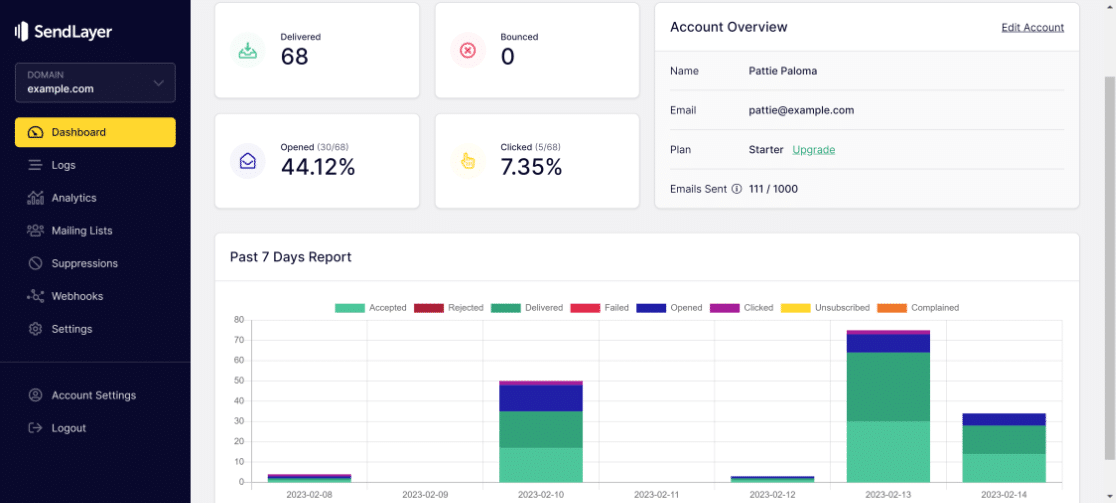
Settings, Account Settings, mailing tools, logs and analytics all live in the sidebar, each one click away. The naming is plain English rather than jargon.
If you have ever tried to find a suppression list buried three levels deep in a competitor’s admin, you will appreciate how little of that there is here.
2. SMTP Relay and the Email API
SendLayer gives you two ways to send, an SMTP relay and a JSON email API, and both are available on every plan including the trial.
The SMTP route is the one most WordPress users want, and SendLayer generates the host, port, username and password for you.
Connecting a site is a matter of pasting those four values into whatever plugin or platform is doing the sending.
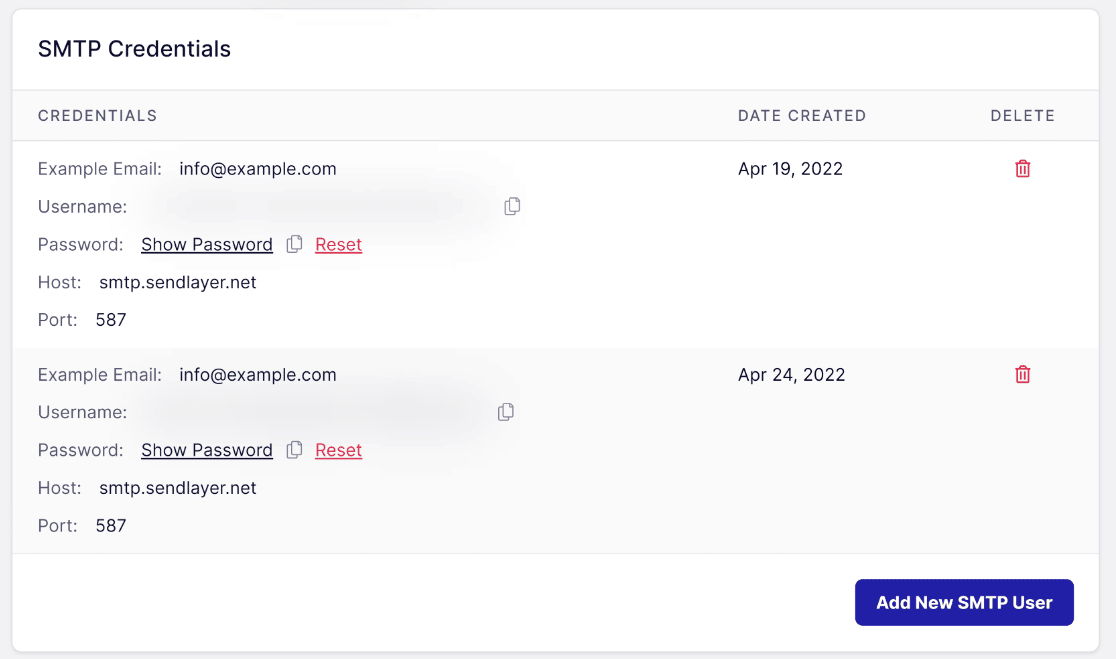
The Email API is the addition most worth knowing about if you are building something custom, and it did not exist in any meaningful form when this review first went up.
It is a JSON API rather than an older XML one, so payloads stay small. A send is a single POST carrying From, To, Subject and either HTMLContent or PlainContent.

There are official SDKs too. The Python one reduces a send to three lines, and SendLayer publishes guides for Nodemailer and smtplib alongside it.
You can also pull your email logs back out through an events endpoint with filtering, which is more than a lot of basic sending APIs offer.
Delivery speed has held up as SendLayer’s strongest quality throughout. Emails sent through the relay rarely bounce, and messages generally show up in a Gmail inbox within seconds rather than minutes.
3. Domain Authentication and Deliverability
SendLayer walks you through SPF, DKIM and DMARC records during setup, and this guided DNS step is the single biggest reason emails stop landing in spam instead of the inbox.
A quick translation of those three, because they get thrown around a lot without explanation.
- SPF tells receiving mail servers which servers are allowed to send on your behalf.
- DKIM adds a cryptographic signature that proves the message was not tampered with in transit.
- DMARC tells those servers what to do when a message fails either check.

Get all three right and Gmail, Outlook and Yahoo have a reason to trust you. Get them wrong and no amount of good copy saves the email.
SendLayer has written host-specific DNS walkthroughs for GoDaddy, Cloudflare, SiteGround, Namecheap, Hostinger, Bluehost, DreamHost, HostGator, A2 Hosting, Amazon Route 53, Name.com, Network Solutions and cPanel, fifteen of them at last count.
Rather than handing you a list of records and wishing you luck, it generates the exact values and gives you copy-and-paste instructions.
DNS is where most people give up on a mailer, so having a guide written specifically for your registrar matters more than it sounds like it should.
There is a second layer of protection that I think is genuinely clever. When you authorize a domain, SendLayer automatically creates a sending subdomain and routes your transactional mail through it.
Because subdomain and root domain reputations are tracked separately, a bad stretch of bounces or spam complaints hits the subdomain rather than your main domain.
Most providers let you set this up, but SendLayer makes it the default, which means you get the protection whether or not you knew to ask for it.
4. Email Logs
SendLayer logs every email you send, including the ones that failed, and the log screen is where I would start if messages ever went missing.
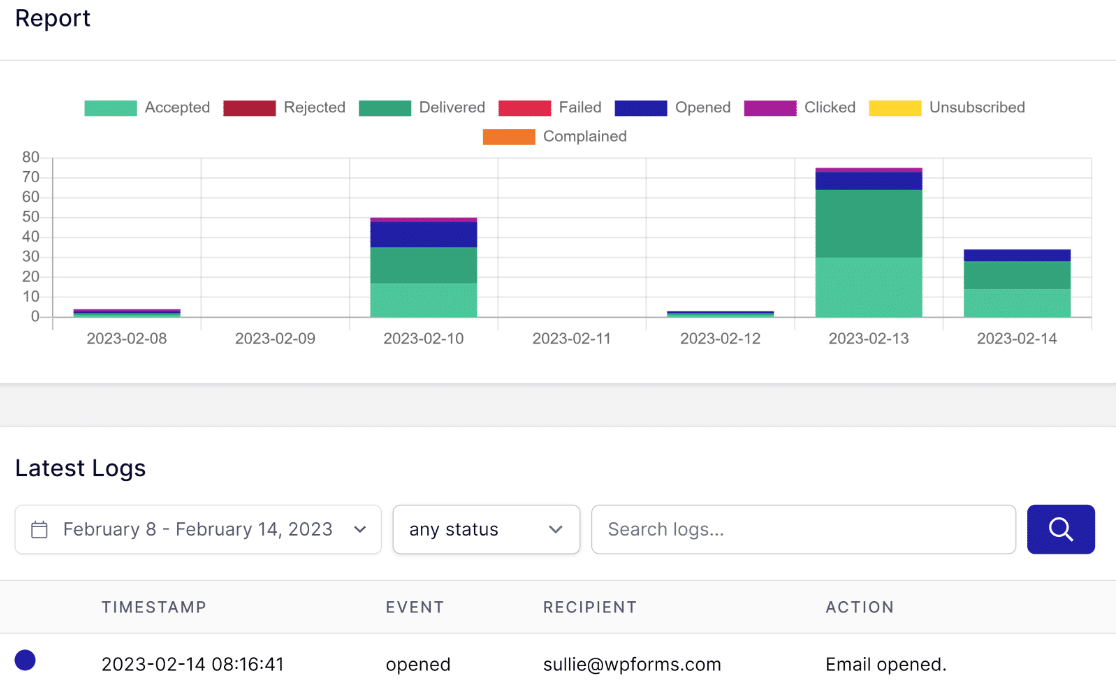
The screen opens on a chart breaking down recent sends by status, then lists individual messages underneath.
You can see what was delivered, what bounced, what was opened, what was clicked and which recipients marked a message as spam. When a customer swears they never got their receipt, this is a one-minute answer instead of a support ticket.
Log retention is the one thing to watch, because it is tied to your plan and the entry tier is tight. Starter keeps 3 days of logs, Business keeps 15 days and Growth and Scale keep 30 days.
Three days is workable for spotting an active problem and no use at all for investigating something a customer reports a week later.
If you want a longer history on the WordPress side as well, you can also keep email logs inside WordPress independently of what SendLayer retains.
5. Email Analytics
Email Analytics is the simplified view of the same data, stripped down to opens and clicks so you can compare engagement without reading individual log entries.
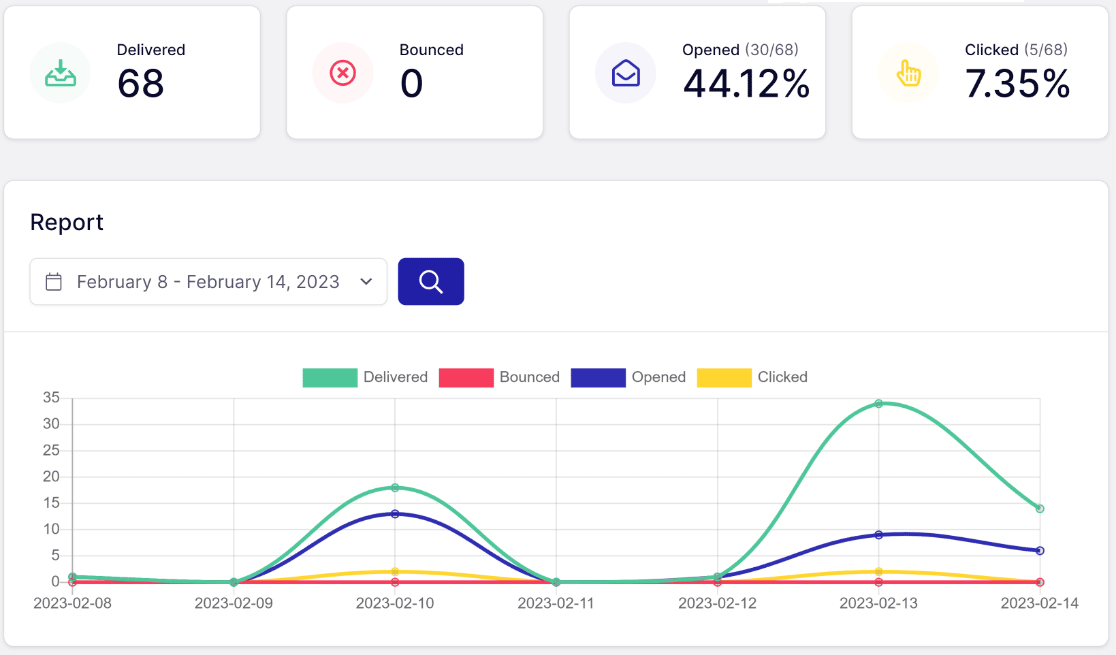
Open and click tracking is a named feature on every plan, and SendLayer treats it as a first-class part of the product rather than an upsell.
In practice the analytics screen is where you go to answer a trend question, and the log screen is where you go to answer a question about one specific message.
For transactional email the numbers matter less than they do for marketing, but they are not useless.
A receipt nobody opens usually means a subject line problem, and a click rate that falls off a cliff usually means a broken link in a template.
6. Suppression and Bounce Management
SendLayer maintains a suppression list automatically, and it catches the two categories of address that damage your sender reputation fastest.
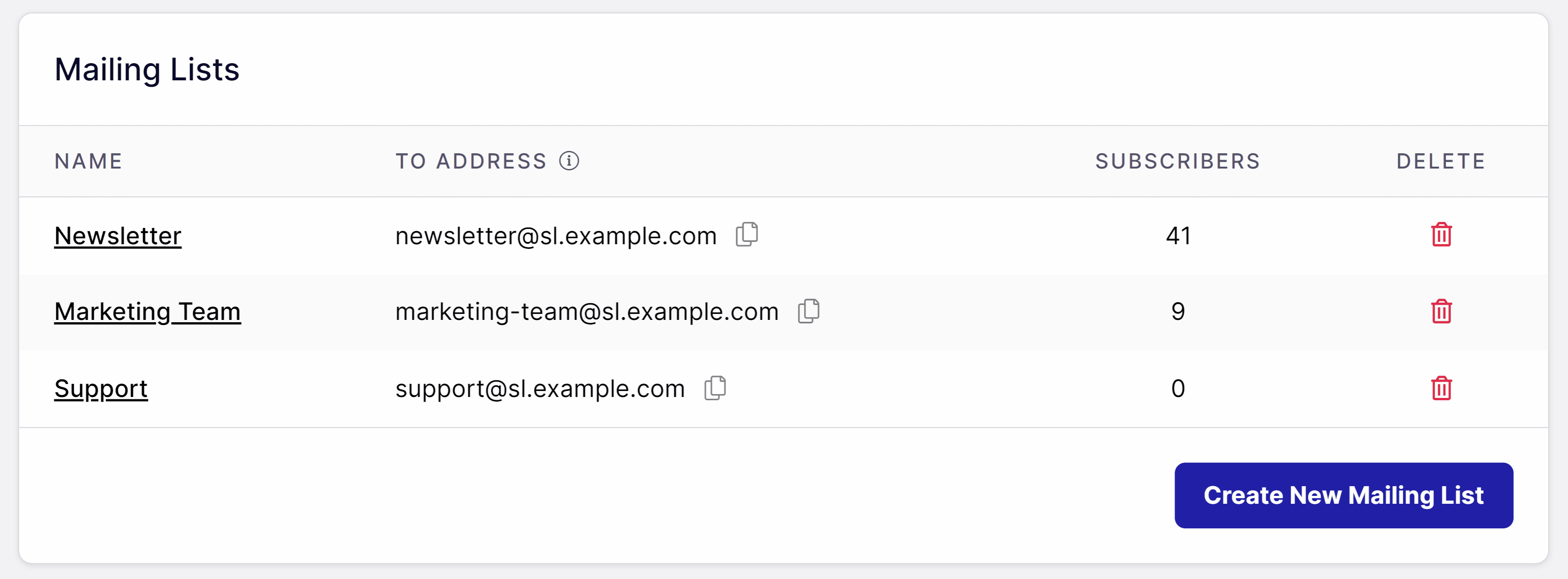
SendLayer adds an address to your suppression list and stops sending to it as soon as a message hard-bounces for a permanent reason.
The same happens when a recipient files a spam complaint. You can review and edit the list yourself so nothing is locked away, but the default behavior is the one you want. Repeatedly emailing a dead address is one of the clearest negative signals a mailbox provider watches for.
Alongside suppression there is bounce management and blocklist management, both included on every plan. Active anti-spam monitoring watches your complaint and bounce rates and flags trouble before it becomes a delivery problem.
7. Webhooks and the SendLayer MCP Server
SendLayer pushes email events to your application through webhooks, which saves you polling the API to find out what happened to a message.
You register a URL and SendLayer sends it an HTTP POST the moment something happens, with delivered, opened, clicked and bounced all available as events.

Webhooks are included on every plan rather than gated behind a higher tier. The practical use is keeping your own database honest.
When an address bounces, you can flag that user immediately instead of discovering the problem the next time you try to email them.
8. Integrations and WordPress Setup
SendLayer works with over 1,000 platforms, and the WordPress path is the smoothest of them.
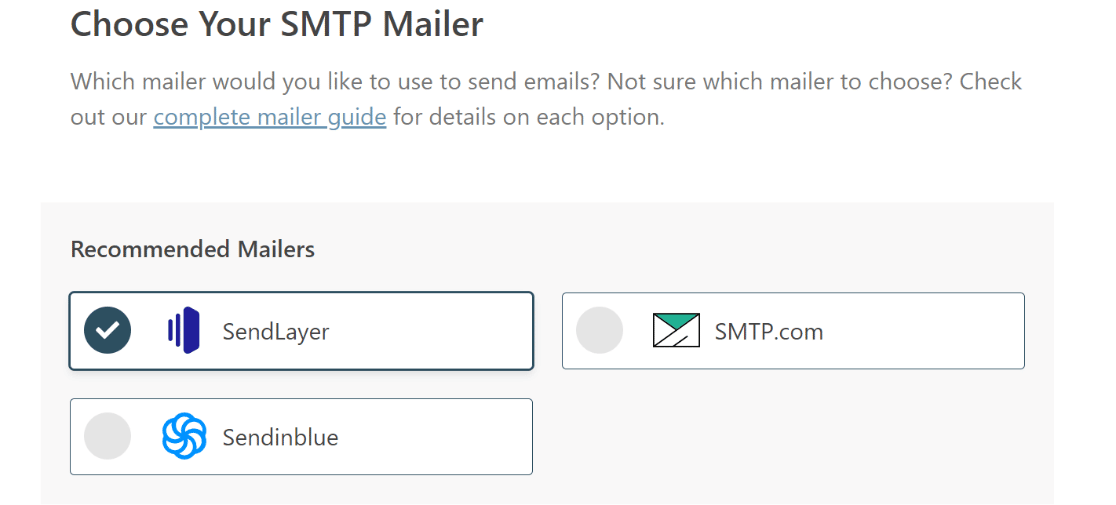
On WordPress, SendLayer connects through WP Mail SMTP, which is free and lists SendLayer as its first recommended mailer. You install the plugin, pick SendLayer from the mailer list and paste your API key.
The site’s outgoing email reroutes through SendLayer from that point on, with no code, no manual SMTP configuration and nothing to buy on the plugin side.
If you are weighing up your options there, our roundup of the best WordPress SMTP plugins covers the alternatives.
SendLayer Pricing
SendLayer starts at $5 a month billed annually, which makes it one of the cheaper transactional mailers you can buy without dropping to a free tier with strings attached.
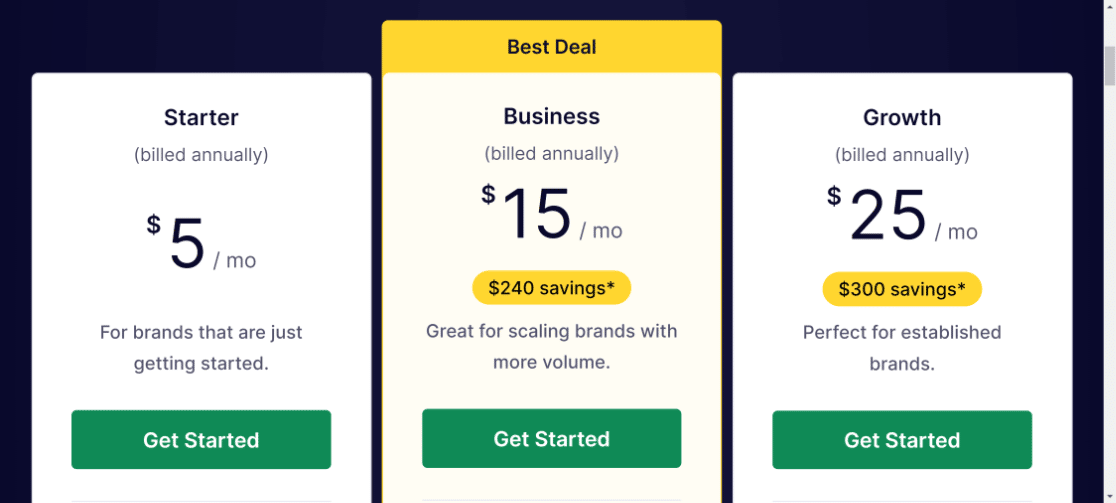
There are four plans and the number of sender domains separates the tiers as much as the sending volume does, and your sending limit resets monthly.
| Plan | Price | Emails per month | Sender domains | Log retention | Support |
|---|---|---|---|---|---|
| Starter | $5/mo | 1,000 | 1 | 3 days | Standard |
| Business | $15/mo | 5,000 | 3 | 15 days | Premium |
| Growth | $25/mo | 10,000 | 5 | 30 days | Premium |
| Scale | Custom quote | 20,000+ | 20 | 30 days | VIP |
API and SMTP relay, suppression management, open and click tracking, bounce management, blocklist management, active anti-spam, event-based webhooks, analytics and DKIM, SPF and DMARC authentication are all in at $5.
- All plans are billed annually: The $5 figure is the monthly equivalent of an annual charge, not a month-to-month price. Budget $60 up front for Starter rather than $5.
- The free option is a trial, not a plan: You get 200 emails to test with, once. SendLayer’s own billing documentation confirms the monthly reset applies to paid plans and explicitly excludes the trial.
If you go over your plan’s limit, SendLayer upgrades you automatically rather than failing your sends.
That is the right call for transactional mail, but it does mean you should watch your volume. Paid plans carry a 14-day money-back guarantee, no questions asked.
Using SendLayer With WPForms
A contact form notification that never arrives is the most common reason WordPress site owners go looking for a mailer in the first place. The form works, the entry saves, and the email announcing it silently disappears.
That happens because WordPress sends mail through PHP by default, without authentication, from a server that mailbox providers have no reason to trust.
Gmail and Outlook treat those messages as suspicious, and the result is a form that looks like it is broken when it is really just being filtered. Our guide to what to do when a contact form isn’t sending email walks through the diagnosis.
My Verdict on SendLayer
Guided SPF, DKIM and DMARC setup, an automatic sending subdomain, full logs, open and click tracking, webhooks, an email API and an MCP server are all available on the $5 plan. Most competitors gate at least two of those behind a higher tier.
FAQs on SendLayer
SendLayer pricing and its free trial are what most people ask about before signing up. Here are the answers to the questions that come up most often in this SendLayer review.
Is SendLayer free?
No, SendLayer has no permanently free plan.
You get a one-time free trial of 200 emails to test the service, and after that every plan is paid, starting at $5 a month billed annually.
The trial is a development and evaluation allowance rather than a free tier with a monthly reset.
How much does SendLayer cost?
SendLayer costs $5 a month for Starter, $15 a month for Business and $25 a month for Growth, all billed annually.
Those plans cover 1,000, 5,000 and 10,000 emails a month respectively. A Scale plan handles 20,000 or more emails on a custom quote. All paid plans come with a 14-day money-back guarantee.
Does SendLayer work with WordPress?
Yes. SendLayer connects to WordPress through the free WP Mail SMTP plugin, where it is listed as the first recommended mailer.
You paste your SendLayer API key into the plugin and your site’s outgoing email routes through SendLayer from then on. No code and no paid plugin are required.
Can I send marketing emails with SendLayer?
SendLayer is built for transactional email and does not include campaign tools, newsletter templates or audience segmentation.
You can technically send any email through the relay, but there is no interface for building and scheduling a campaign, and SendLayer retired its mailing list feature.
Use a dedicated marketing platform for newsletters and keep SendLayer for the automated messages your site triggers.
What are the best SendLayer alternatives?
The closest alternatives for WordPress sites are Brevo, SMTP.com and Amazon SES. The plugin side is worth considering separately from the mailer. Easy WP SMTP is one option there.
That said, SendLayer remains my recommendation for most WordPress sites, because the cheapest plan includes the full feature set and the guided DNS setup removes the step most people get stuck on.
Next, Fix WordPress Email Delivery Issues
Email failures are one of the most common problems WordPress sites run into, and almost all of them come down to authentication rather than anything genuinely broken.
Our detailed guide on fixing email delivery failures in WordPress walks through the causes in order, from the PHP mail function through to DNS records.
If you are thinking about the wider picture of how your site talks to customers, it is also worth reading up on conversational marketing and where automated email fits into it.
Create Your WordPress Form Now
Ready to build your form? Get started today with the easiest WordPress form builder plugin. WPForms Pro includes lots of free templates and offers a 14-day money-back guarantee.
If this article helped you out, please follow us on Facebook and Twitter for more free WordPress tutorials and guides.