


AI Summary
When a good employee quits, the first question I want answered is why. The honest why, the one you only get when someone has nothing left to lose and feels safe enough to say it.
An exit survey is the cleanest way to get that answer, as it catches what slips past managers in day-to-day reviews, and it gives you a paper trail of patterns you can act on.
If you’re not sure what to ask, I’ve put together a list of 20 questions that consistently surface useful feedback, plus a few best practices I’d follow no matter what tool you use.
Get the Exit Survey Template Now! 🙂
Must-Ask Exit Survey Questions
When designing your exit survey, I strongly recommend keeping it short enough that it takes no longer than 15-30 minutes for a person to fill out.
You don’t have to use every question in the list below. Instead, I suggest picking only the survey questions that make the most sense for your organization.
- 1. Why are you quitting this job?
- 2. What made you look into a new job?
- 3. What could have been done for you to remain employed here?
- 4. Did you share your concerns with anyone at the company prior to leaving?
- 5. What would you have changed about your job?
- 6. Did you have clear goals?
- 7. Were you given enough training for your job?
- 8. What extra responsibilities would you have taken on?
- 9. Does the company stick to its values and mission?
- 10. How would you describe the company's culture?
- 11. Do you believe that upper management communicates well?
- 12. Do you enjoy the way we conduct employee reviews?
- 13. What did you enjoy the most about this job?
- 14. What did you enjoy the least about this job?
- 15. Are there any specific issues you'd like us to know about?
- 16. What would need to change for you to consider returning to this job?
- 17. Did you ever feel bullied or harassed in any way?
- 18. What new company will you be joining?
- 19. How can we make your transition smoother?
- 20. Is there anything else you'd like to add?
1. Why are you quitting this job?
This is an obvious one that you’ll want to ask right away. There are a few ways you could present this question in your survey form.
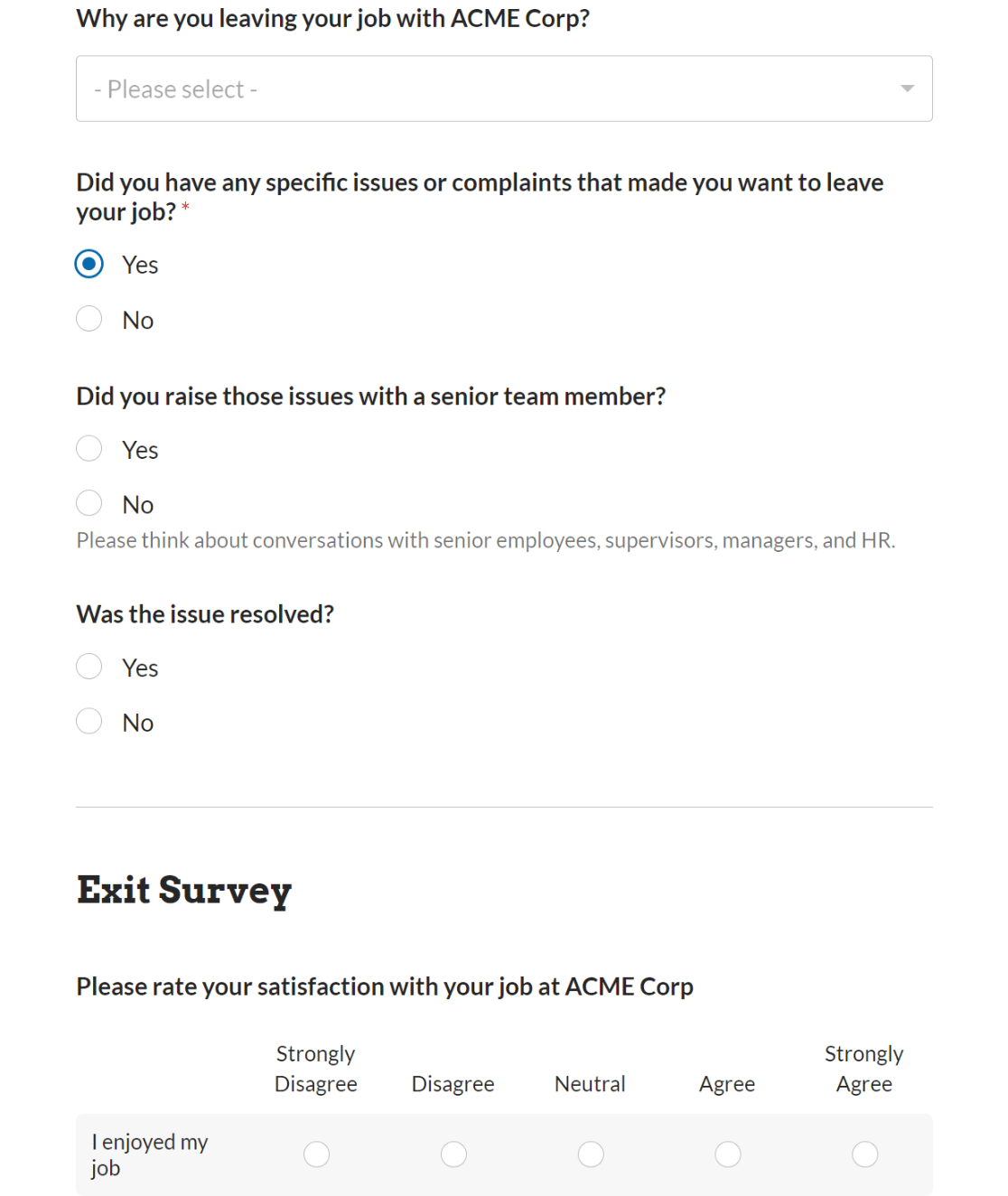
For instance, you could use a Dropdown field with common reasons for quitting listed, along with a Paragraph field for allowing the leaving individual to provide details.
Or you could only use the Paragraph field to capture details about the person’s reasons for quitting.
2. What made you look into a new job?
Figuring out a specific time or event that caused someone to leave can help you pinpoint where and by whom changes need to be made.
Once again, you could use a Dropdown field with a few selection options for this question. Some common preset options for this question are:
- Pay lower than expectations
- Dissatisfied with growth prospects
- Unhappy with work-life balance
- Other
You could then couple the Dropdown field with a Paragraph field that appears after the respondent has selected an option from the Dropdown. In WPForms, this can be easily accomplished using conditional logic.
3. What could have been done for you to remain employed here?
People love being asked this and they tend to answer specifically. You’ll often get incidents named, sometimes other employees named, and almost always a workable suggestion.
The answers here are the most actionable in the entire survey. If three people in a row mention the same blocker, that’s not coincidence, that’s your roadmap.
4. Did you share your concerns with anyone at the company prior to leaving?
This question tells you whether your feedback channels are working. If most exiting employees say no, you’ve got a communication problem before you’ve got a retention problem.
Follow up with “if not, why not” to dig into whether people felt safe raising concerns, or whether they tried and got nowhere. The answer pattern tells you a lot about whether your culture supports candor.
5. What would you have changed about your job?
This question reframes the conversation from complaint to design. You’re asking the person who knows the role best how they’d improve it for whoever comes next.
Save the responses and reference them when you write the next job description. It’s the most efficient role redesign you’ll ever do.
6. Did you have clear goals?
If employees say they didn’t, you’ve got an organizational clarity problem that costs you more than you think. People who don’t know what they’re aiming for tend to underperform, get frustrated, and eventually leave.
Pair this with a follow-up about whether goals changed without explanation. Goal whiplash is a quiet killer of engagement.
7. Were you given enough training for your job?
This surfaces gaps in onboarding and ongoing development. New hires often don’t know what they’re missing until 6 to 12 months in, at which point you’ve already lost time.
If the answer is no, ask what specifically would have helped. Most of the time you’ll hear about a knowledge gap, a tool they never got trained on, or a process that was tribal knowledge nobody documented.
8. What extra responsibilities would you have taken on?
Useful for two reasons. First, it tells you where the role had room to grow, which helps you design the next iteration. Second, it tells you what motivated the person leaving, which is data you can use to retain similar profiles.
If you hear “I would have loved to mentor junior staff” or “I wanted to own the analytics work”, those are signals about what your team genuinely wants from their work.
9. Does the company stick to its values and mission?
If you put your values on a careers page, you should be willing to hear what departing employees really think about them. A “no” here stings, but it’s a free audit.
Ask for examples. Generic “no” answers tell you something is off. Specific “no” answers tell you exactly what to fix.
10. How would you describe the company’s culture?
Culture is fuzzy by nature, which is why you want to ask it open-ended. Two people in the same office can describe wildly different cultures, and both descriptions are real.
Look for patterns across responses over a year. If five out of seven exiting employees describe the culture as “competitive” or “siloed”, you’ve got an actionable signal even if no single answer was a smoking gun.
11. Do you believe that upper management communicates well?
Communication is the most common complaint on exit surveys, full stop. Always ask about it.
You’re looking for two signals. Whether information flows down (do people know what’s happening), and whether feedback flows up (do leaders hear concerns and act on them). Both are worth measuring separately, so if you have space, split this into two questions.
12. Do you enjoy the way we conduct employee reviews?
Reviews are where careers either grow or stall, so the process matters more than most leaders think. Ask how the employee perceived appraisals, promotions, and feedback cadence.
If you hear that reviews felt rushed, unfair, or disconnected from actual day-to-day work, that’s a fixable problem and a major reason people leave.
13. What did you enjoy the most about this job?
This one matters just as much as the negative questions because it tells you what you’re doing right and need to protect.
Common answers cluster around teammates, learning opportunities, and meaningful work. If those start drying up across your responses over time, you’ll know you’re losing what made the place worth working at.
14. What did you enjoy the least about this job?
The flip side. If you see the same answer pop up repeatedly across departing employees, that’s your immediate priority list.
The strongest exit survey data is patterned, not individual. One person hating the all-hands meetings is noise. Twelve people hating them in a row is a signal.
15. Are there any specific issues you’d like us to know about?
Open-ended catch-all for anything the other questions didn’t surface. Some employees only feel safe naming a specific issue on the way out, and this question gives them a clean place to do it.
Treat the answers here with care. If someone names a person or incident, take it seriously, even if the report is the only one. Patterns start with the first datapoint.
16. What would need to change for you to consider returning to this job?
Two things make this question valuable. First, the answer is specific and actionable. Second, it opens the door to winning the person back if you’re willing to put in the work.
Boomerang employees, people who leave and come back, tend to be high performers because they’ve now seen the alternative. Don’t underestimate the value of leaving that door open.
17. Did you ever feel bullied or harassed in any way?
This is a hard question to ask, but it’s a non-negotiable. You need to know if there’s a problem, and an anonymous exit survey is often the safest place for an employee to say so.
If the answer is yes, follow up immediately and through the proper channels. Don’t let the anonymity of the survey become an excuse to not investigate.
18. What new company will you be joining?
Optional, but useful if the employee is willing to share. You’re not snooping, you’re looking for patterns about where your people go.
If you keep losing engineers to one specific competitor, that’s market intelligence worth having. It tells you something about how the market sees your compensation, your work, or your brand.
19. How can we make your transition smoother?
This one’s a small gesture that makes the rest of the survey feel less transactional. Asking it signals you care about the person, not just the data.
Common answers are practical, things like documentation handoffs, exit timing, or COBRA paperwork. The act of asking is often more important than any specific answer.
20. Is there anything else you’d like to add?
Always close with this. It’s the safety net for whatever you didn’t think to ask, and it’s where the most surprising insights tend to live.
I’ve seen single answers to this question reshape entire team policies. Give it space.
Exit Survey Best Practices
A list of questions only gets you halfway. How you run the survey shapes the answers as much as what you ask, so here are the practices I’d follow before sending one out.
- Keep responses anonymous: If you build the form in WPForms, you can keep responses anonymous by skipping name and email fields entirely.
- Send it 30 days after the last day: People are more honest once they’re settled into the new role and the pressure to be polite has lifted. The “right at the door” timing produces sanitized answers.
- Mix open-ended with closed-ended questions: Dropdowns and rating scales give you clean data to chart. Paragraph fields give you the context behind the chart. You need both.
- Cap it at 10 to 15 minutes: If you can’t get what you need in 15 minutes of someone’s time, you’re asking too much. Use Multi-Step Forms to break the survey into shorter screens so it feels lighter.
- Act on what you find: Summarize the patterns to your leadership team and tie at least one action item per quarter back to exit survey findings.
Get Started With Your Exit Survey
It’s straightforward to build an effective and professional exit interview survey using WPForms.
Many fields in the exit survey template only appear depending on how a person answers preceding questions, so the respondent only sees what’s relevant to them.
Build Your Exit Survey With WPForms
You’re free to edit the template any way you want using the drag-and-drop builder. Add or remove questions, change field types, or rearrange the flow. If you’d rather start from scratch, you can create a survey form in a few minutes.
If you enable the Surveys & Polls addon on Pro or higher, you also get visual reports that summarize all your responses in interactive charts. No spreadsheet exports required.

A few other features that make WPForms a solid fit for an exit survey:
- Tons of Templates: Easily set up forms for the rest of the employee lifecycle, including job application forms for finding their replacement.
- Surveys & Polls addon: NPS scoring, Likert scale fields, and real-time interactive reports on Pro and above.
- Email Marketing Integrations: Pipe responses to your email lists in Constant Contact, Brevo, Mailchimp, and more if you want to follow up.
- Conversational Forms: Use one-question-at-a-time interactive forms to make a long survey feel more like a chat than a form.
- Landing Pages: Embed the survey on a distraction-free landing page so respondents focus only on the questions.
- Secure Forms: Built-in protection with custom CAPTCHA, hCaptcha, Google reCAPTCHA, Akismet, Turnstile, and more.
FAQs About Exit Survey Questions
For more context on exit survey questions, here are answers to the questions HR teams ask most often.
What is the purpose of an exit survey?
Employee retention is one of the most expensive line items in any business. You’d rather spend time and resources growing the team than constantly backfilling roles.
An exit survey gives you data on why people leave so you can fix what’s fixable. If you have a Human Resources department, they’ll use the findings to improve employee engagement and address issues before they cost you the next person.
When should an exit interview be done?
Exit interviews work best while the job is still fresh in the employee’s mind. Run the live interview during the last few days of employment, or within a week of their official departure.
The written exit survey is a different story. Send that 30 days after the last day, when the employee has settled into the new role and the social pressure to be polite has lifted. You’ll get more honest answers and richer detail.
If you wait too long on either, you risk the employee forgetting the specifics that would have helped you make changes.
How often should organizations review and revise their exit survey questions?
Review your survey at least once a year. Revise it any time your organization goes through a significant change, restructures, shifts policies, or rebrands its culture work.
Also revise it when you have concrete feedback from employees that the existing questions are missing the mark. The survey is a living document. If it stops surfacing useful information, change it.
Next, Learn Survey Complaints to Avoid
You’ve got the questions and the practices. The hard part is acting on what they surface, but that’s where the real return on the survey comes from.
For a related read on what not to do, check out our guide to the top complaints customers have about online surveys. Many of the same principles apply to employee surveys.
Ready to build your form? Get started today with the easiest WordPress form builder plugin. WPForms Pro includes lots of free templates and offers a 14-day money-back guarantee.
If this article helped you out, please follow us on Facebook and Twitter for more free WordPress tutorials and guides.