

AI Summary
I’ve been knee-deep in AI plugins for WordPress for over a year now, and I’ll be honest with you, most of them aren’t worth the install slot.
Some make bold claims and quietly crash your site, while others only work if you bring three different API keys and a credit card.
So, I took it upon myself to test a bunch of plugins with AI capabilities and was super impressed by a few. I’ll share about those in this post.
Best AI Plugins for WordPress
I tested each one on real sites with real workflows, so the picks aren’t ranked by features-on-paper but by what actually pulled its weight when I was the one clicking buttons.
| AI Plugin 🤖 | Ideal For 🎯 | Pricing 💰 |
|---|---|---|
| WPForms | Building smart forms by chatting with AI, plus AI-generated field choices | Free + paid from $49.50/yr |
| SeedProd | Spinning up full WordPress sites and landing pages with AI | From $39.50/yr |
| All in One SEO | On-page SEO with AI titles, meta descriptions, and internal link suggestions | From $49.50/yr |
| WPCode | Generating safe WordPress code snippets in plain English | From $49/yr |
| WPVibe (Vibe AI) | Letting Claude, ChatGPT, or Cursor control your site through plain conversation | Free + paid from $99/yr |
| Uncanny Automator | Wiring WordPress plugins together with ChatGPT in your automations | Free + paid from $199/yr |
| HelpJet | AI chatbots and customer service with a proprietary AI agent | Free + paid from $29/mo |
| 10Web AI Assistant | Generating sites, content, and pages with one platform | Free + paid from $10/mo |
1. WPForms
I have to start with the one I use the most, which is also the one I work on. WPForms is the easiest way to build forms on WordPress, and over the last year the team has built AI into the parts of the builder where it actually saves time.
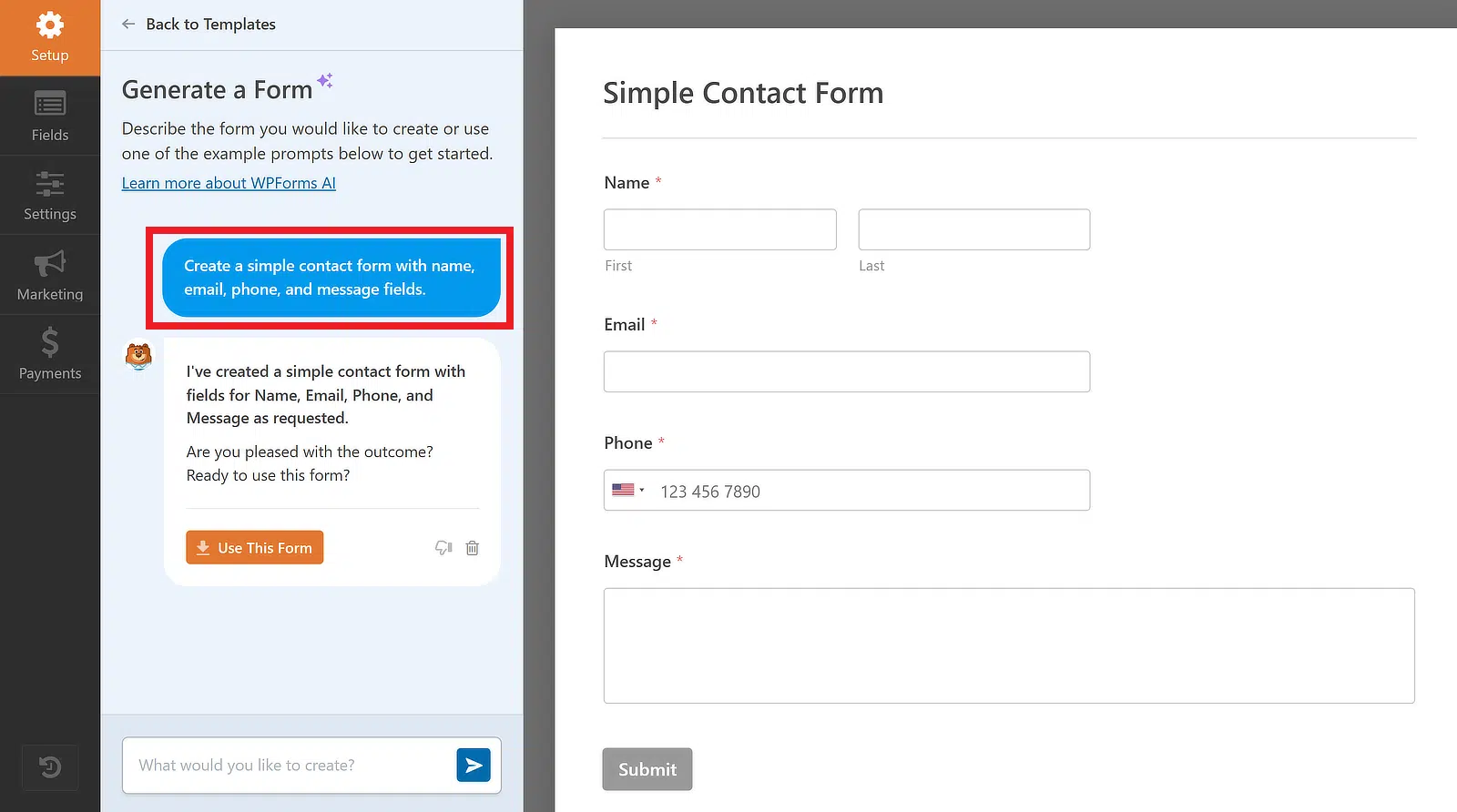
The WPForms AI form builder allows you to type a sentence about the form you want and generates it automatically. You can then keep chatting to refine it, and when it looks right, you click Use This Form to load it into the builder.
The second feature I keep coming back to is AI Choices. Any time I’m building a dropdown, radio button, or checkbox field and I don’t want to manually type out 50 options, I describe the list and let AI Choices fill it in.

What I like most about how WPForms uses AI is that the AI features are free for everyone. AI Form Builder and AI Choices both work on the free Lite version.
That’s unusual, because most plugins in this space gate AI behind a Pro plan and an API key. A few standout AI moments inside WPForms:
- WPForms AI: Describe your form, get a working form. Keep chatting to refine.
- AI Choices: Generate dropdown, radio, and checkbox options from a short description.
- AI Calculations: Build calculated fields by describing the math you want, instead of writing a formula syntax.
- AI Translation: Translate your form’s text into another language inside the builder.
The fact that the AI is bolted into the actual workflow, not in some “AI dashboard” you have to switch to, is the part that keeps it from feeling like a gimmick.
I’ve used a lot of “AI form builders” and most are just OpenAI completion calls dressed up in WordPress paint, which is a bit counterproductive.
WPForms AI is the only one I haven’t quietly uninstalled within a week. (If you want a closer comparison, here’s our breakdown of the best AI form builders.)
Pricing: WPForms Lite is free and includes AI Form Builder and AI Choices. Paid plans start at $49.50/yr for one site and scale up to $299.50/yr for unlimited sites.
2. SeedProd
SeedProd has been the go-to WordPress page builder for years. What I didn’t expect was how good the AI workflow became after they shipped their full AI site builder.

If you’ve ever stared at a blank WordPress site wondering where to start, SeedProd’s AI builder is the closest thing I’ve found to skipping that step.
You describe your business and the kind of site you want, and SeedProd generates a complete theme with pages, content, and AI-generated images.
From there you can drag-and-drop edits the same way you would in their normal builder. I tried this on a hypothetical “cleaning services business” prompt last month.

In under five minutes I had a homepage, an about page, a menu page, and a contact page, all themed consistently with cleaner-friendly visuals and copy.
Beyond full sites, the AI tools show up in the regular builder too. You can generate headlines, body copy, calls to action, and images directly inside any block while you’re editing.
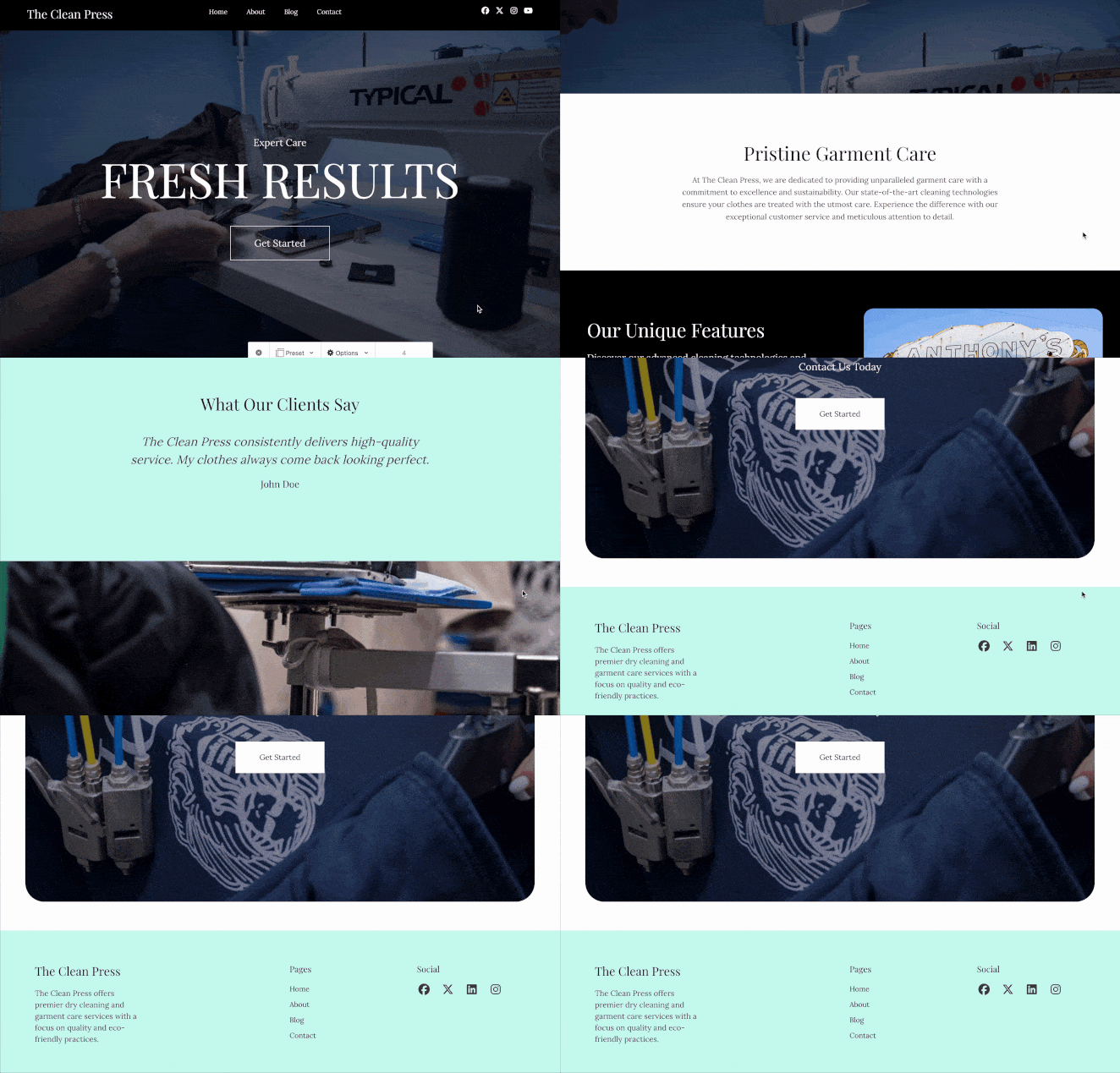
The image generation in particular pulls its weight when I’m prototyping a landing page and don’t want to spend 20 minutes hunting through stock libraries.
A few things that earn SeedProd this spot:
- AI site builder: Generate a complete WordPress site (theme, pages, content, images) from a prompt.
- AI content generation: Headlines, paragraphs, button copy generated inside the block editor.
- AI image generation: Built into the page builder so you’re not switching tools.
- 300+ premium templates if you’d rather start from a template than a prompt.
For a fuller walkthrough of the builder itself (the non-AI parts are also worth knowing about), our SeedProd review covers it in detail.
Pricing: Starts at $39.50/yr for the Basic plan on one site. Pro is $199.50/yr for 5 sites with the theme builder and full template library. Elite at $239.60/yr supports up to 100 sites.
3. All in One SEO (AIOSEO)
SEO is the area where AI assistance feels least gimmicky to me, because the task is small and repetitive and easy to judge on the spot.
AIOSEO is the SEO plugin I’ve used the longest, and the AI features they’ve shipped over the last two years are the ones I actually leave switched on.
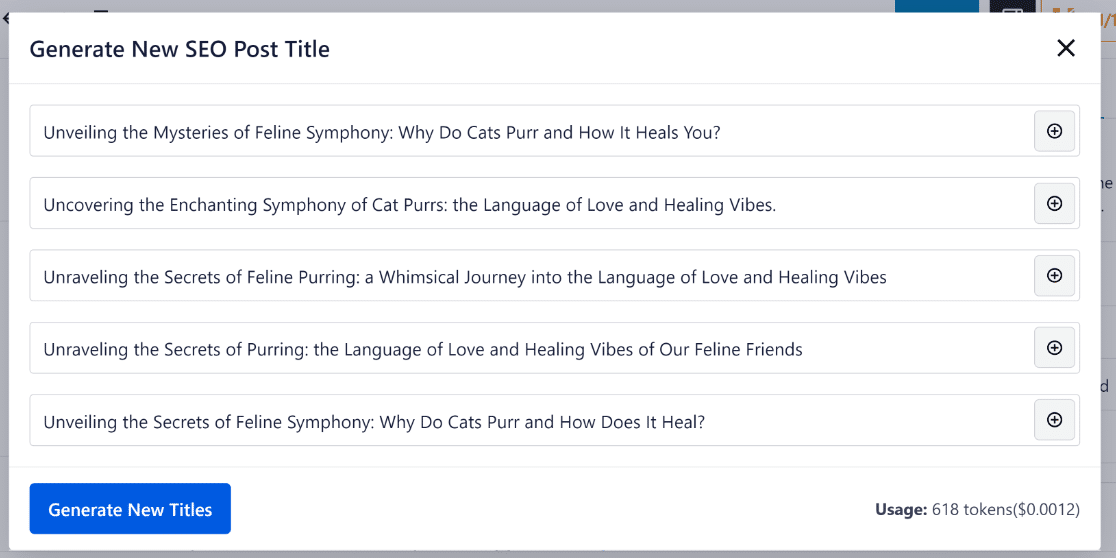
When I’m publishing a new post, AIOSEO suggests four or five alternative titles based on the content, and almost every time at least one is better than what I’d typed myself.
The meta description generator works the same way and saves me the “stare at the box, try three versions, settle on a meh one” cycle.
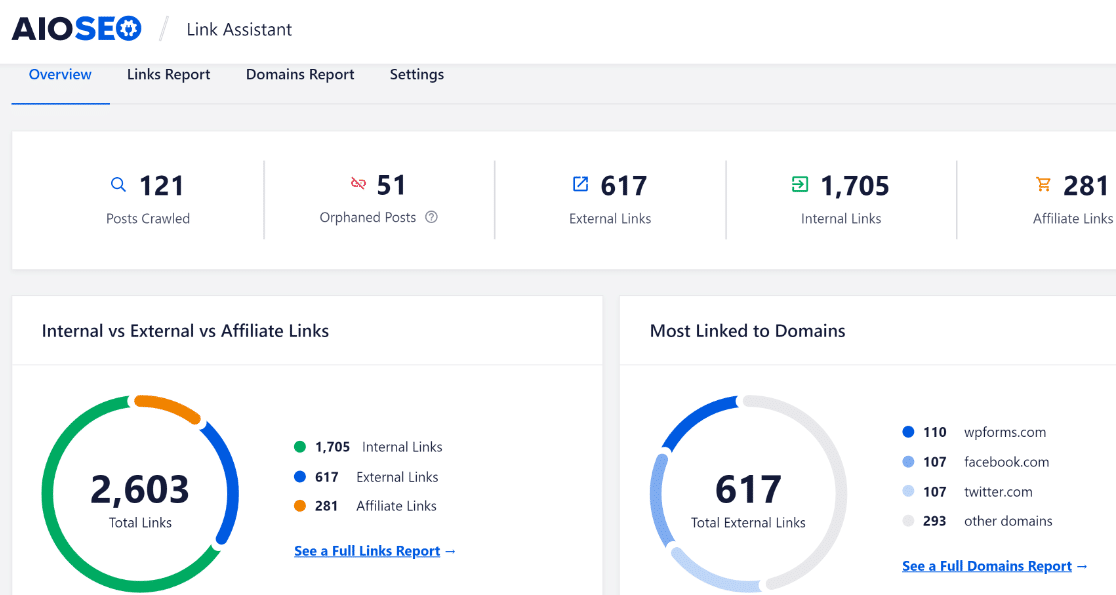
The other AI-adjacent feature worth mentioning is Link Assistant. It scans your content and suggests internal links from older posts to your new ones, and from your new ones to older posts.
Not pure generative AI, more of a smart relevance engine, but it has saved me hours of manually searching for the right place to drop an internal link.
What I like about AIOSEO is that the AI doesn’t try to replace the writer. It hands you options and leaves the final call to you.
That’s the right energy for SEO work in 2026, where Google has been clear that quality matters more than authorship but the SERP is still won by humans making editorial calls.
- SEO title generator: Suggests four or five alt titles based on the post’s content.
- AI meta descriptions: Same idea for the SERP snippet, with alternative wordings.
- Link Assistant: Suggests internal links between related posts on your site.
- Schema generator for rich results, with built-in templates.
Pricing: Basic at $49.50/yr (1 site), Plus at $99.50/yr (3 sites), Pro at $199.60/yr (10 sites), Elite at $299.60/yr (100 sites). Each plan includes a yearly allowance of AI credits.
4. WPCode
WPCode is the plugin I install on every site I touch, even though I’m not a developer. It lets you manage code snippets safely without ever editing your theme’s functions.php file, and the AI layer is what makes it useful to non-coders like me.
You can describe what you want the snippet to do in plain English (“disable comments on all pages but keep them on posts”), and WPCode generates it for you.
It handles the language detection (PHP, JS, CSS, HTML), inserts safety wrappers, and lets you preview before activation, so you can ensure everything works correctly.

I asked WPCode AI to write a snippet that hides the WordPress admin bar for everyone except administrators. It generated three lines of clean PHP with a comment explaining what it does, and it worked on the first try.
The kind of task that used to mean pasting code from a 2014 Stack Overflow answer and praying nothing breaks. Beyond the AI, WPCode also has:
- A snippet library with over 1,000 community-contributed snippets you can install with one click.
- Conditional logic so a snippet only runs on certain pages, post types, or for specific user roles.
- Logging and error catching so a broken snippet doesn’t take your site down.
- Cloud sync to share snippets across sites if you manage multiple.
I’d argue WPCode AI is the most under-rated AI plugin in the WordPress space. It quietly removes the biggest fear non-developers have, which is breaking their site by editing the wrong file.
Pricing: A free version on WordPress.org with the snippet library and basic features. Paid plans start at $49/yr for Plus, $99/yr for Pro, and $199/yr for Elite.
5. WPVibe (Vibe AI)
This is the most interesting AI plugin I’ve installed all year, and the newest entry on the list.
WPVibe is from the SeedProd team, and it does something I haven’t seen any other plugin do as cleanly. It lets Claude, ChatGPT, or Cursor control your WordPress site through normal conversation.

The short version is that MCP (Model Context Protocol) is a new standard for letting AI assistants safely talk to apps.
WPVibe installs as a free WordPress plugin, you connect it to your AI assistant of choice, and then you can manage your site by typing into Claude or ChatGPT instead of clicking through the WordPress dashboard.
I tested the plugin out recently and told Claude, “draft a new blog post about the benefits of contact forms, save it as a draft, and add a featured image from Unsplash.”
Claude wrote the draft, set the featured image (WPVibe has Unsplash search built in), and saved it. I opened my WordPress admin and the draft was waiting for me, no clicks or copy-paste needed.
- Free, no credit card. The plugin is on WordPress.org as Vibe AI.
- Works with multiple AI assistants (Claude, ChatGPT, Cursor) instead of locking you to one.
- Safe by default. New posts go to draft, deletions go to trash, theme edits run in a sandbox.
- Real WP-CLI access through chat, which means you can do things like activate a plugin or run a database health check by asking.
If you’re the kind of person who lives in their AI assistant already, WPVibe is the missing link between that workflow and your WordPress site.
It also points to where AI in WordPress seems to be heading, where the editor itself becomes optional and the assistant does the clicking for you.
Pricing: Free, with no subscription or credit card required. There’s also a Pro plan for $99/year and a Power plan available for $299/year.
6. Uncanny Automator
Uncanny Automator is the closest WordPress has to a built-in Zapier, and the AI integrations they’ve added over the last two years turn it into a quiet workhorse for any workflow that needs OpenAI or ChatGPT.
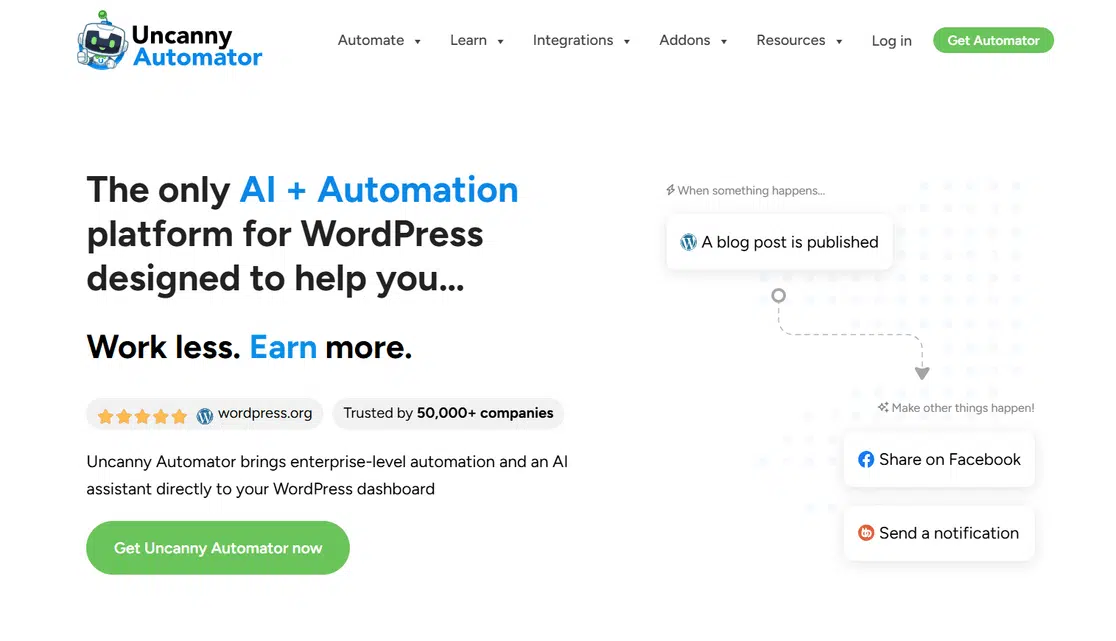
Here’s how I use it most. I have a WPForms intake form on one site, and any time someone submits, Uncanny Automator triggers OpenAI to draft a personalized follow-up email based on the form’s content.
The draft lands in my email queue and I review it before sending. The work I used to spend writing follow-ups is now mostly editing.
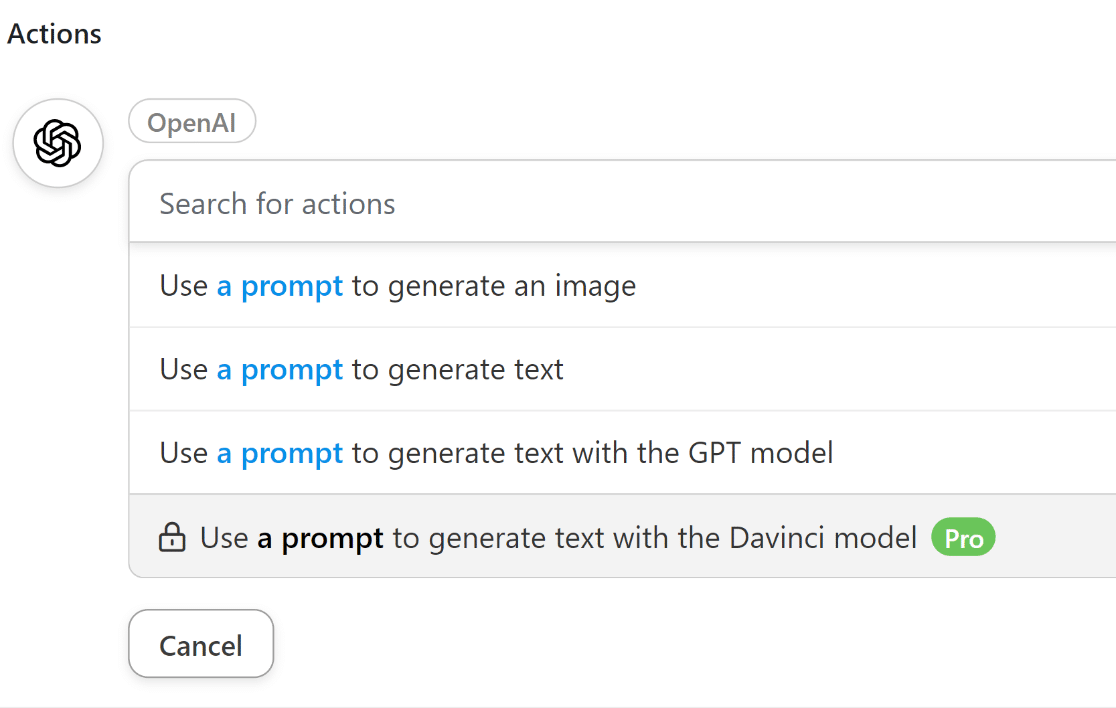
Uncanny calls these workflows “recipes”. You pick a trigger (form submission, new user, WooCommerce order), then chain a series of actions (run a prompt through OpenAI, save the response somewhere, send an email, post to Slack, update a CRM record).
If you want a working example to play with first, try sending AI-generated email notifications when someone fills out a form. We have a walkthrough of how to send AI-generated notifications using exactly this stack.
Plus, if clicking through triggers and actions yourself still feels like a lot of setup, Uncanny Agent is a powerful AI assistant that can do it for you instead. I told it, “When someone completes a course in LearnDash, tag them in my CRM and send a follow-up email,” and it built the whole recipe.
Standout features:
- 800+ integrations across WordPress plugins and external apps.
- ChatGPT / OpenAI actions for content generation, summarization, classification.
- Conditional logic inside recipes so you only fire actions on specific data.
- Free Lite version that covers WordPress-internal integrations.
Pricing: Free Lite version covers WordPress-only integrations. Basic is $199/yr (1 site), Plus at $349/yr (10 sites), Elite at $599/yr.
7. HelpJet
Customer service AI is the one category where the gap between “demo” and “actually useful in production” tends to be enormous. HelpJet is the plugin that closed that gap the fastest for me.

HelpJet’s AI chatbot doesn’t start from a blank slate. It reads your posts, pages, knowledge base, and help docs, so answers come from your actual content instead of a generic script.
The setup is friendlier than most. You install the WordPress plugin, point HelpJet at a page, a sitemap, or your whole domain, and it’s trained and ready in roughly ten minutes. Plus, there’s a preview window to test it yourself before it talks to a real visitor.
Even better, HelpJet quietly re-crawls your content every week so answers stay current as your site changes.
Questions it can’t handle get handed to your team instead of leaving the visitor stuck. Once your team answers, HelpJet learns from that resolution, so the next time someone asks something similar, it can handle it on its own. What I like:
- No flows or scripts to build, just point it at content you’ve already published and it starts answering.
- Reads the intent behind a question, not just the keywords, so a typo or an oddly phrased question still gets the right answer.
- WooCommerce integration, so it can speak to product variations, stock levels, and shipping classes.
- Detailed analytics show satisfaction rate and resolution rate at a glance, plus the exact questions customers ask most, which show you where your documentation still has gaps.
Pricing: The free plan is genuinely free forever, with one bot and 100 interactions a month. If you outgrow that, Pro runs $29/month (about $23/month billed annually) for three bots and 1,000 interactions.
8. 10Web AI Assistant
10Web has shifted shape a few times since I first tried it, and the 2026 version is the strongest I’ve seen.
The pitch is broad now and includes an AI website builder, an AI assistant inside the WordPress editor, a hosting platform, and a PageSpeed booster, all in one product.
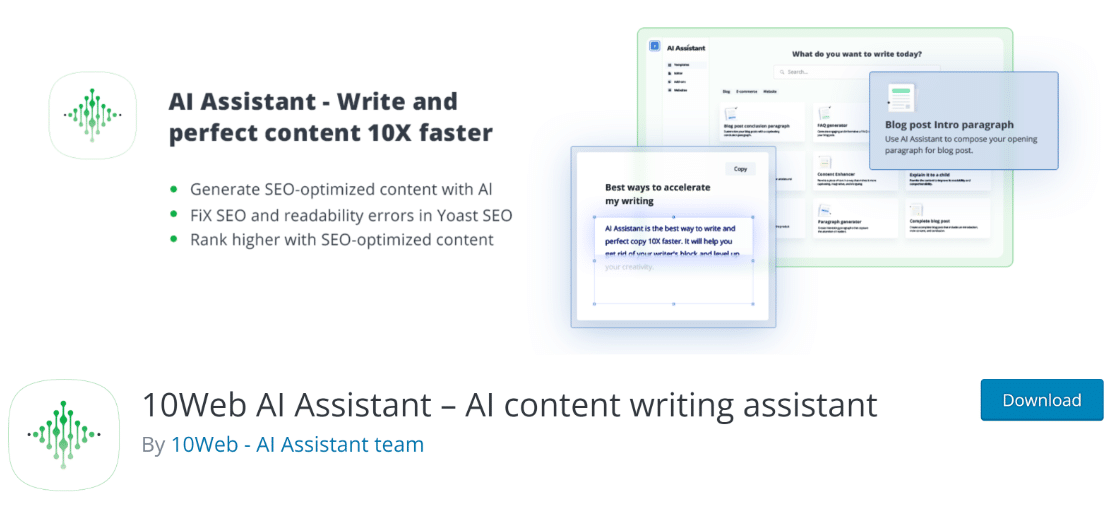
The AI Assistant plugin (the part most relevant to this list) lives inside the WordPress block editor. You can highlight a paragraph and ask it to rephrase, summarize, expand, or translate.
You can also start from scratch and have it draft a section based on a description. The interface is clean and the suggestions tend to be sharper than what I get from a plain ChatGPT browser tab, because the assistant has the context of the post you’re editing.
Where 10Web stands out is the broader site-building product. If you sign up for 10Web’s hosting, you get the full AI website generator (similar idea to SeedProd’s AI builder but bundled with managed hosting), plus the PageSpeed Booster that automatically tunes images, caching, and CDN settings on your behalf.
- AI Assistant inside the WordPress block editor for rewriting, summarizing, expanding, translating.
- AI website builder (with their hosting plan) for full-site generation.
- PageSpeed Booster that auto-tunes performance, useful if you’re not technical.
- WooCommerce-aware AI generation if you’re running a store.
10Web works on bring-your-own-API-key, so you’ll need an OpenAI account if you want to use the editor assistant on its own. For the full builder, you sign up for their managed hosting plan.
Pricing: Free assistant plugin (with your OpenAI key). Managed hosting with the AI builder starts at $10/mo for AI Starter and scales to $23/mo for AI Ultimate. Agency plans range from $24/mo to $250/mo.
FAQs on the Best AI Plugins for WordPress
The best AI plugins for WordPress are the ones that solve real problems without making you babysit them. Here are answers to the questions readers most often ask me about choosing and using them.
What is the best AI plugin for WordPress?
The honest answer depends on what you’re doing.
- WPForms (with AI Form Builder and AI Choices) is the pick if you need forms.
- AIOSEO is the pick for SEO, SeedProd handles full-site generation
- WPVibe lets you control WordPress through Claude or ChatGPT
- Uncanny Automator covers workflow automation.
If I had to pick one plugin that helps the widest range of people, I’d go with WPForms because forms are the entry point for almost every business workflow on WordPress.
Are there free AI plugins for WordPress?
Yes, and more than you’d expect. WPForms Lite includes AI Form Builder and AI Choices for free. WPVibe is fully free with no subscription.
WPCode has a free version on WordPress.org. AIOSEO has a free version with basic AI title suggestions. Tidio has a free plan that handles 50 conversations a month. If you’re starting out, you can build a real AI-assisted workflow without paying a single dollar.
Which AI plugins work without an OpenAI API key?
WPForms AI is bundled, no API key needed. Tidio’s Lyro is proprietary AI built into the platform, also no API key. WPVibe brings your own AI assistant (Claude, ChatGPT, Cursor), so the AI is whichever assistant you already use.
AIOSEO uses bundled AI credits per plan. The plugins that do require your own OpenAI API key are Uncanny Automator’s OpenAI actions and the 10Web AI Assistant for the editor (not the hosting platform).
Can I use AI-generated content on my website?
Yes. Google’s stance has been clear since 2023, and the line is that quality matters more than how the content was created. AI-generated content that helps the reader and demonstrates real expertise ranks fine.
How do I use the OpenAI API in WordPress?
Most plugins that need OpenAI walk you through it during setup. The common pattern goes like this. You create an OpenAI account, generate an API key, paste it into the plugin’s settings page, and the plugin’s AI features start working.
For a broader walkthrough of what’s possible once you’ve connected OpenAI, see our guide to using OpenAI on your WordPress site.
Next, Make Your Website Smarter With AI
The plugins above are the foundation, but AI on WordPress goes deeper if you want to keep going. If you want to wire up AI workflows beyond what one plugin can do, our roundup of the best WordPress marketing automation plugins covers the broader stack.
For deeper automation patterns, see our best WordPress automation tools guide. If you’re more interested in ChatGPT-style use cases, we have a separate roundup of the best ChatGPT plugins for WordPress that goes deeper on that category.
Ready to build your form? Get started today with the easiest WordPress form builder plugin. WPForms Pro includes lots of free templates and offers a 14-day money-back guarantee.
If this article helped you out, please follow us on Facebook and X (Twitter) for more free WordPress tutorials and guides.