



AI Summary
Are you looking for a WordPress event registration plugin to help manage your organization’s events? There are plenty of calendar plugins out there, but not quite as many that can handle the registration process.
Below are my seven picks, with real WordPress.org stats, current pricing, and where each one actually fits. I have ranked them so you can start at the top, but the right choice depends on whether you need a full calendar or just a reliable way to take registrations.
- Best WordPress Event Registration Plugins
- 1. Sugar Calendar – Best Overall for Event Registration
- 2. WPForms – Best for Event Registration Forms
- 3. The Events Calendar – Best All-in-One Event Plugin
- 4. Events Manager – Best Free Event Booking System
- 5. EventPrime – Best Modern Free Events Calendar
- 6. WP Event Manager – Best Lightweight Event Plugin
- 7. Quick Event Manager – Best for Simple Event Setups
- How to Choose an Event Registration Plugin
- 1. Sugar Calendar – Best Overall for Event Registration
Best WordPress Event Registration Plugins
Every plugin here can collect event registrations, but they go about it in very different ways. To rank them, I looked at how easy each one is to set up, what you get for free versus paid, how well it handles payments and attendees, and how actively it is maintained.
| Plugin | Best For | Free Version | Starting Price | Rating |
|---|---|---|---|---|
| Sugar Calendar | Purpose-built event management | Yes (Lite) | $49.50/yr (Basic) | 4.4/5 |
| WPForms | Custom registration forms | Yes (Lite) | $199.50/yr (Pro) | 4.8/5 |
| The Events Calendar | All-in-one calendar and tickets | Yes | $199/yr (Pro) | 4.2/5 |
| Events Manager | Free booking management | Yes | ~$99/yr (Pro) | 4.2/5 |
| EventPrime | Modern free calendar | Yes | $69/yr (premium) | 4.5/5 |
| WP Event Manager | Lightweight, modular setup | Yes | ~$99/yr (addons) | 4.0/5 |
| Quick Event Manager | Simple, quick setup | Yes | $49/yr (Pro) | 4.9/5 |
1. Sugar Calendar – Best Overall for Event Registration

Sugar Calendar is built by the same team behind WPForms, and it is built to manage events without the usual bloat. If your site revolves around a schedule of events, this is the one I would set up first.
What pushes it to the top spot is how much the free version already does. You can take registrations, manage attendees, and sell tickets through Stripe without paying for a single addon, which is rare in this category.
My Experience
Setting up an event felt closer to writing a normal WordPress post than configuring a heavy events system.
You add the event, set the date, time, and venue, assign it to a calendar, and it shows up in a clean monthly, weekly, or day view.

I was able to switch on Stripe and start selling tickets from the free version, then export the attendee list to CSV without hitting a paywall.
You can even specify time zones for events that might have attendees around the globe, such as virtual events.
Visitors can add your events directly to their calendars from the calendar view, making it less likely that they’ll forget, especially if it’s not a ticketed event.

And speaking of tickets, if you want to take complete control of your events by selling tickets, the Event Ticketing addon is perfect.
It lets you sell tickets through Stripe or WooCommerce. It’s a powerful feature for users who are ready to take it to the next level with their event management.

It also offers one-click migration, so switching from The Events Calendar to Sugar Calendar does not mean rebuilding everything.
Feature Breakdown
- Free registration and ticketing: Collect signups and sell Stripe tickets in the free version
- Clean calendar views: Monthly, weekly, day, and upcoming-event layouts via blocks or shortcodes
- Attendee management: View registrants and export them to CSV
- Calendar sync: iCal feeds plus Add to Calendar for Google, Outlook, and Apple
- One-click migration: Move over from The Events Calendar without starting from scratch
- Recurring events and RSVPs: Included on the paid plans, along with venue and speaker profiles
How Much Does Sugar Calendar Cost?
Sugar Calendar has a free Lite version on WordPress.org that already covers registration and Stripe ticket sales. Paid plans start at $49.50 per year for Basic on one site.
Then move up through Plus at $99.50, Pro at $199.50, and Elite at $299.50 for more sites. The Plus plan and above add the Event Ticketing addon, which brings WooCommerce ticketing and removes the 3 percent fee on Stripe sales.
2. WPForms – Best for Event Registration Forms
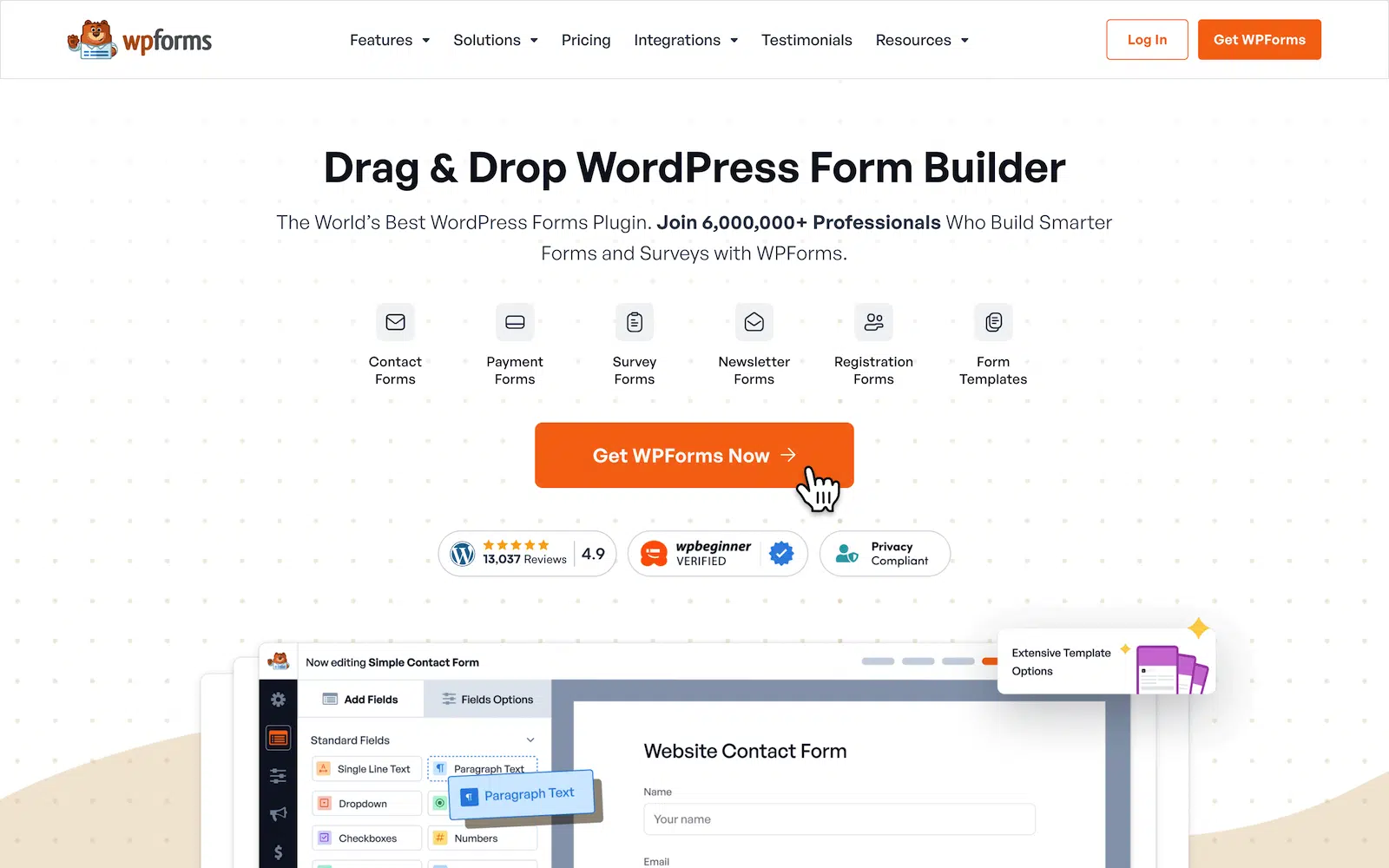
WPForms takes a different route to event registration than the calendar plugins on this list. Instead of building your events around a calendar, you build the exact signup form you want and drop it anywhere on your site.
That matters when your registration needs a specific set of details, like meal choices, t-shirt sizes, session picks, or a waiver. You control every field, and you can take payments on the same form without sending people off to a third-party checkout.
My Experience
I built a test event registration form using one of the ready-made templates, and it took a few minutes to go from a blank form to something I could embed.

The drag-and-drop builder is genuinely beginner-friendly, and adding a date field, a dropdown for ticket types, and a payment field was just a matter of dragging them in.

What I like most is the conditional logic, which lets you show a “number of guests” field only when someone selects “bringing a plus one,” or route different registration types to different email notifications.
If you want a walkthrough, we have a full guide on how to build an event registration form, plus a more specific one for a race registration form.
You can even accept community submissions with the Post Submissions addon if you want visitors to add their own suggests for upcoming events.
Feature Breakdown
- Drag-and-drop builder: Create any registration form without touching code
- Ready-made templates: Event registration, RSVP, and booking templates to start from
- Payments: Stripe, Square, and PayPal, with no extra transaction fees on Pro
- Conditional logic: Show fields, pricing, or notifications based on what people select
- Entry management: View, search, and export every registration from your dashboard
- Smart notifications: Send confirmation emails to attendees and alerts to your team
How Much Does WPForms Cost?
WPForms has a free version, WPForms Lite, that lets you build basic registration forms and even accept Stripe or PayPal payments with a small processing fee. Paid plans start at $49.50 per year for Basic.
For event registration with payments, I would go with Pro at $199.50 per year, which removes the extra transaction fees and gives you the full template library plus advanced addons.
3. The Events Calendar – Best All-in-One Event Plugin

The Events Calendar is the plugin most people picture when they think of WordPress events. It is the one of the biggest names in this category, and the free version alone gives you a polished calendar with month, day, and list views.
Registration is where it gets layered, since the calendar itself is free but collecting signups means adding the companion Event Tickets plugin for free RSVPs and paid tickets.
My Experience
Setting up the calendar was smooth, and I liked that visitors can add events straight to Google Calendar, Apple Calendar, or Outlook.
The reason it is not my top pick for pure registration is that the pieces are sold separately, so a full paid ticketing setup means stacking The Events Calendar Pro and Event Tickets Plus.
If you run a community calendar, the Community Events addon lets visitors submit their own events. We even have a tutorial on setting up a user-submitted events calendar with it, and a separate guide on how to manage event ticketing.
Feature Breakdown
- Free calendar: Month, day, and list views out of the box
- Calendar exports: Google, Apple, and Outlook calendar support
- Ticketing: Free RSVPs and paid tickets through Event Tickets
- Recurring events: Available with the Pro version
- Community submissions: Let visitors add events with the Community addon
- Responsive design: Calendars adapt to mobile and tablet screens
How Much Does The Events Calendar Cost?
The core plugin and basic Event Tickets are free. The Events Calendar Pro starts at $199 per year for a single site, after a price increase in early 2026.
To sell paid tickets and add custom registration fields, Event Tickets Plus is $149 per year. Bundles are available if you want several of the premium add-ons together.
4. Events Manager – Best Free Event Booking System
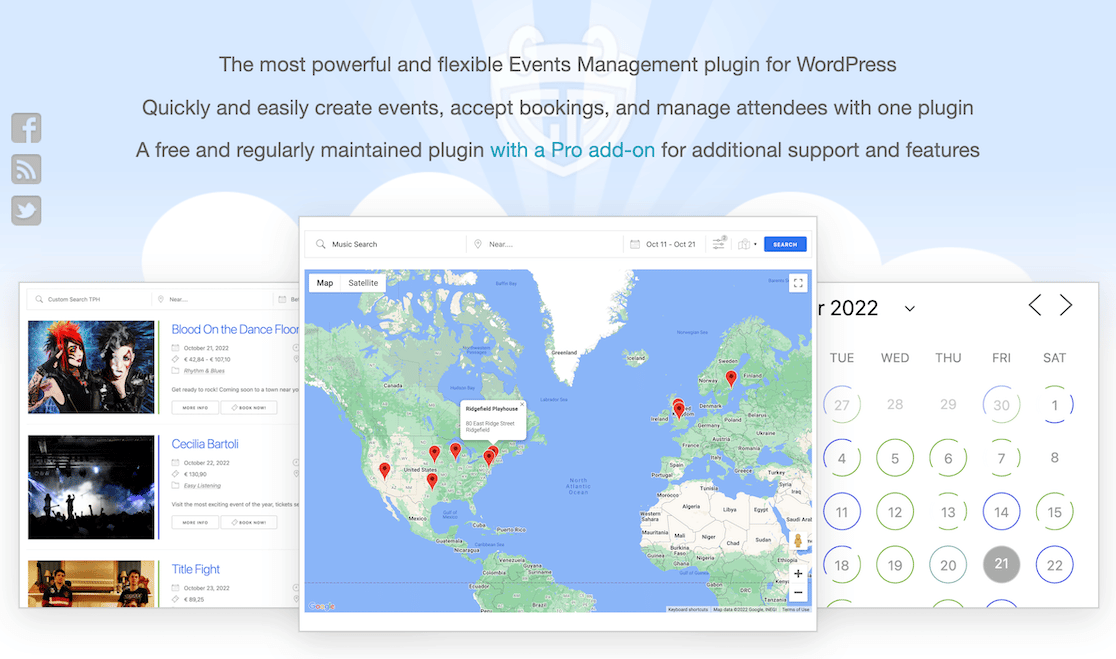
Events Manager stands out because it packs real booking management into the free version. A lot of plugins make you pay before you can collect a single registration, and this one does not.
The free plugin gives you custom event post types, flexible calendars, recurring events, Google Maps, and a bookings dashboard. It is a genuinely capable starting point for managing attendees.
My Experience
I found the free bookings system to be the main draw, as you can accept registrations and track attendees without spending anything, which is rare in this space.
The catch is payments, so if you want to charge for events you need Events Manager Pro, since payment gateways are not part of the free version.
It also has a nice touch for international organizers, with the interface available in around ten languages thanks to a team of volunteer translators.
If your events involve webinars, you can pair it with a webinar landing page to capture signups.
Feature Breakdown
- Free bookings: Accept and manage registrations at no cost
- Custom event types: Single-day, multi-day, and recurring events
- Bookings dashboard: Track attendees and manage capacity
- Google Maps: Show event locations automatically
- Calendar exports: Save events to Google, Apple, and Office calendars
- Multilingual: Available in about ten languages
How Much Does Events Manager Cost?
The free version handles bookings and attendee management on its own. Events Manager Pro starts at around $99 per year and adds payment gateways, custom booking forms, coupons, and priority support, with higher tiers for multiple sites. If you need to accept event payments, Pro is required.
5. EventPrime – Best Modern Free Events Calendar

EventPrime is the most modern-feeling option on this list, and its free version is more generous than you would expect. You can create events, take PayPal payments, manage attendees, and view event analytics without paying anything.
It also uses a clean calendar view for adding and managing events, which makes the whole process feel more visual than the older plugins here. For a smaller plugin, it covers a lot of ground.
My Experience
When I tested the free version, the standout was how much it lets you do before asking for money, including online payments through PayPal and a real attendee management screen.
It integrates with tools like MailPoet, WooCommerce, Zoom, and Zapier, so it slots into an existing setup well.
What keeps it at number four rather than higher is the smaller user base, which means a smaller community and fewer third-party tutorials when you get stuck.
The premium features are sold as separate extensions, so you can add things like seat selection or recurring events without buying a full bundle you do not need.
Feature Breakdown
- Free payments: Accept PayPal payments in the free version
- Attendee management: Track and manage registrants out of the box
- Visual calendar: Add and edit events in a calendar view
- Event analytics: See how your events are performing
- Integrations: MailPoet, WooCommerce, Zoom, and Zapier
- Modular extensions: Buy only the premium features you need
How Much Does EventPrime Cost?
EventPrime is free to start, with full calendar, booking, and ticketing basics included. Premium extensions begin at $69 per year for a single site, and there is an all-extensions bundle for $199 per year if you want everything. You can also buy individual extensions as your needs grow.
6. WP Event Manager – Best Lightweight Event Plugin

WP Event Manager is built for people who want something lightweight and open source. The core plugin stays lean and fast, then you extend it with addons only when you need more.
That modular approach appeals to developers and anyone who dislikes bloated plugins. It handles event listings and widgets well, and it supports live, virtual, and hybrid events.
My Experience
The core plugin was quick to install and did not slow anything down, which is the whole point of a lightweight tool.
It also connects to services like HubSpot, Constant Contact, Brevo, and Zoho CRM through its addons, so it fits neatly into a marketing stack.
The trade-off is that the features you probably came for, like selling tickets and taking registrations, live in the paid addons rather than the free core.
So the real cost depends on how many addons you end up adding, and the base experience is more of a listing tool until you extend it.
Feature Breakdown
- Lightweight core: Fast, open-source base plugin
- Modular addons: Add only the features you need
- Event types: Live, virtual, and hybrid events
- CRM integrations: HubSpot, Constant Contact, Brevo, and Zoho
- Embeddable widgets: Place event listings anywhere
- Bundle savings: Discounts when you buy addon bundles
How Much Does WP Event Manager Cost?
The core plugin is free and open source, while registration and ticketing addons are sold individually starting around $99 per year, with bundles that bring the per-addon cost down if you need several. Budget based on the specific features you want rather than a single flat price.
7. Quick Event Manager – Best for Simple Event Setups
Quick Event Manager lives up to its name, and if your needs are simple, it is one of the easiest plugins here to get an event up fast.
The free version covers the basics well, including event creation, a calendar display, recurring events, and even basic PayPal payments. It also lets you assign an event manager role so someone else can handle the backend.
My Experience
I appreciated how little friction there was in the free version, and being able to accept basic PayPal payments without upgrading is a nice bonus for small events.
It is clearly aimed at straightforward use cases rather than large ticketed conferences. The one thing to flag is maintenance, since its last update was in late 2025.
And it is tested only up to an older version of WordPress, meaning it is not refreshed as often as the others on this list. For a simple event on a simple site that is usually fine, but it is worth knowing before you commit.
If you want to charge for registrations, you can also connect it to guides on accepting PayPal payments and Stripe payments through your forms.
Feature Breakdown
- Simple setup: Create and publish events quickly
- Free PayPal payments: Basic IPN-based payments without upgrading
- Recurring events: Set weekly or monthly repeats
- Event manager role: Give backend access to a specific user
- Calendar display: Show events in a clean calendar layout
- Registration reporting: Track who has signed up
How Much Does Quick Event Manager Cost?
The core plugin is free and includes basic PayPal payments. Quick Event Manager Pro starts at $49 per year for a single site, with higher tiers at $109 and $269 per year for more sites. Pro adds full Stripe integration and guest-submitted events.
How to Choose an Event Registration Plugin
The right plugin comes down to one question first. Do you want a full events calendar, or do you want control over the registration form itself?
If your site is built around a schedule of events that people browse, a calendar-first plugin like Sugar Calendar and Events Calendar makes sense.
If the signup itself is the important part, with custom fields and payments, a form builder like WPForms gives you more control.
From there, check whether payments are included for free or gated behind a paid tier, since that is the most common surprise.
It also helps to read our roundup of the best WordPress calendar plugins and our guide to building an RSVP form if you are still comparing approaches.
FAQs About WordPress Event Registration Plugins
Choosing a WordPress event registration plugin raises a few common questions, especially around free versus paid features and how payments work. Here are the answers I get asked about most.
What is an event registration plugin?
An event registration plugin lets people sign up for your events directly on your WordPress site. It usually gives you a registration form, an attendee list, and often a calendar, so you can manage signups and see who is coming without juggling separate tools.
Do I need a plugin to accept event registrations in WordPress?
WordPress does not handle event registration on its own, so you need a plugin to do it properly. A dedicated event plugin or a form builder like WPForms gives you the signup form, confirmations, and attendee tracking that a plain page cannot.
Can I collect payments for event registrations?
Yes. Most plugins here support payments, though many require a paid version for full gateways. WPForms, EventPrime, and Quick Event Manager all let you accept some payments in their free versions, while The Events Calendar and Events Manager gate paid ticketing behind their premium tiers.
What is the best free WordPress event registration plugin?
If you want free booking management, Events Manager is the most capable. If you want a free way to accept payments, EventPrime and WPForms Lite both let you take money without upgrading. The best fit depends on whether you need a calendar or a custom form.
Next, Build Your Own Event Registration Form
If you decided a custom form is the way to go, the fastest path is to follow our step-by-step guide on how to create an event registration form in WordPress. It walks you through the template, payments, and notifications from start to finish.
You can also connect your registrations to your calendar automatically by sending WPForms entries to Google Calendar, so new signups show up on your schedule without any manual work.
Create Your Event Registration Form Now
Ready to build your form? Get started today with the easiest WordPress form builder plugin. WPForms Pro includes lots of free templates and offers a 14-day money-back guarantee.
If this article helped you out, please follow us on Facebook and Twitter for more free WordPress tutorials and guides.